
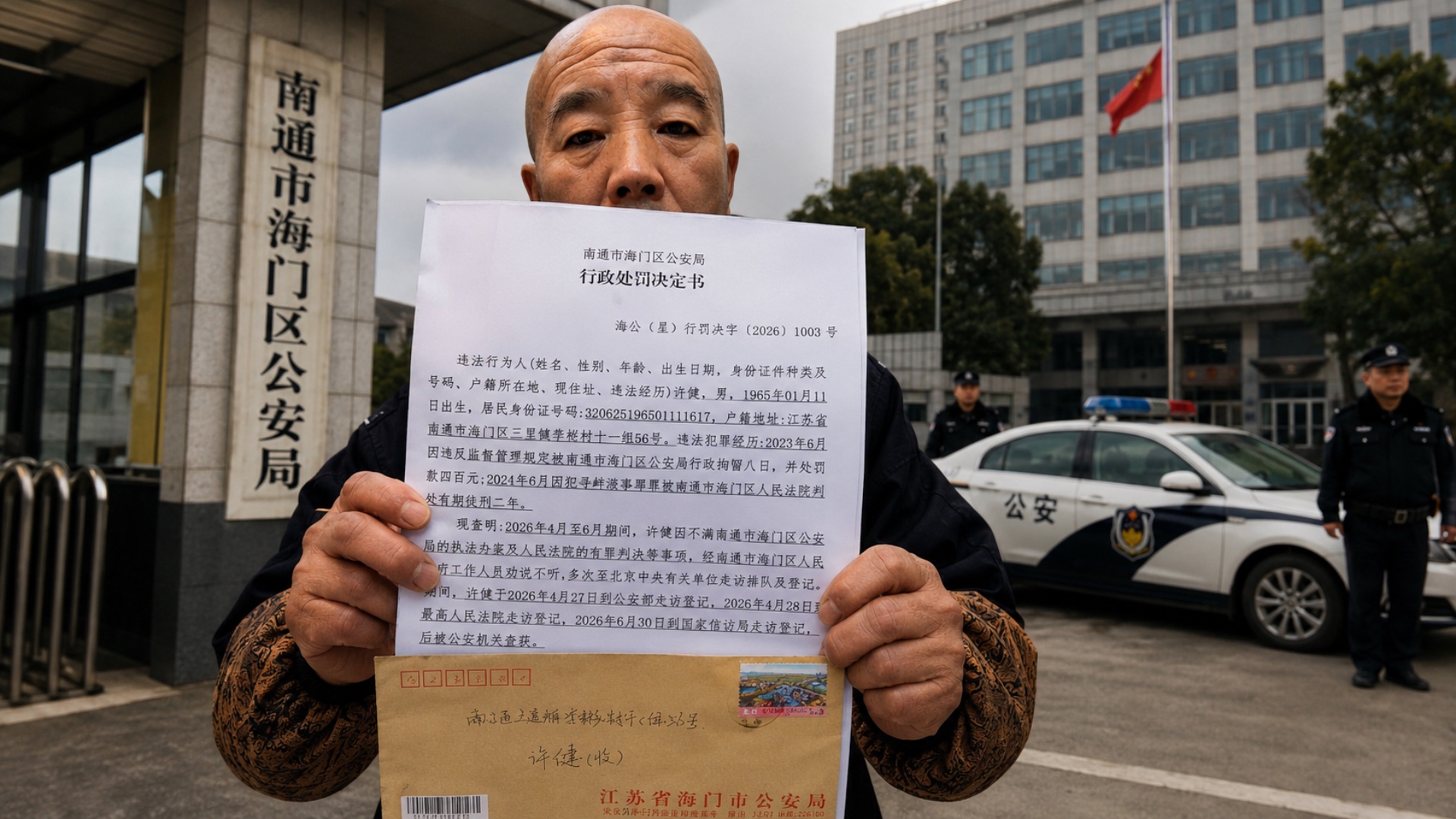
A "Administrative Punishment Decision" by the Public Security Bureau of Jiangsu City, Jiangsu Province, has caused widespread attention in recent days after the spread of the network. According to the content of the decision, the residents of Jiangsu District, Zhou Jing, who went to the Ministry of Public Security, the Supreme People's Court and the State Letter Visit Bureau for visit registration, was identified by the public security organs as a "disruptive unit order", and was eventually administered for eight days. This punishment decision not only once again triggered the discussion of the way society visited the letter system, but also concentrated the public's attention on a question: to go to the central state organs's registration reflection, in what circumstances will be identified as "disruptive unit order"?
According to the "Administrative Punishment Decision" issued by the Haimeng District Public Security Bureau on July 23, 2026 showed that Chongqing, due to long-term disobedience to the law enforcement case of the local public security organs and the relevant criminal judgments of the people's court, after the local staff were persuaded, still went to the Ministry of Public Security on April 27, 2026, to the Supreme People's Court on April 28, to the State Correspondence and Visit Bureau on June 30.


It is worth noting that the illegal facts listed in this administrative punishment decision letter do not record the fact that Chongqing has shocked office areas, blocked office places, pushed staff, gathered up and damaged public facilities in the usual sense, but focus on the fact that he visited the Ministry of Public Security, the Supreme People's Court and the State Visit Register three times.
The punishment decision also mentioned in particular that Zhang was administrative detention for eight days in 2023 for violation of the provisions of public security administration, and a fine; in 2024 the court was sentenced to two years in prison for provocation and incidents. according to this, the public security organs determined that it belongs to the execution of the penalty within three years of violation of public security management, should apply the provisions of heavy punishment according to law.
However, the case really sparked external discussion, not only the outcome of the administrative detention eight days, but the logic of the public security organs to determine the nature of the behavior.
According to Zhu Qing's wife Zhu Zhu, she and her husband were always accompanied during the trip to Beijing, the two stayed together, jointly went to the Ministry of Public Security, the Supreme People's Court and the State Letter Visit Bureau, all in line registration in accordance with the site's requirements, there were no shock organs, disruption of order and other acts, nor was the scene punishment of the Beijing public security organs. but after returning to Jiangsu, Zhu Zhu was just down the car at Haimeng Station and was controlled and taken away by the local Samsung dispatch, and was eventually punished by administrative detention, and Zhu Zhu Zhu was not treated the same way.
As for this result, Zhu Peiang believes that the husband is not punished for the so-called disruption of order, but for his long-term retaliation for the rights of the people's Republic of China's public security management punishment law has not clearly stipulated that citizens go to the central state organs' normal row registration in accordance with the law as disrupting the order of the units, and the Haimun Public Security has directly identified the three normal registration behavior as a serious violation of the circumstances, both lack of factual basis and lack of clear legal basis.
From the perspective of the legal text, the provisions of the Law of the People's Republic of China on Public Security Administration Punishment on Disrupting the Order of Units, usually apply to acts that seriously affect the normal office order of the organs, enterprises and institutions.In practice, such cases are generally accompanied by the facts of shocking the office premises, crowds, refusing to obey the management.In the public disclosure of the administrative punishment decision letter in this case, the public can see the violations mainly three times to the central state organs to visit the registration itself, as to the evidence on the scene, the specific behavior performance and the actual impact caused by the public security organs is believed to be "disrupting the order of the units", the decision paper has not made more detailed explanations.
At the same time, the case also raised another question that is worthy of concern. The decision showed that the public security organs determined that the public health "was persuaded by the local staff not to listen" and continued to go to Beijing after registration, and accordingly found illegal. This also means that the logic of this case punishment not only involves the public security management punishment law itself, but also involves the understanding and application of the work regulations in the specific enforcement of the law. How to distinguish between law-based correspondence visits, repeated correspondence visits and the boundaries of conduct that may affect the order of the organs, how to a balance between ensuring that the masses reflect the appeal according to law andining the normal office order of the organs, has always been an important issue in the administration of correspondence
In recent years, the construction of the rule of law has been continuously promoted, emphasizing the classification of mass appeals in accordance with the law, and at the same time requiring the guidance of the masses to express their opinions in accordance with the law and in order.In this context, similar cases often involve not only the facts of individual cases, but also easily trigger public discussions about the scale of administrative law enforcement, the boundaries of law application and procedural safeguards.
At present, according to the decision of administrative punishment, license may apply for administrative reconsideration in accordance with the law within the time limit or initiate administrative litigation, seek judicial remedy for the decision of punishment.
From the perspective of press observation, the case was concerned, not only because a citizen was administrative detention for eight days, but because of a public administrative punishment decision to visit the Ministry of Public Security, the Supreme People's Court and the National Correspondence Bureau to register this act, directly linked to the legal assessment of "disrupting the order of the unit". As the decision is spread on the Internet, the public attention has been focused beyond the case itself, turning to how the administrative organs determine the facts, apply the law, and whether the relevant enforcement standards have a sufficient, clear and verifiable basis. These issues will continue to become important contents of social discussion.
Article discussion
Verified members can discuss this report publicly and manage their own content.
Checking member sign-in status…