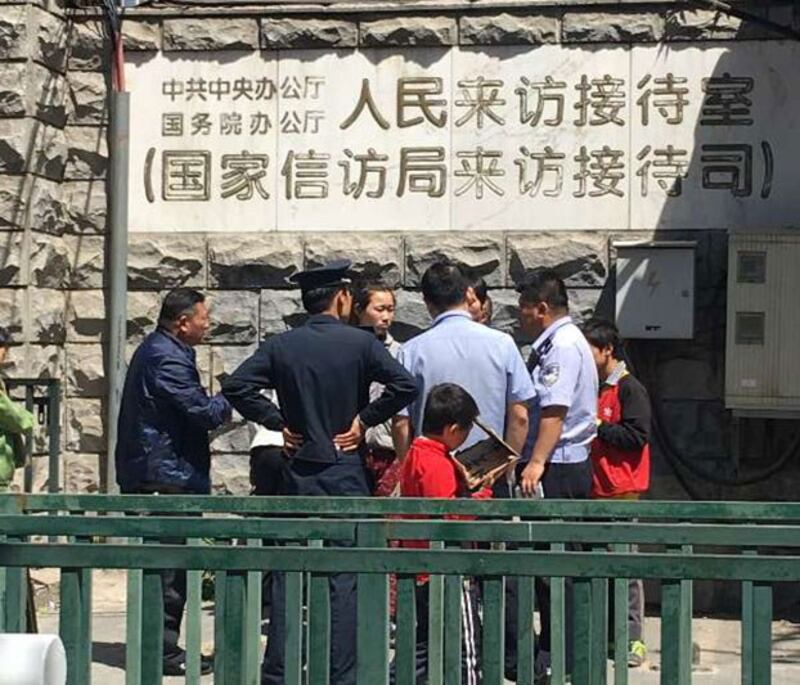
In order to bring local grievances to Beijing, the visitors now have to prove that they have completed the process of correspondence from the local to the provincial level. The " Approach to further regularizing the registration of visits ", which was implemented on 1 July, incorporates this procedural threshold into the central rules of access. October 6, <a href="https://safeguarddefenders.com/en/blog/new-rules-give-police-more-scope-punish-petitioners"target" = "_blank" rel = "nopener noreferrer" data-linked-reference= "tru" data-reference-label = "protecting the guards' investigation" of October 6th.
The practical effect of article 4 of the new regulation is to tie “into the Kyoto registry” to local procedural evidence. > The previous combo of the method by Kyinyun Law Office shows that those who visit the national mail service and cannot provide the prior processing and processing of the material will be informed to return to the authority competent to process the information; Article 6 also provides for the education of repeat visitors and the referral of violations of public order or suspected crimes to public security. For those who cross the line because of land claims, evictions, judicial complaints or issues of local officials, this means that they need to obtain information from the local system against which they are being charged in order to continue to move forward.

The change in response quickly occurred on the streets of Beijing when the paper rules were laid down. July 1-3, State Department of Letters and Visits, Ministry of Public Security and Central Clean-up Records for Visiting People around the River Yongding. For visitors, the process entrances were narrowed and the site was removed: one occurred at the registration window and one occurred on the way to the registration window.
, 7 September, when many of the people who visited Beijing were taken to the police station in To-Kung Lane and then waited for the interceptions to take them away. This is a point to note: in the past, the interceptions were often seen as grey operations by local governments, the Kyoto-based agencies and even outsourced personnel, and now the Beijing police have a more direct role in the field control and handover. The export of administrative relief is thus increasingly a route that is screened locally and then maintained by the police in the capital.
The design changed the incentives for local governments to face the mail. (b) The fact that the local authorities may be the subject of complaints and have prior access to and processing of information; The centre also emphasizes the “dissolved at the grass-roots level” of the conflict. When the number of people entering Kyoto is per se perceived as a pressure to govern, the most accessible performance at the local level is not to correct errors, but to keep the case from moving forward to Beijing.

The Xi recent experience of the Maple Bridge has been reinforced, and one of the core requirements is to keep the contradictions at the grass-roots level. The new rules for letters of enquiry further proceduralize this political objective: instead of establishing a local independent channel of complaint, the central authorities require the complainant to prove that he has completed the required steps within the local system. This amounts to more placing the key to the upper-line relief under the lower-level authority for ordinary visitors.
The system of letters and visits is not an independent judiciary. The large number of citizens who have entered the country for a long time is due to court, administrative review, media exposure or local errors that fail to provide credible exports. Now, when the central access window has raised the threshold and the public security has been given more explicit space for on-site disposal, the first thing the State will resolve is not the content of the complaint, but the ability of the complainant to arrive in Beijing, to remain there and to be seen.
This is not a simple “normative order”. It redistributed power: local governments gained more space for interception, the Beijing police gained a more direct control role, and visitors took on higher costs of proof and personal risks. A system that has existed for many years under the name “hearing the popular voice” is redefining the most persistent and unwilling claim as a question of mobile populations and order that needs to be managed.
Article discussion
Verified members can discuss this report publicly and manage their own content.
Checking member sign-in status…