
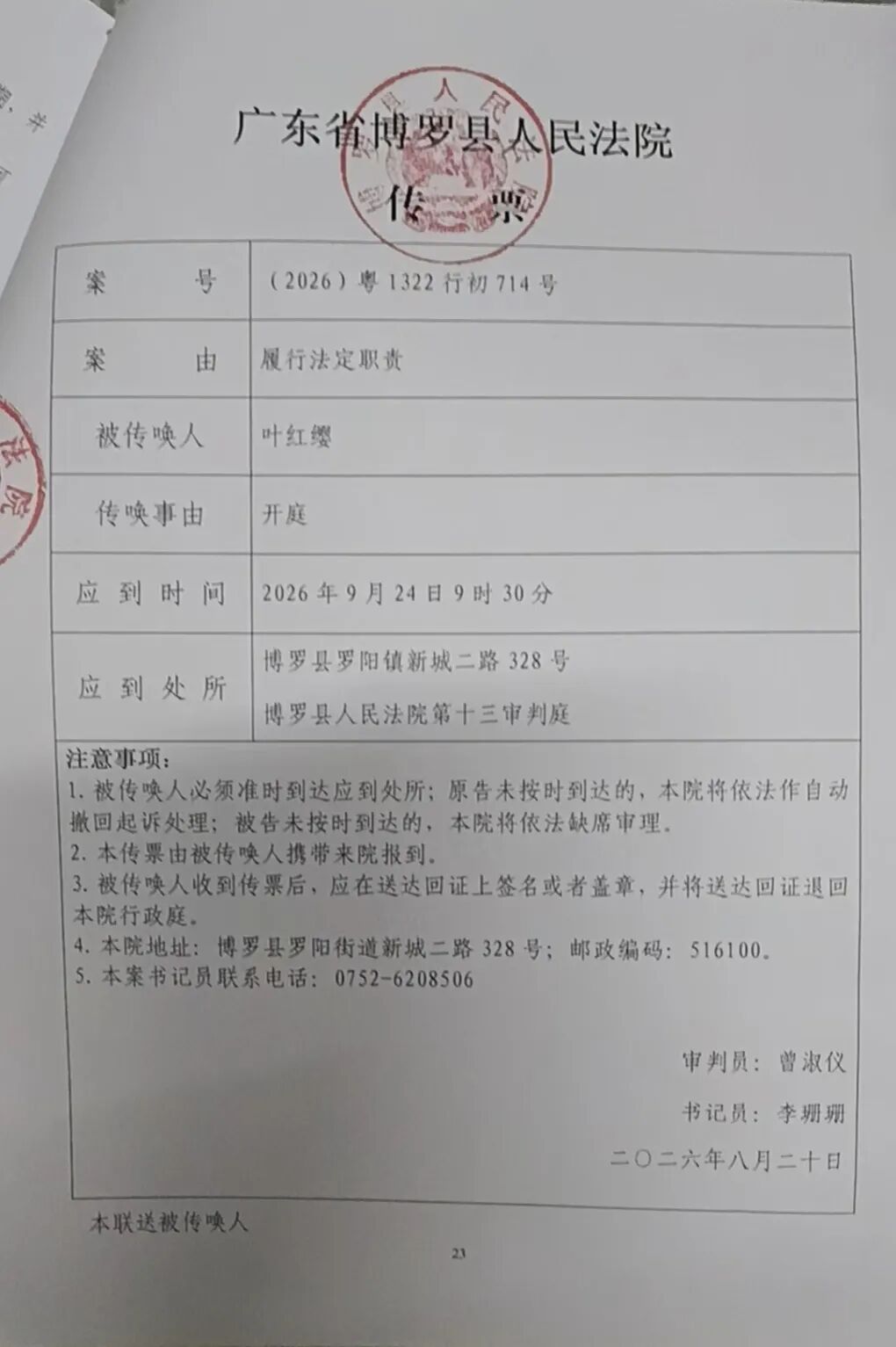
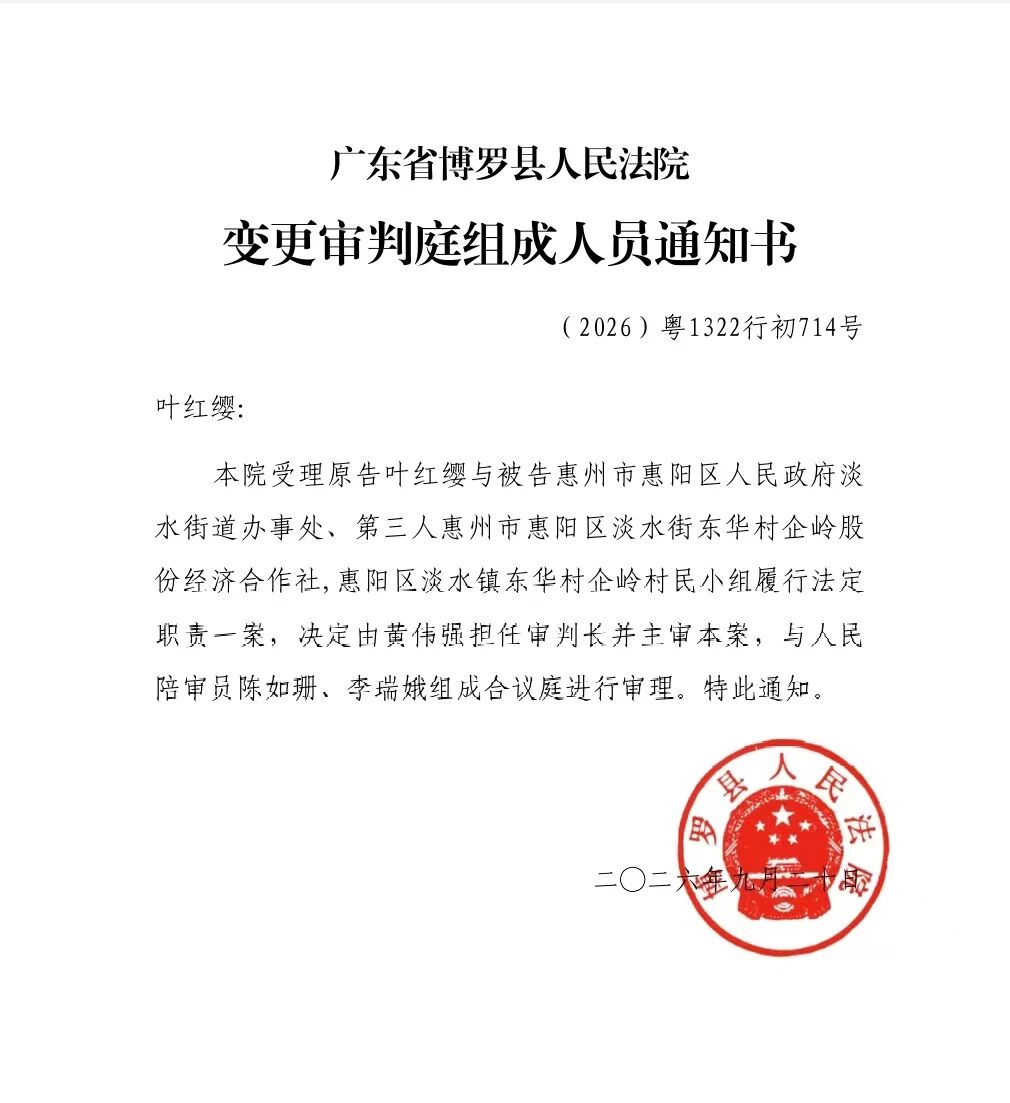
The morning of the court's introduction
The thirteenth session of the People ' s Court of Boro County, Whezhou, on 24 September 2026, at 9.30 a.m. I sat on the table. This is my tenth year in a lawsuit.
At the very beginning of the trial, my attorney challenged the defendant ' s status as a court defendant
- the deputy director of the freshwater street office, Ri, presented as a "legal representative" and not as a legal representative and head of the executive. The administrative procedure provides that the head of the executive body shall appear before the court.
I also raised my hand to strongly disagree that a question mark should be given to whether a person who is responsible for the organization of the rural collective economy, but who is acting as a “legal representative”, is legally entitled to appear before the court; She sits here and I think it is incompatible with the status of the respondent in the administrative proceedings, disturbing the court order and requesting the presiding judge to remove the other party from the court.
The presiding judge did not respond to my and counsel's objections, but said two times and four words: "Register." The defendant's appearance was reviewed, no problems, and was in accordance with the law.
After entering the bench to ask the former defendants whether they had requested the recusal of members of the Full Court, my counsel and the party ' s counsel strongly requested the recusal of the presiding judge. The reason is that he was suspected of protecting and harbouring the accused.
The trial was increasingly intense, having lasted about 15 minutes and was not going to go on, and the presiding judge adjourned the trial for five minutes.
In the quarter-hour trial, the presiding judge seemed to be in a poor state of concentration because of the busy work he had to do and the lack of rest last night. I doubt even that he has been able to examine my file.
The Court of Justice of Boro did not expressly grant the adjournment and vote on the motion for the presiding judge’s recusal. The presiding judge returned and announced that the trial would end on that day and that the hearing would be held on a date to come.
During the recess, the defendant represented the defendant, Ryon and her representative, sitting there, smiling, laughing and being angry by the listeners.
This case, from 2016 to now, we have been used to this.
Why would a rural woman have to fight for 10 years first to say who I am?
My name is Yip Hongxiang, a guest daughter born in 1982 from the village of Zhang Jia, East Hua Village, a freshwater street in Huiyang District, Guangdong. I'm the original villager, the account has been here. Ten years of hard litigation, I'm only 44 years old and I'm pale and tired.
But in the village, my identity was never fully recognized.
Around 2016, the village was transformed into a group economic organization with a firm mandate and a shareholding system. And in the process, I was told: "Marriage, not counting."
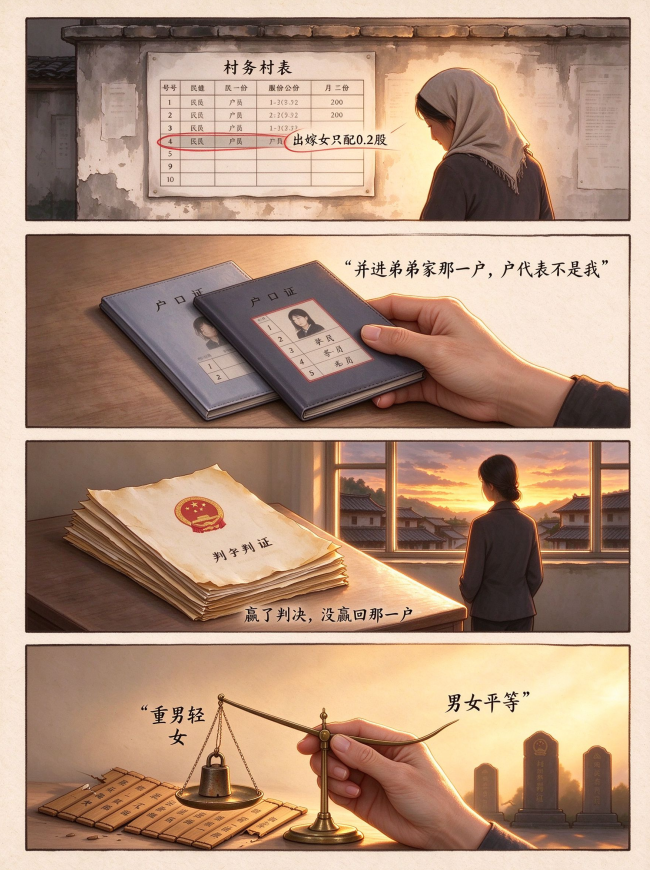
Not to say that I will not be granted membership — they recognize me as a member, but they do it in the key places. For example, the stock allocation, the village has a 0.2 share of "married daughter" and the other members are one. I was in a division, and I was in a two-household, two-family family with my brother, and the village took me "and" into the family home, and the family representative wrote someone else's name, and I was actually the head of the family who was excluded from the bill. For example, the right to vote of household representatives, because I am “not the head of the household”, I cannot vote in the village council.
What I cannot accept most is that Liu Xiao, who is with me, is not a native villager, but can be a representative of the family alone. I am a native-born original villager, but I am merged and excluded.
I asked why the village treated different. The answer to the village is always the same sentence: it is decided by the meeting of members, the meeting of representatives of the household.
So I started defending. A dozen, almost ten years.
02 The verdict won, justice didn't come back, and I've had several legal instruments in effect in the last 10 years, which is in my interest.
In 2016, the City Intermediate People ' s Court of Whezhou issued (2016) Zen 13 Civil Judgement No. 2823, ordering the village to cease the violation and I am entitled to the same treatment as the villagers of my village.
In 2022, the City Intermediate People ' s Court (2022) ruled in Administrative Decision No. 663 of 13th row of the City of Whezhou, ordering the Office of the Fresh Water Street to act as supervisory authority and to take administrative action on my application.
I've been taking the sentence to apply for execution. In 2023, the People ' s Court of the Heeyang District (2023) Zen 1303, Executive Decision No.
- In 2026, the City Intermediate People's Court (2026) Zen13 of Whezhou re-confirmed that the village had already produced me a shareholding certificate, but the family representative on the card wrote someone else, not me; I can't find any information about my membership on the three-mandate management platform. The so-called "file register" has only taken a form.
There is also the Criminal Decision (2025) No. 419 of the Final Sentence of 13 Zen. I am in it accusing the village of long-standing violations of my rights to identity, to the economy, to participation -- to have me break the law and enter another 's household, to keep me out of the land distribution table, to withhold my core income and to deprive me of my right to participate, vote, monitor.
The judgement is in a copy down. Justice, never really came back to me.
New law, 1 May
- 1 May 2025, the Law of the People ' s Republic of China on Collective Economic Organizations in Rural Areas was officially enacted.
The law is clear and clear.
Article 8: Women shall have equal rights with men and shall not be subject to any infringement of the rights and interests of women in rural collective economic organizations on the grounds of their marital status, marriage, divorce, widowhood or absence of a male member of the household.
Article 18: The former Collective Economic Organization may not revoke membership of a member who is married and has not acquired membership in other collective economic organizations.
Article 17: Loss of membership of a civil servant (except for civil servants appointed).
I took this new law and again challenged the village's publicity list, which incorporated my independent head of household into another household. The fact that the civil status of the people has been removed and that they have been appointed to the Council is not a matter of the people's choice. (b) The membership of civil servants is maintained; Some families, daughters only have 0.2 shares.
On 6 May 2025, I submitted an Application for Dissenting Supervision to the Office of the Fresh Water Street, making three claims: I have been identified as independent head of household and have been identified as a separate household; Verification to correct irregularities in the membership roster; Guaranteeing my right to know as a member, I shall have access to the original civil registration certificate and the relevant meeting records.
The “one-off” of the regulations, as provided for in the Organic Law on Rural Collective Economics, provides for the supervision of the neighbourhood offices as the supervisory body of the rural collective economic organization. My Dissenting Monitor Application was delivered to the freshwater street.
The street response is a way of dealing with it.
On 7 July 2025, the street office issued a Notice of Order Reorganization to the village, requesting it to correct or clarify my questions and to submit them in writing within five days.
On 16 July, the village newspaper sent a rectification note. What did you say? With regard to the division of households: a meeting of representatives of households was held on 27 May 2025, which should be held in 35 households and 28 households, with no votes and no votes, and no applications for division were made. Retention of civil servants: under revision. With regard to access: It was agreed to look at the minutes of the meeting that the original certificate of domicile was personal and could not be provided.
Then, on 23 July, the street office replied to me. The letter ends with the most crucial sentence: I, the street, as the watchdog, respect the democratic decision-making of the organization.
Respect for democratic decision-making outcomes. Thus, my division application was rejected by a “democratic vote” in the village, and the responsibility for supervision was returned to the person to whom it was placed in the street by a “respect for the results of democratic decision-making”.
But I never wanted someone to make my decisions. What I want is a supervisory review -- is that the vote against me, the procedure, legal? Is it against the equality of men and women that the statute that includes "the daughter married with a 0.2 share" is written? Is the letter of resolution that agreed to zero votes and no 28 votes really, as the village said, “procedures meet the requirements of the law”?
I've read that letter. The text reads “6 representatives of the family who abstained”, and the table reads “0 votes abstain”. Twenty-eight people were present, agreeing to zero, against 28 and abstaining, and none of these figures were matched by the same. The handwritten template of the resolution, which is written in front of another village, another name, is used in the wrong template.
I have written these questions together in the proceedings.
In January 2026, I filed an administrative action with the People ' s Court of Boro County against the Office of the Fresh Water Street for failing to perform its statutory supervisory duties. Case No. (2026) No. 714, Zen 1322, p. 1.
My claim is clear: the Street Office is ordered to fully perform its statutory supervisory responsibilities — not as a substitute for village decisions, but as a legal duty to monitor and correct clear violations of the resolutions and statutes.
The case was opened for the first time on 24 April
- I have submitted a great deal of evidence, including the judgements that entered into force.
Second session, 24 September. That's the beginning.
It is really difficult for me to calm down, not what the accused has said in his defence, but the proceedings themselves.
The head of the executive branch should appear before the court, which is a mandatory requirement of law, in black and white, and not a soft constraint that can be reduced at will. However, the defendant did not bring the person in charge before the court and only one “vote representative” was assigned to deal with it. We challenge it on the spot, the presiding judge “records it” and does not deal with it — as if a record would level the procedural issues.
The presiding judge can be avoided — the last procedural weapon of the parties and the bottom line of the law when we believe that he may favour one side. We applied for it, and the reason was written on paper. According to the procedure, the request for disqualification should be decided by the President, who should suspend his participation in the case until the person who had applied for disqualification has made a decision. However, until the adjournment of the hearing, the President did not grant the adjournment or expressly grant the request for disqualification; The presiding judge declared the trial closed that day and the trial resumed on a date to be determined. The procedure was suspended in half-empty and did not respond, with only a light “day of re-examination”.
The program, is the last thing a common man can catch. If not even the procedure is to be expected, then there is only one word of “record”. And now, even this sentence “on record” has not yet been prepared for a clear response.
The old lion was shown in the application for a trial by a Guangdong guest to the Huizhou courtyard... I'm sorry.
06 It's not just a story of a person I don't think it's just a case of me alone. A decade for a rural woman, never a decade for a man.
In the broad-based rural collective economic organization of China, the integration of “married women” into the family, the reduction of shares and the denial of participation are far from being an exception. A new law, which had just been in force, stated that women had equal rights with men and that marriage should not be used to infringe on women ' s rights and interests in collective organizations. But laws can be enacted overnight, and the idea of a millennium cannot be retired overnight.
More interesting is the question of oversight. The statutes, resolutions and distribution of shares of collective economic organizations can be made under the name of “democratic vote” for “village self-government”. But a democratic majority must not be able to counter the mandatory rule of law — that a majority cannot by a vote deprive a minority of its legal rights. The responsibility of the supervisory body lies precisely in identifying this point, not in the conclusion of a sentence “respect for the results of democratic decision-making”. The use of “autonomy” as a shield and “voting” as a shield is precisely where the need for sword-lighting is most acute.
The tradition of son preference and inferiority has never been the “traditional” of which village or surname, but the legacy of thousands of years of feudalism has been sank on Chinese soil. It makes women different at birth, and is married into “water thrown out”, and collective assets are quantified with only 0.2 shares, with names swiped off on the household representative seat. This set of concepts is incompatible with today's social civilization, the civilization of the rule of law, which at its core is the equality of rights, which presupposes respect for everyone. The exclusion of “women” from equity is the most direct rejection of civilization and the rule of law.
Equality between men and women is not a slogan, but a basic stylistic of modern civilization. A society that excludes half of its population from equity, however well-developed and high-rised, is not truly modern civilization. Only when men and women are equal can a nation be properly integrated into the ranks of modern civilization. We cannot speak out for the progress of civilization while acquiescing in locking women into a.02-part box.
More alarming are the stereotypes in the name of “village rules” and the old-fashioned forces that link “clans” — the most heavy shackles around women's necks. They use “traditional” as a shield, and they package discrimination as “autonomy” and exclusion as “democratic votes”. Such “village rules” are contrary to the law and should be abandoned; Such “clan forces” should be rejected as obstructing progress. The change of customs is not to lose the roots of civilization, but to remove the dead trees that prevent the growth of civilization and run counter to the rule of law.
And that is when the supervisory body must come forward. A sentence “respect for the results of democratic decision-making” does not exempt resolutions that violate the law from liability; A paper modification notice cannot automatically dissolve entrenched discrimination. When the supervisory body turns a blind eye, discrimination is passed on from generation to generation in the cloak of “autonomy” until another woman spends 10 years to recover her share.
Write in the final judgment continues out. The case is reheard.
I don't know what the next trial will be like. But I recall the members who announced in April 2026 — 35 families, 179 people — my name is still in my brother's house, and it is not me.
Ten years. They changed the lists, and my position never changed.
And I always remember the way the defendant talked to her lawyer on behalf of someone who was a funny person.
I do not ask for speed, nor do I ask for compassion. I'm asking for the four words that are true — “records”, that are actually recorded. Then one day, the black and white will return justice to me.
[Statement of content] The facts of this case are based on the submissions of the parties on the case case and the minutes of the hearing, based, inter alia, on the following for pre-publication verification:
One. Legal background: The Law of the People ' s Republic of China on Collective Economic Organizations in Rural Areas was implemented on 1 May
- Article 8 provides that women shall have equal rights with men and shall not be subject to any infringement of the rights and interests of women in collective economic organizations on grounds of marriage, divorce, widowhood or absence of a man; Article 17 provides for the loss of membership of a civil servant (except for civil servants who are appointed); Article 18 provides that the former organization may not revoke the membership of a member if the member marries without acquiring his collective membership. Source: Chinese Government Network, Ministry of Agriculture and Rural Affairs, Department of Regulations and Rules, Chinese People ' s Congress.
- Entry into force instruments: The list of evidence and the execution, examination and examination of the evidence provided by the parties are not independently verified, as it is quoted in the following documents: (2016) Zen13, final 2823; (2022) Zen13, final 663; (2023) Zen1303, final 2263; (2026) Zen13, final 19; and (2025) Zen13, final 419.
- Timeline for administrative procedures: Application for supervisory challenge submitted on 6 May 2025, Notice of Orders for rectification of 7 July, Statement of Adjustment of 16 July, reply of 23 July from the parties.
The Queen of the West is a great country. Proceedings: The proceedings of the trial on 24 September 2026 (the challenge to the accused ' s representation, the application for the disqualification of the presiding judge, the adjournment of the trial, the absence of a clear approval by the presiding judge and the re-trial of the case at another date) are the minutes and the oral proceedings of the parties, which are unilateral and have not been confirmed by the court transcript. The information on the position of the Deputy Director of the Office of the Fresh Water Street, the areas of management (rural management, rural collective economic organization, rural property transfer trade, etc.) is drawn from the list of division of labour of the persons in the neighbourhood provided by the persons concerned, which is presented in their actual names.
The government has been working on the issue of the death penalty. The first person approach is to make it more visible and expressed.
"To be continued... #... #
Original source
- Original title
- 一位广东惠州出嫁女的艰辛十年:赢了判决,程序却依然在那里空转!
- Original author
- 胡老狮WOA
- Source account / outlet
- 微信公众号“胡老狮WOA”
- Originally published
- 2026-09-25 20:06
- Content treatment
- Republished
- Original article
- View original ↗
- Published by China Focus
- 会员发布
Article discussion
Verified members can discuss this report publicly and manage their own content.
Checking member sign-in status…