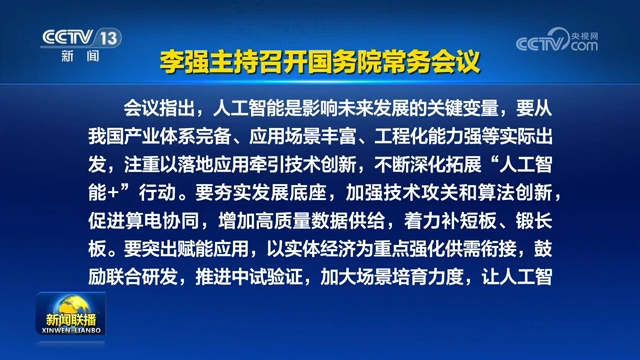
Algorithms, power supply, data and applications were placed in the deployment of the same State Council Standing Meeting.Conference drafts issued by XinhuaIt was shown that on 16 October, Li Keung was briefed on the progress of the "Assumption Plus" initiative, which called for practical applications to pull innovations and promote computer synergies and increased quality data availability.
The draft highlights the application focus on the real economy: bridging supply and demand, encouraging joint R & D, advancing the pilot testimonial, and transforming technology into productivity. It does not include in this public text the scale of new investments, specific target targets for subsidies or quantitative indicators of performance. The current meeting had therefore released a way forward that could not be written as a new funding had been allocated or a new project had been launched.
But direction itself changes the competition for resources. When power, power and data availability are both policy tasks, competition is not just a comparison of model effects, but also who has access to infrastructure, data conditions and pilot opportunities. The relationship between the technology enterprise and the administration is thus part of the understanding that the industry is not to be bypassed.
This drive has been going on for months.State Council Thematic Study, 11 FebruaryThe project is also being conducted around the "Advisory Intelligence Plus" and proposes a comprehensive approach to innovation, industrial development and application, with a clear call for the implementation of the relevant directives of Xi Jinping and the deployment of the CCP. By October, the Conference had begun to hear about progress in action, and the policy had moved from mobilization to a sustained follow-up phase.
In the CCP political system, this continuous deployment is carried out along sectoral and local lines. For local governments, the direction that has been repeatedly emphasized by the central authorities is attractive for performance; For enterprises, policy language may help to enter the resource allocation horizon. The key tension that has emerged is whether the administrative speed of advance is commensurate with real needs. The ability of mid-test and joint R & D to produce effective products ultimately depends on the need of the user and the willingness of the enterprise to pay for it on a continuous basis.
At the same meeting, draft amendments to the price law were discussed, proposing to combat the disorderly competition at low prices. The combination of the two agendas shows that Governments are pushing for new industries and, on the one hand, are trying to regulate the way in which firms compete. The executive branch is both a driving force for expansion and a power to interpret the market order; Enterprises must respond to both technology needs and policy boundaries.
Videos of the OCK posted on People's NetThis deployment is presented in text. This cover is taken from the cover of the video. The public picture highlights the State's drive to make AI a productive target, while the draft includes “integrated development and security” as another requirement.
For the general workforce and users, the significance of AI landing will not be determined by the number of new models. The way policies reach everyday life is through how jobs are re-oriented, how data enter the system, how efficiency gains are distributed. The State can pool its resources to accelerate the application of technology, but not by proving that costs and benefits have been equitably distributed by the concentration itself.
Article discussion
Verified members can discuss this report publicly and manage their own content.
Checking member sign-in status…