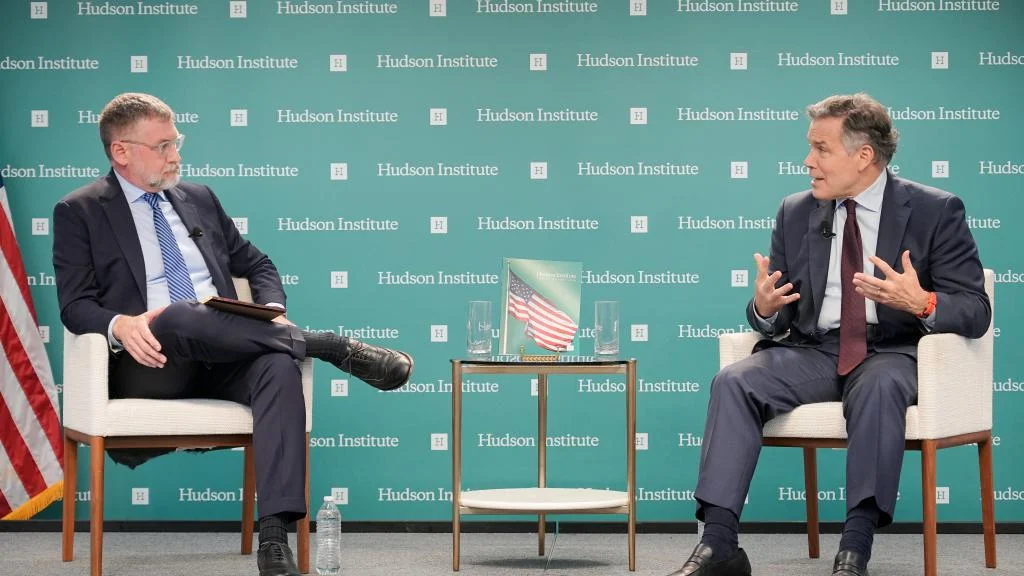
In 2005, Dave McCormick was involved in managing sensitive technology exports in the United States Department of Commerce, fearing that the Chinese military would benefit from United States technology transfer. Twenty-one years later, the Republican Senator from Pennsylvania at the Hudson Institute proposed a far greater policy shift than that of technology: the US should end its trade-to-China engagement as a strategic tool to promote political openness in China.16 OctoberIt is tantamount to putting the export control work that it did in its early years into a policy debate that lasted for a quarter of a century.
McCormick's speech is reminiscent.During the Bush Administration, he had made demands for restrictions on the flow of technology to China and had therefore had frictions with Beijing. He acknowledged that the United States had different expectations at the decision-making level about China ' s accession to the World Trade Organization, one of which was market engagement that ultimately promoted compliance with rules and political change. Real development did not follow that path: the Chinese Communist Party had accumulated industrial and financial resources through exports, investment and external markets, and political control had not been relaxed. He wished to amend today, first and foremost, the policy assumptions of Washington.
Looking back at this process, it is not important that all historical decision makers be endorsed as one. United States enterprises profit from low-cost Chinese manufacturing, consumers enjoy cheaper goods, and United States universities and technology companies expand their cooperation; Chinese workers also gained jobs in export industry growth. At the same time, the CCP leadership combines industrial expansion with organizational control, and strengthens its political and social dominance through technology, data and capital development. Trade brings wealth without the corresponding institutional channels that give the public oversight power in China. The strategic failure that McCormick acknowledged today is between these two trajectories.
He's got a specific prescription.• Linking access to advanced chips, manufacturing equipment and key technologies to security risks, preventing US capital from supporting activities that could strengthen China’s military power, and enhancing its own scientific and manufacturing capabilities, while requiring Japan, Korea, and others to assume a synergistic responsibility. He also proposed to adjust China ' s treatment for permanent normal trade relations and supported it.Legislative measures targeting remote access to United States computing power overseasI'm sorry. These initiatives involve different legal and administrative procedures, and not a single speech can be immediately implemented.

Taking the policy recommendations apart, McCormick is finding that he is combining the tools that were scattered in the Ministry of Commerce, the Ministry of Finance, the R & D budget and the Allies diplomacy into the same long-term competition strategy. In export controls, the civil-military use of technology needs to be identified; In terms of outward investment, the final beneficiaries need to be tracked; In the area of ally coordination, national enterprises are not necessarily willing to bear the same business losses. The more tough policies are advocated, the more they need to answer who provides the information, who bears the costs and how the executive branch avoids expanding economic competition itself indefinitely into a security exception.
His speech also placed Taiwan's security at the front of this strategic framework.I'm sorry. McCormick believes that Washington must allow Beijing to calculate the cost of using force to see a more convincing US and ally. The real policy challenge here is coordination, not slogans: Japan and Korea face different domestic political and security tasks, and Taiwan ' s defence and social resilience cannot be unilaterally replaced by Washington. The United States has moved from the optimism of the trading age to the security age, and it is still unable to answer how effectively to avoid war if it remains merely to declare Beijing dangerous.
For Chinese politics, the speech was delivered by a revalued external trust. For a long time, the CCP had hoped that global capital would be able to believe that the Chinese market was rich and cooperatively profitable, while accepting party ultimate control over industrial policy, information and public life. McCormick asked the United States to withdraw part of its trust and replace the past wait for political evolution with export licences, capital reviews and coalition terms. Beijing could disagree with his judgement but could not continue to make the opening of external markets a condition of perpetuity.
Article discussion
Verified members can discuss this report publicly and manage their own content.
Checking member sign-in status…