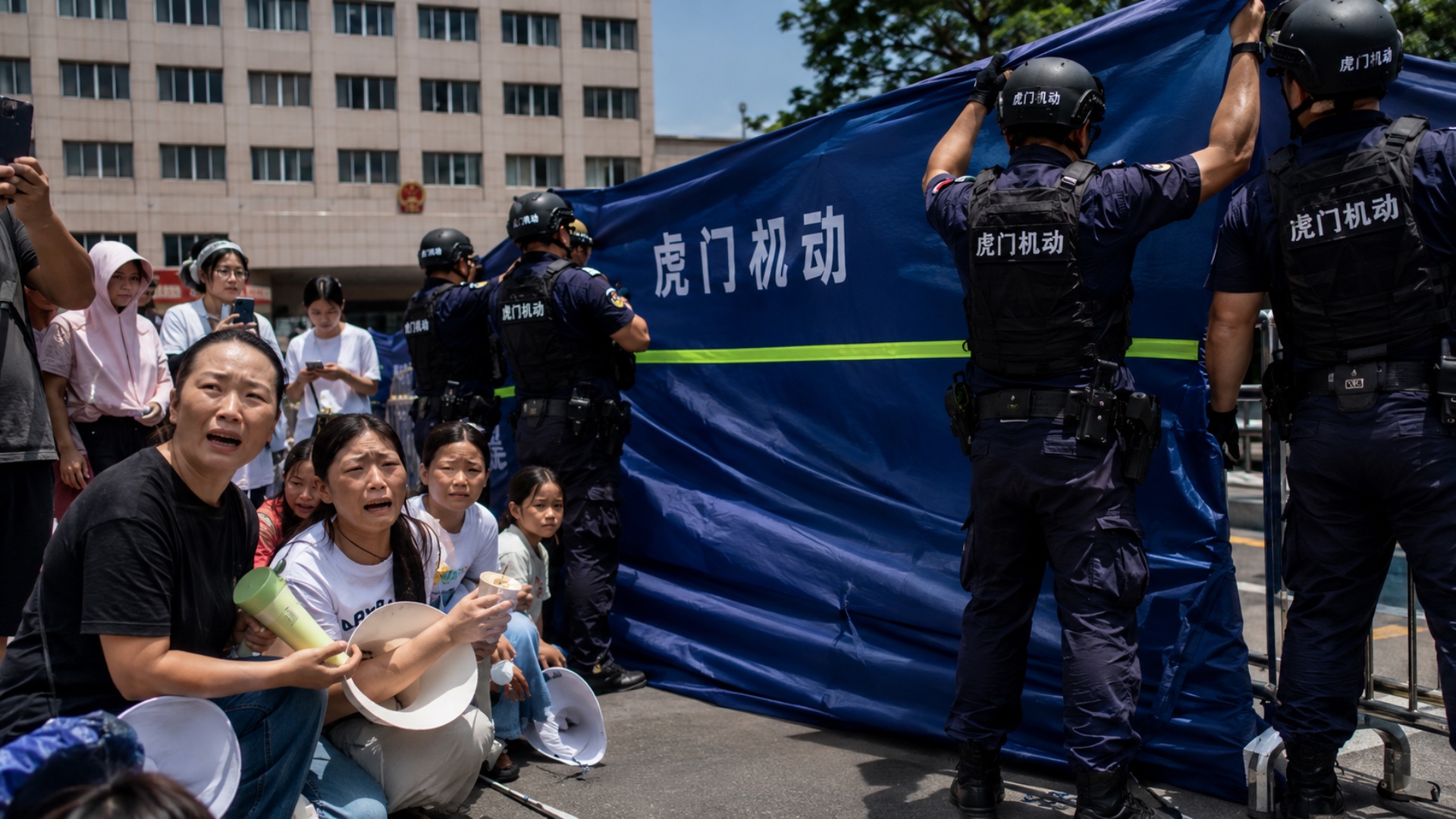
在广东东莞虎门镇政府大楼前,巨大的蓝色塑料遮挡布被数名身穿制服的警务人员拉起,试图将一场突如其来的抗议隔离在公众视野之外。然而,在布帘的另一侧,几名学龄儿童与家长的哭喊声依然清晰可闻。

近日,一段在社交平台流传的现场视频显示,多名虎门镇本地家长带着孩子在镇政府外跪地维权,抗议当地教育部门对学龄儿童的学校调配政策。据现场抗议者透露,事件起因于当地政府在周边学校尚有学位空缺的情况下,强行将符合条件的本地学生重新分配至距离居住地近10公里以外的学校,给家庭带来极大的通勤负担与教育不便。

“遮罩”下的维权与现场博弈

视频𝕏 X 原帖

记录了抗议现场激烈的对峙与维稳过程。画面中,数名女孩和母亲瘫坐在地上失声痛哭,手持喇叭诉说诉求。随后,多名头戴盔甲、身穿“虎门机动”字样制服的特勤人员赶到现场,合力拉起一张数米宽的蓝色防护布,将抗议者群体紧紧围住。

这种用于事故现场或敏感事件防围观的蓝色遮罩,一时间成为了抗议现场最刺眼的符号。

面对警方的遮挡与围堵,不少围观市民和路人表达了强烈不满。一名现场拍摄的男子在视频中激愤地质问:“大家看,这就是我们交税养的人!用我们纳税人的钱,交给他去压迫我们老百姓!”在警方试图阻止其录像并要求其离开时,该男子据理力争:“我就要录,我就要发抖音!”

学位矛盾与“纳税人意识”的觉醒

这起事件折射出中国珠三角地区长期存在的教育资源供给矛盾。随着城市化推进及人口政策调整,优质基础教育资源的分布不均与就近入学政策之间的冲突日益凸显。许多家长认为,按照现有户籍与房产政策,自己的孩子理应享受附近的公共教育资源,而官方“跨区域调配”的行政决策缺乏透明度与沟通机制。

值得注意的是,视频中市民频繁提及“纳税人权益”与“政府公共服务职责”,显示出基层公众在面对行政权力时,开始更多地运用法律与公民权利框架进行抗辩,而非仅仅停留在传统的“求官作主”式上访。

地方治理模式的挑战

对于抗议者的诉求及现场警方的维稳举措,当地政府及教育部门尚未公开发表官方回应。海外关注中国社会议题的分析人士指出,面对公众的利益诉求与情绪爆发,基层政府第一反应往往是采取“物理隔离”与“信息封锁”的维稳思维(如使用遮挡布、现场控场及网络删帖),这种做法非但未能解决教育资源调配失衡的根源问题,反而进一步加剧了官民之间的信任赤字。

目前,关于该事件的视频与讨论在中国国内主流社交平台上已受到不同程度的清理与限流,但家长们对教育公平的呼吁仍在海外社交媒体上持续发酵。

In front of the Humen Town Government building in Dongguan, Guangdong, huge blue plastic screening tarps were pulled up by several uniformed police officers in an attempt to isolate a sudden protest from public view. However, on the other side of the curtain, the cries of several school-aged children and their parents remained clearly audible.

Recently, a video of the scene circulating on social media platforms showed several local parents in Humen Town bringing their children to kneel in protest outside the town government, protesting the local education department's school allocation policy for school-aged children. According to protesters at the scene, the incident was triggered by the local government forcibly reallocating eligible local students to schools nearly 10 kilometers away from their residences, despite vacant places still being available in nearby schools, bringing an immense commuting burden and educational inconvenience to the families.

Rights Protection and On-site Confrontation Under the "Screens"

Original post on X (formerly Twitter):

This recorded the intense confrontation and stability-maintenance process at the protest site. In the footage, several girls and mothers sat slumped on the ground crying out loud, using a megaphone to state their demands. Subsequently, multiple special police officers wearing helmets and uniforms bearing the words "Humen Mobile" arrived at the scene, working together to pull up a blue protective tarp several meters wide, tightly enclosing the group of protesters.

This type of blue screen, used to prevent onlookers at accident scenes or sensitive incidents, instantly became the most glaring symbol of the protest site.

Faced with the police's blocking and containment, many onlookers and passersby expressed strong dissatisfaction. A man filming at the scene questioned indignantly in the video: "Look, everyone, these are the people we pay taxes to support! Using our taxpayers' money to oppress us, the common people!" When police attempted to stop him from recording and demanded that he leave, the man stood his ground: "I will record it, and I will post it on Douyin!"

Conflict Over School Places and the Awakening of "Taxpayer Consciousness"

This incident reflects the long-standing conflict in China's Pearl River Delta region regarding the supply of educational resources. With the advancement of urbanization and adjustments in population policies, the conflict between the uneven distribution of high-quality basic education resources and the policy of enrolling in nearby schools has become increasingly prominent. Many parents believe that according to existing household registration (hukou) and property policies, their children should rightfully enjoy nearby public educational resources, and that the official administrative decision of "cross-district allocation" lacks transparency and communication mechanisms.

Notably, the frequent mentions of "taxpayer rights" and "government public service responsibilities" by citizens in the video indicate that when facing administrative power, the grassroots public is beginning to use legal and civil rights frameworks more often to argue their case, rather than merely relying on the traditional petitioning style of "begging officials to act on their behalf."

Challenges to Local Governance Models

Regarding the protesters' demands and the on-site police's stability-maintenance measures, the local government and education departments have not yet issued an official public response. Overseas analysts focusing on Chinese social issues pointed out that when faced with public interest demands and emotional outbursts, the first reaction of grassroots governments is often to adopt a stability-maintenance mindset of "physical isolation" and "information blockade" (such as using screening tarps, controlling the scene, and deleting online posts). This approach, rather than resolving the root cause of the imbalanced allocation of educational resources, further exacerbates the trust deficit between the government and the public.

Currently, videos and discussions about the incident have been subjected to varying degrees of cleanup and traffic restriction on mainstream social media platforms within China, but parents' calls for educational equity continue to ferment on overseas social media.

Voor het gebouw van de gemeentelijke overheid van Humen in Dongguan, Guangdong, werden enorme blauwe plastic afschermzeilen omhooggetrokken door verschillende geünformeerde politieagenten in een poging een plotseling protest te isoleren van het publieke oog. Aan de andere kant van het zeil bleven de kreten van verschillende schoolgaande kinderen en hun ouders echter duidelijk hoorbaar.

Onlangs toonde een video van de scène die op sociale media circuleerde, hoe verschillende lokale ouders in Humen hun kinderen meenamen om geknield te protesteren buiten het gemeentehuis. Ze protesteerden tegen het schoolplaatsingsbeleid van de lokale onderwijsafdeling voor schoolgaande kinderen. Volgens demonstranten ter plaatse werd het incident veroorzaakt doordat de lokale overheid in aanmerking komende lokale leerlingen gedwongen herplaatste naar scholen op bijna 10 kilometer afstand van hun woonplaats, ondanks het feit dat er nog vrije plaatsen waren op nabijgelegen scholen. Dit brengt een enorme reislast en onderwijsongemak met zich mee voor de gezinnen.

Belangenbehartiging en confrontatie ter plaatse onder de "schermen"

Originele post op X:

Dit legde de felle confrontatie en het proces van stabiliteitshandhaving op de protestlocatie vast. Op de beelden is te zien hoe verschillende meisjes en moeders huilend op de grond zaten en met een megafoon hun eisen kenbaar maakten. Vervolgens arriveerden meerdere agenten van de speciale eenheid met helmen en uniformen met de tekst "Humen Mobiel" ter plaatse. Zij werkten samen om een metersbreed blauw beschermzeil omhoog te trekken, waarmee de groep demonstranten nauwlettend werd omsingeld.

Dit type blauwe afscherming, dat wordt gebruikt om toeschouwers bij ongevallen of gevoelige incidenten te weren, werd in één klap het meest in het oog springende symbool van de protestlocatie.

Geconfronteerd met de blokkade en omsingeling door de politie, uitten veel toeschouwers en voorbijgangers hun sterke ontevredenheid. Een man die ter plaatse aan het filmen was, vroeg zich in de video verontwaardigd af: "Kijk allemaal, dit zijn de mensen die wij met onze belastingen onderhouden! Ons belastinggeld wordt gebruikt om ons, het gewone volk, te onderdrukken!" Toen de politie probeerde te verhinderen dat hij opnames maakte en eiste dat hij vertrok, hield de man voet bij stuk: "Ik ga het opnemen en ik ga het op Douyin zetten!"

Conflict over schoolplaatsen en het ontwaken van het "belastingbetalersbewustzijn"

Dit incident weerspiegelt het langdurige conflict in de Chinese Parelrivierdelta over het aanbod van onderwijsvoorzieningen. Met de voortschrijdende verstedelijking en aanpassingen in het bevolkingsbeleid is het conflict tussen de ongelijke verdeling van kwalitatief hoogwaardig basisonderwijs en het beleid van instroom op nabijgelegen scholen steeds prominenter geworden. Veel ouders zijn van mening dat hun kinderen, volgens het bestaande registratie- (hukou) en eigendomsbeleid, recht hebben op nabijgelegen openbare onderwijsvoorzieningen, en dat het officiële administratieve besluit van "regio-overschrijdende toewijzing" transparantie en communicatiemechanismen mist.

Opvallend is dat de frequente verwijzingen door burgers in de video naar "rechten van de belastingbetaler" en "de publieke dienstverleningsplicht van de overheid" aantonen dat het gewone publiek, wanneer het geconfronteerd wordt met administratieve macht, vaker juridische en burgerrechtelijke kaders begint te gebruiken om hun zaak te bepleiten, in plaats van louter te vertrouwen op de traditionele manier van petitierechten waarbij men "ambtenaren smeekt om namens hen op te treden."

Uitdagingen voor lokale bestuursmodellen

Wat betreft de eisen van de demonstranten en de stabiliteitsmaatregelen van de politie ter plaatse, hebben de lokale overheid en onderwijsafdelingen nog geen officiële publieke reactie gegeven. Overzeese analisten die zich richten op Chinese maatschappelijke kwesties wezen erop dat wanneer zij geconfronteerd worden met publieke eisen en emotionele uitbarstingen, de eerste reactie van lokale overheden vaak is om een stabiliteitshandhavingsmentaliteit van "fysieke isolatie" en "informatieblokkade" toe te passen (zoals het gebruik van afschermzeilen, het controleren van de locatie en het verwijderen van online berichten). Deze aanpak lost de dieperliggende oorzaak van de onevenwichtige verdeling van onderwijsvoorzieningen niet op, maar vergroot de vertrouwenskloof tussen de overheid en de burgers juist verder.

Momenteel zijn video's en discussies over het incident op de belangrijkste sociale-mediaplatforms binnen China in verschillende mate opgeschoond en in bereik beperkt, maar de oproepen van ouders voor onderwijsgelijkheid blijven op overzeese sociale media circuleren.

参与讨论Join the discussionNeem deel aan het gesprek

请围绕事实与观点理性交流。新评论会先进入编辑审核。Discuss facts and views constructively. New comments are reviewed before publication.Bespreek feiten en standpunten op een constructieve manier. Nieuwe reacties worden voor publicatie beoordeeld.