
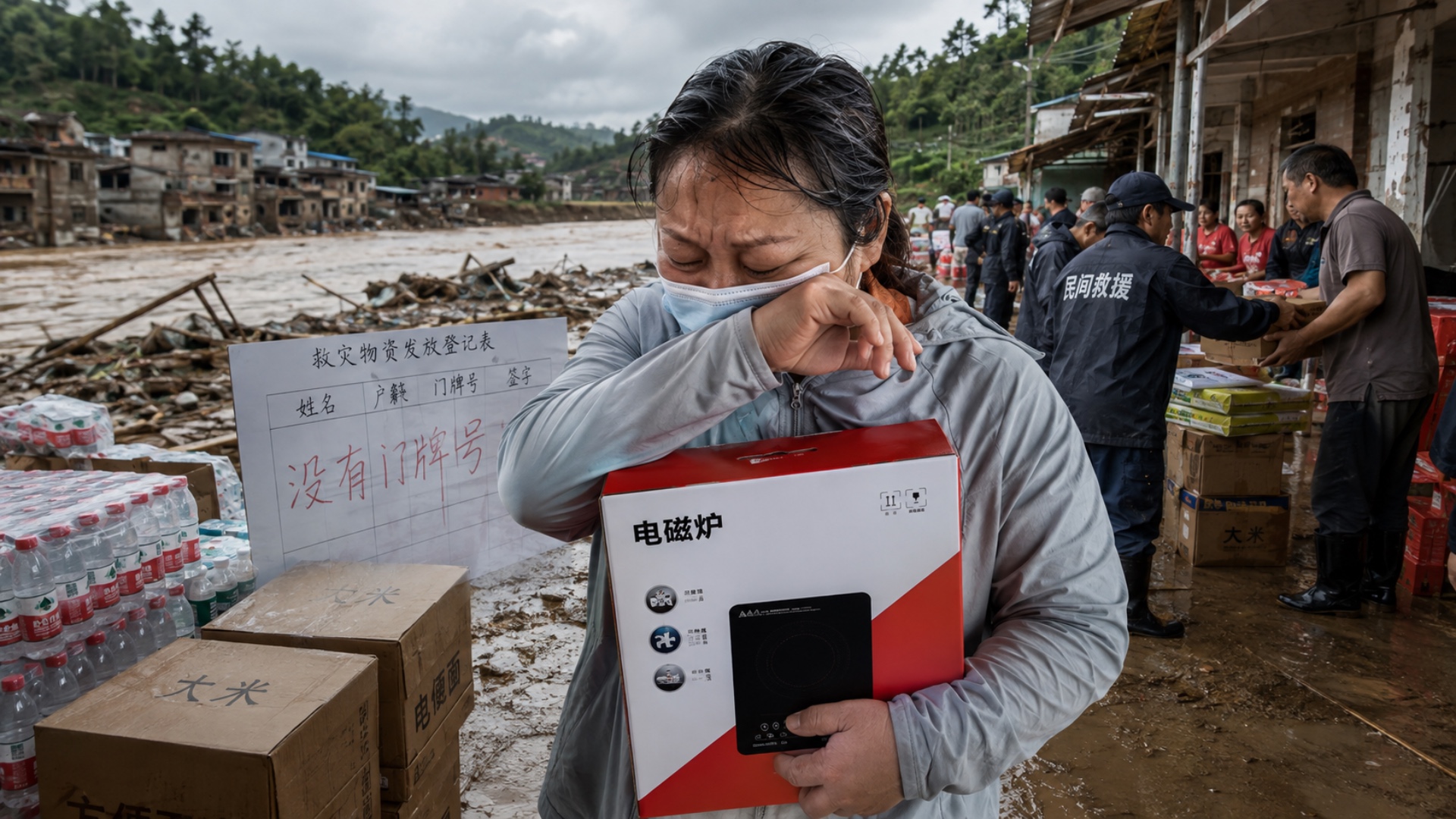
Under a corridor along the Jiang Street in the cloud town of Guangzhou, a woman wearing a mask held tightly a electric magnetic oven she had just received, and could not withstand wiping the corners of her eyes with her sleeves.
This is one of 100 kitchen utensils purchased by civilian rescue workers for self-funded funds. From the dam of the reservoir on July 6, until August 3 saw these social rescue workers, for a month, she and her family received a full set of disaster relief materials from the local government, only 5 kilograms of rice and a small amount of convenience and mineral water.
When rescue workers routinely asked her for the door number to be registered, she lowered her head: “No door number, we are outdoors.”
Disaster relief blind areas "deleted" by the administrative form
“No gateway” and “outside”, which are short words, tear away the most brutal reality in the outbreak of disaster rescue.
In the functioning logic of the grassroots regime of the Communist Party of China, a person can not eat the food of relief, first of all depending on whether he is a line of effective data in the administrative table. In the distribution of post-disaster emergency supplies, issuing lists are heavily dependent on existing household names and fixed door registration. However, along the River Street, the grain road has gathered a large number of residents who migrated to this because of relocation or work. The flood destroyed houses, but can not wipe out the bureaucratic system's persistence on households and door names
- no door names, is equivalent to "no longer exist" in the administrative list of the Communist Party of China.
This endpoint pain is not unique. Over the course of the day, many people affected by disasters have reflected similar encounters on the network:
- There are villagers in Panjang Village in Qinghai City, Qinghai City, Qinghai City, Qinghai City, Qinghai City, Qinghai City, Qinghai City, Qinghai City, Qinghai City, Qinghai City, Qinghai City, Qinghai City, Qinghai City, Qinghai City, Qinghai City, Qinghai City, Qinghai City, Qinghai City, Qinghai City, Qinghai City, Qinghai City, Qinghai City, Qinghai City, Qinghai City, Qinghai City, Qinghai City, Qinghai City, Qinghai City, Qinghai City, Qinghai City, Qinghai City, Qinghai City, Qinghai City, Qinghai City, Qinghai City, Qinghai City, Qinghai City, Qinghai
Extremely scarce individual survival guarantees, with the macro narrative of "sufficient supply of materials, efficient and orderly rescue" in the official statement of the Communist Party of China, formed an extremely sharp contrast.
Prefer to starve and never let go of control.
More devastating than material scarcity is the stagnation of rescue routes.
The electromagnetic furnace in the arms of the woman who was interviewed was spontaneously raised by the civilian rescue team. Volunteers deliberately saved her one from a limited inventory after noticing that her home had "no door mark" and special circumstances. In the face of major disasters, spontaneous social compassion tends to be more sharp and efficient than the bureaucratic system.
However, the local authorities of the Communist Party of China have alwaysined a high level of caution and hostility towards this kind of spontaneous rescue by civilians.Many civilians reflect that they are frequently blocked, dissuaded or rejected by local governments when trying to deliver disaster relief materials to disaster areas.
This blockade is not a simple administrative inefficiency, but a deep-seated control fanaticism in the bone marrow of the CCP’s rule.
- Monopoly rescue power: unorganized civil rescue, breaking the absolute monopoly of authorities on resources, visually exposing the bureaucratic system's incompetence and failure to work.
- Preventing group autonomy: Compared to disasters hungry and not hungry, rulers are more afraid of civilians to form uncontrolled self-organized forces.
In order to maintain the political illusion of “perfect rescue,” the CCP system has demonstrated an extremely aggressive exclusivity to civilian self-help. From a six-shared three-barrel convenience in the village of Guangdong, to the completely forgotten foreigners in the cloud town, these disappointments of the victims point to a reality: in the CCP’s disaster rescue logic, the right to survive at the bottom is always at the end, at the forefront, always the monopoly of power, the blockade of information and the face of the regime.
Article discussion
Verified members can discuss this report publicly and manage their own content.
Checking member sign-in status…