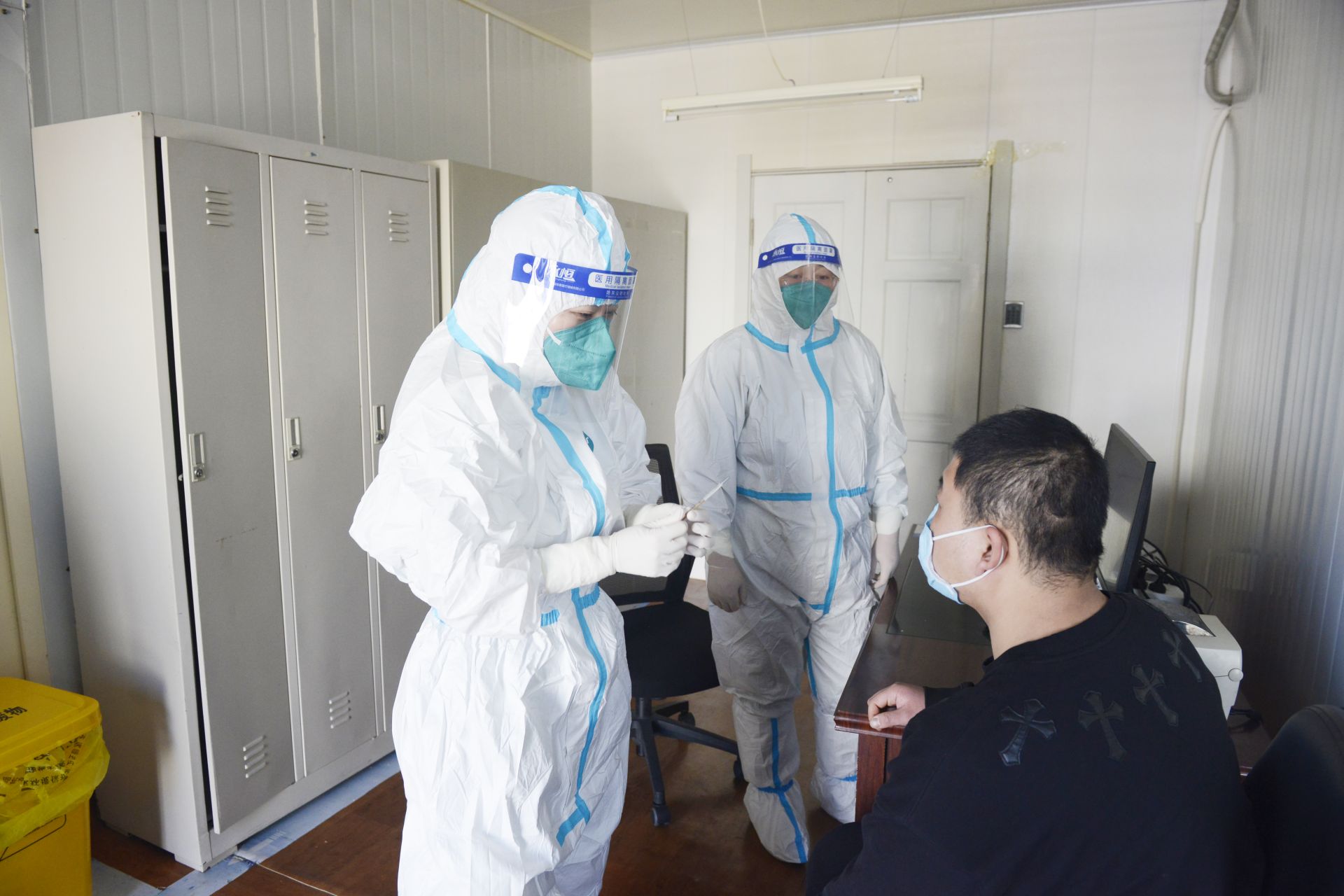
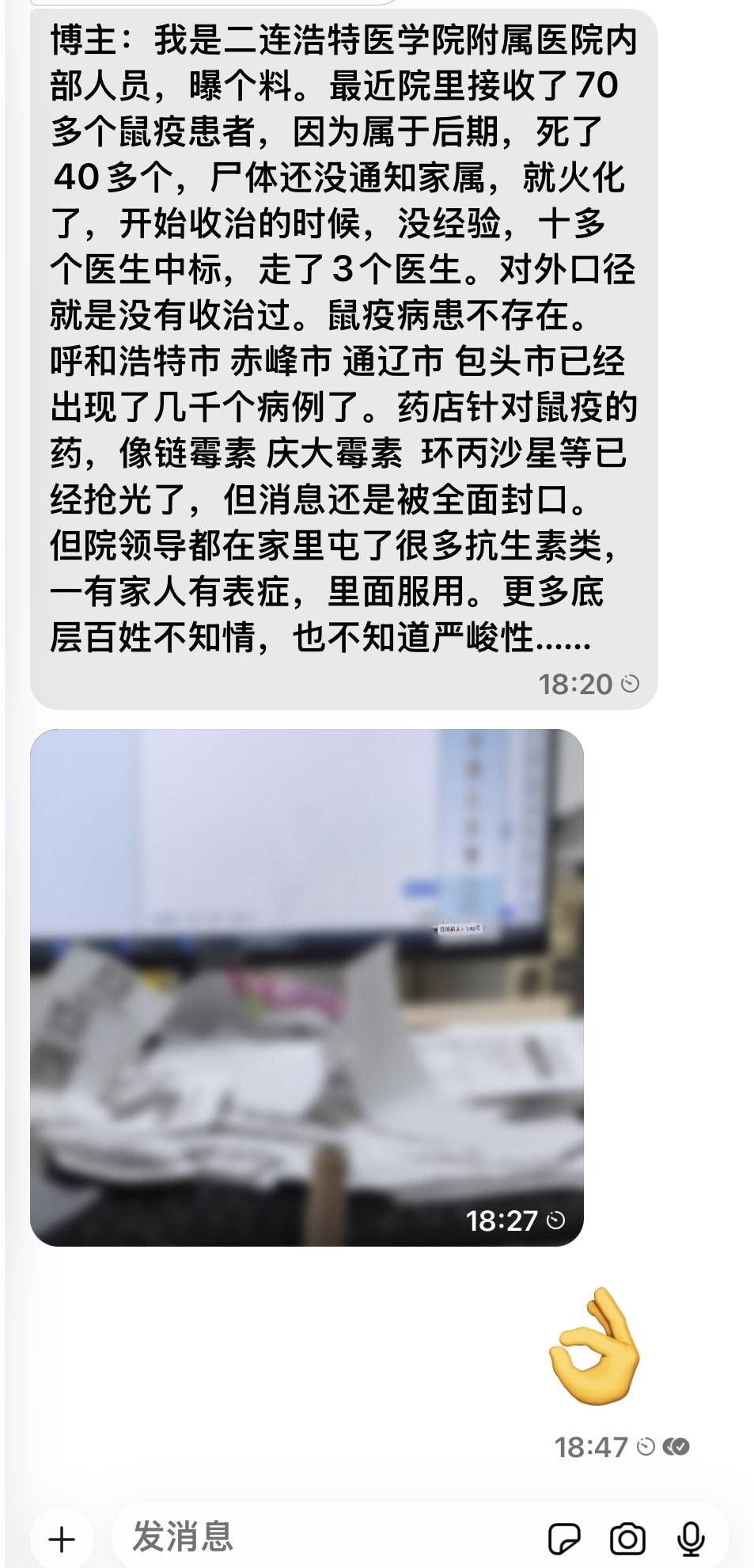
An anonymous contribution circulated online pushed two mendinghots in Inner Mongolia to the centre of a public health dispute: the contributor claimed that more than 70 plague patients, 40 deaths and the spread of the epidemic to the areas of Houth and Houth Houth, Ching Feng, Tung Cai, and the top of the pack were treated in a local hospital. This figure, which is sufficient to alert the entire region, is not currently corroborated by independent medical records, famous testimony or other reliable information. However, the search for the name of the medical facility in the explosion and the information on the local plague control revealed another more specific question: who is responsible for taking out a case, testing and reporting record and giving the public a testable answer in the face of rumours of major infectious diseases?
Anonymized contributions stated that the so-called “Attach Hospital of the Erenhot Medical School” had recently admitted over 70 patients to treatment for the plague, of whom more than 40 had died; (b) Some of the patients ' remains are cremated without adequate notification to their families; More than 10 doctors were allegedly infected and three died. The paper also accused other cities in the country of thousands of patients, of drug purchases such as scathin, Qinga, and Zenprosa, and of early drug accumulation by hospital management, while denying cases to society. These are successive allegations in the same explosion, which does not mean that each of them is supported by independent evidence; As of the time of the release, no sufficiently confirmed information had been obtained on the related deaths, infections, cremation and drug sales records.

The most important thing to verify is not how alarming the figures are, but the report which hospital is the one that is taking care of the patients. "Ahref, published by the Medical Insurance Service of Erlianhot City in April."https://www.elht.gov.cn/mobile/c/2026-04-30/114214.shtml"target = _blunk" rel = noopener noreferrer" data-linked-reference = true" data-reference-label = `Annual Examination Results of the Direnhot Medical Point Institution' for 2025, which includes institutions such as the Minonhot City People's Hospital and the Mhongchon Medical Hospital in Minhut, but not the "Alonhot Hospital" Unit. This list covers only health-care establishments and does not allow for the assertion that there are no other health-care facilities in the area; However, it is sufficient to show that the most critical institutional identity of anonymous revelations remains unrecorded. If the person who made the explosion used abbreviation or misspelled the name of the institution, the exact address, the section, the date of the visit and the number of the medical record became the necessary clue for further verification.
The risk of the plague itself is not a fictional context. The two condos are at the source of the plague and are also border crossings with frequent traffic of people, and local health systems have long-term monitoring and prevention. From 27 to 28 July, the Municipal Health Board conducted a visit to the district health facility at , examining pre-screening and sub-diagnosis, referral of suspicious case reports, hospital infection control and personnel training, and indicating that requests for correction of the weaknesses identified are made.
September 2, 2nd, 2nd, 2nd, 2nd, 2nd, 2nd, 2nd, 2nd, 2nd, 2nd, 2nd, 2nd, 2nd, 2nd, 2nd, 2nd, 2nd, 2nd, 2nd, 2nd, 2nd, 2nd, 2nd, 2nd, 2nd, 2nd, 2nd, 2nd, 2nd, 2nd, 2nd, 2nd, 2nd, 2nd, 2nd, 2nd, 2nd, 2nd, 2nd, 2nd, 2nd, 2nd, 2nd, 2nd, 2nd, 2nd, 2nd, 2nd, 2nd, 2nd, 2nd, 2nd, 2nd, 2nd, 2nd, 2nd, 2nd, 2nd, 2nd, 2nd, 2nd, 2nd, 2nd, 2nd, 2nd, 2nd, 2nd, 2nd, 2nd, 2nd, 2nd, 2nd, 2nd, 2nd, 2nd, 2nd, 2nd, 2nd, 2nd, 2nd, 2nd, 2nd, 2nd, 2nd, 2ndhttps://wjw.nmg.gov.cn/xwzx/msdt/202609/t20260902_2948565.html"target" rel= "nopener noreferrer" data-linked-reference= "tru" data-reference-label= "Stranger Control Control of 2 September of the Epidemic Control of the Epidemic Control of the Rats" The public meeting records show that the municipality nominated the deputy mayor, Ja Xiaogang, to attend; Controls in the areas of disease control, medical care, customs, etc. have been integrated into the integrated deployment, including on the early warning of disease surveillance, protective fleas, medical agency posts, emergency material reserves and 24-hour information reports. The meeting also recognized the daunting task of controlling the plague at ports of entry. This is an administrative record that can be traced to the chain of responsibility and is not a notification of confirmed cases.

The following day, the Sansa Sabotone Health Commission organized a group of , with over 300 participants. Training records mention that some grass-roots clinicists are not aware of control, are not familiar with the process and are not in a regular manner in emergency response; The course specifically covers the screening, registration, reporting, referral and protection against infection in hospitals for suspicious cases. The official materials leave a specific description of the risks and the short sheets, but do not include in these training reports a list of patients who have been reported as “over 70” “over 40”. These meetings and trainings cannot be used as evidence of outbreaks of the epidemic or as a substitute for public responses to the number of current cases.
In 2019, the cases of plague in Inner Mongolia were reported by the Chinese disease prevention and control field <a href="https://pmc.ncbi.nlm.nih.gov/articles/PMC8428432/"target" rel = "nopener noreferrer" data-linked-reference = "true" data-reference-label = "Research paper on the Mongolian plague in 2019" </a" for detailed documentation: in November of that year, Beijing confirmed two patients from Silling Kowloon, and another patient was identified as gland plague in mid-November, with the contact of the case receiving the treatment. He was under medical observation. By contrast with these retroactive case reports, the public is not only choosing between “convincing the explosion” and “convincing the denial”. Pathological tests, clinical diagnosis, exposure history and epidemiological surveys can inherently form an independent and verifiable chain of facts. The cases of 2019 did not prove that an epidemic of the same magnitude occurred in 2026, but showed that serious pest surveillance in the area was a real necessity.
What really needs to be made public is a time-stamped reporting chain. Revised in 2025 lists the plague as a category A infectious disease, requiring medical and CDC bodies to report directly on the Internet within two hours of detection of a category A patient or suspected patient (a) The use of the Internet; The reporting obligation is also applied to the CDCs. The law also expressly prohibits concealment, false reporting, late reporting and underreporting, and stipulates that, in the event of an outbreak of infectious diseases, the authorities concerned shall publish in a timely and accurate manner the number of confirmed cases, suspected cases and deaths. If the reported large number of confirmed and deceased cases does exist, it is desirable that records of testing, reporting, treatment, death and disposal be kept; If not, the competent body should also provide clarification with verifiable data and a clear time frame.
A more public-value response than a “no case” should include how many suspected cases have been reported to the two conglomerates and associated allies since the date of the survey, how many people have been screened, how many samples have been tested for the plague, and what results have been obtained; (b) Whether there has been a concentrated infection in a medical institution or a death of a medical practitioner; Has contact tracing, epidemiological disposal of remains and the allocation of special drugs been initiated? The serious allegations of “corresponding without informing the family” require more death certificates, legal proceedings and information from the family than the mere anonymous identification of the violation.
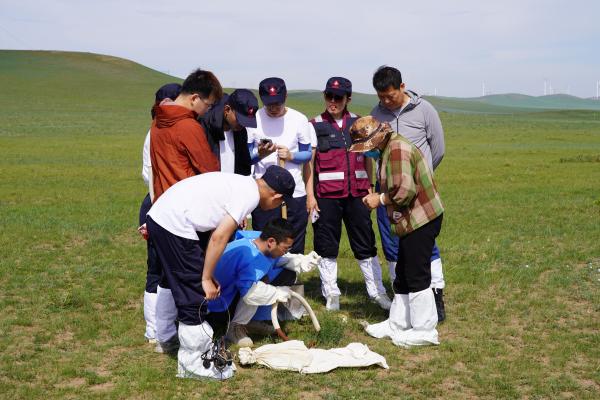
WHO Update reminds that the plague is usually associated with infected animals and fleas, that the disease can be transmitted through the respiratory tract, and that early diagnosis and antibiotics treatment can improve the prognosis significantly. The critical point is that the pulmonary plague can be moving very quickly. This is why the public needs timely risk alerts, standard diagnostics and professional assessments of exposed persons, rather than self-advocacy of antibiotics, as rumoured by the drug hoarding; The need for preventive medication should be judged by medical personnel on the basis of actual exposure risks.
This issue of responsibility should not be decided in advance of the time when the truth is not in order. If the investigation confirms that a report of a statutory epidemic has been concealed, the responsibility should be determined by ranking along the lines of the first medical institution, the CDS, the competent health care agency and local administrative decision-making; If the core allegations are false, it should also indicate the time periods for which case and test data were consulted, so as to avoid forcing the public to accept only oral conclusions that lack evidence. The value of independent press monitoring is in this: it does not package the appalling anonymous numbers into reality, nor does it allow an administrative caliber without numbers to be the whole truth.
The answer most needed to be known by the residents of Inner Mongolia is not a pre-characterization “brash” or “fouling” but a public record of specific hospital, date, test and disposal points. The September meeting of Erenhot has included monitoring of early warning, medical outposts and reporting systems on a case-by-case basis. The moment when the system is truly tested is when major questions arise as to whether the institutions that are charged with these tasks can record and explain the differences so that the population can be informed of the real risks to which they are exposed in a timely manner.
Article discussion
Verified members can discuss this report publicly and manage their own content.
Checking member sign-in status…