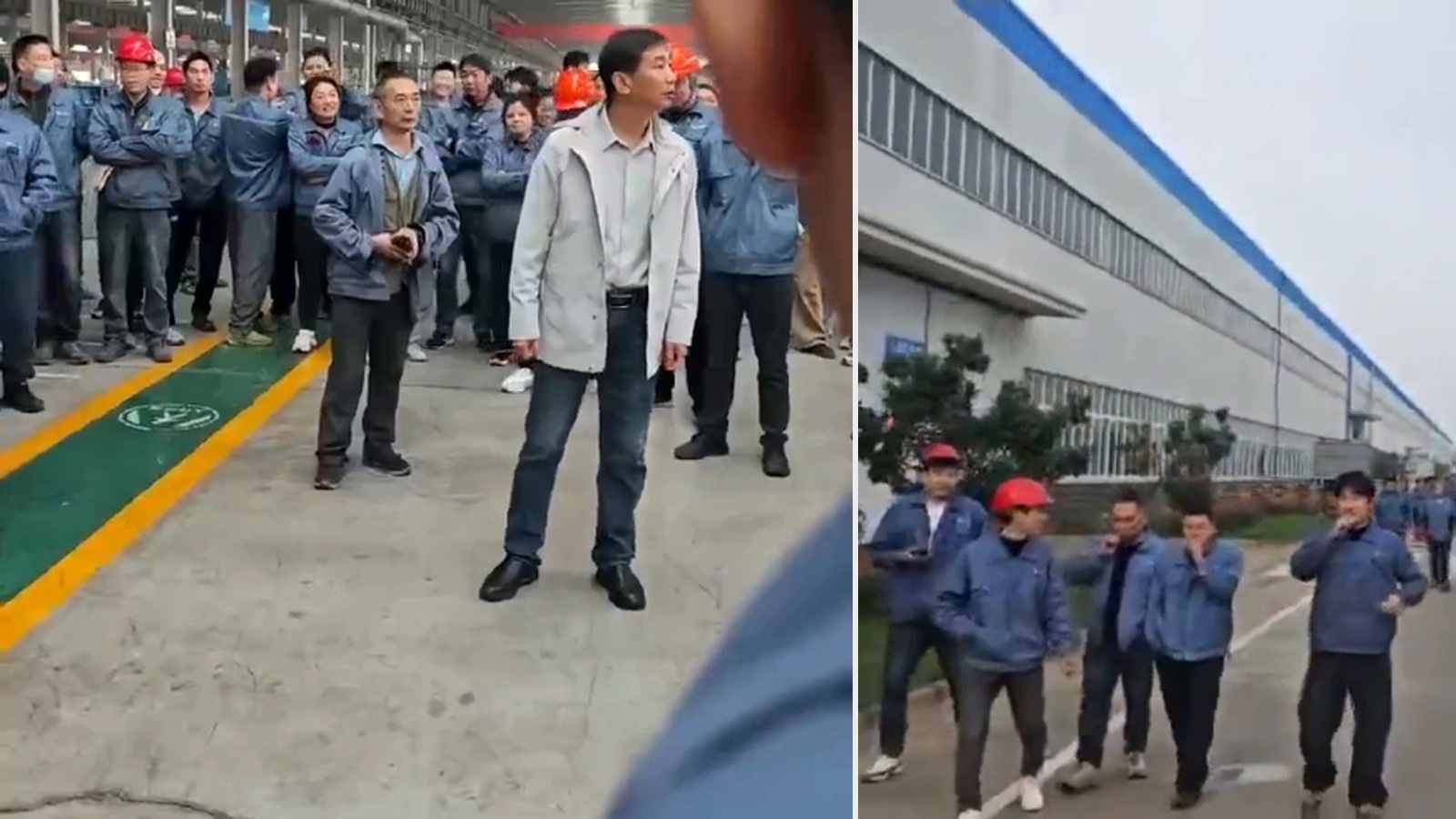
Collective labour disputes have recently erupted in Jiangyang cable in Jiangsuyan County. The live video, which is circulated on the Internet, shows that a large number of workers in blue working clothes gather in production workshops and then travel collectively along the road to the factory area to express their dissatisfaction with the reduction in wages.
According to the records of the group of workers, in September and October 2026, some employees were reduced for two months in a monthly rate of $2,000, to a cumulative value of $4,000. Workers have indicated that wages actually reach only 2,500 dollars and have affected household mortgages and basic living expenses.
This labour dispute, which occurred within the larger manufacturing enterprises, has brought the distribution of wages, the assumption of business risks, the performance of trade union duties and the responsibility for local labour regulation to the public.
dozens of workers' workshops gathered to protest the extension of the road to the factory
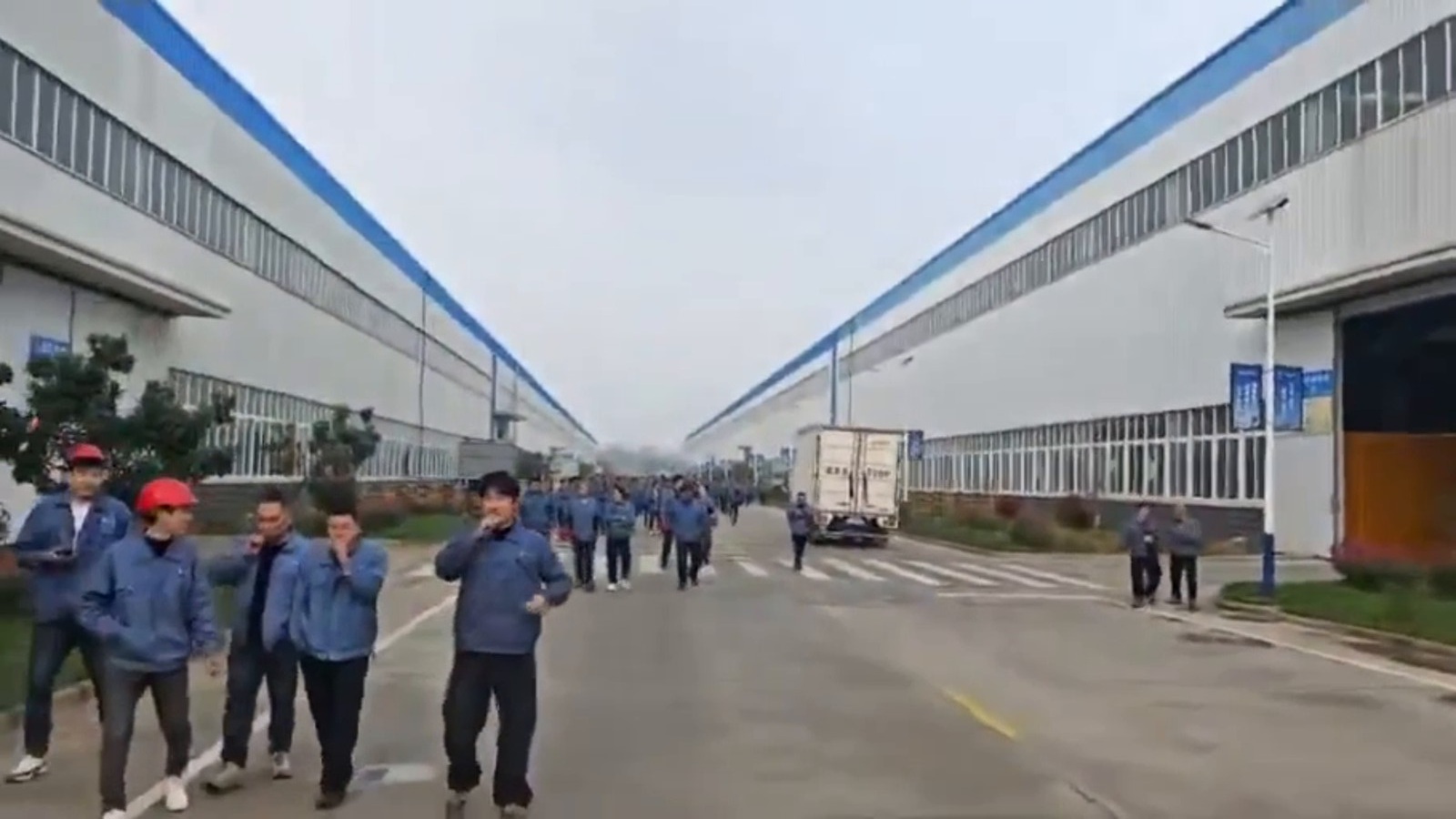
Three of the live videos received showed that the first was taken in large production workshops, with dozens of workers in blue working clothes gathered near the production corridor, some wearing safety hats and many people talking at the scene. Two other videos show workers moving out of the workshop and moving collectively along the road in the factory area. One of the images taken from a high point showed that the team was extending along the plant building, with a significant number of participants beyond the original workshop lens. The information circulated on the Internet stated that the workers then went to the administrative building to express their claims.
原始来源 · 91blv.com11月2日工人抗议相关视频及群聊资料91blv.com ↗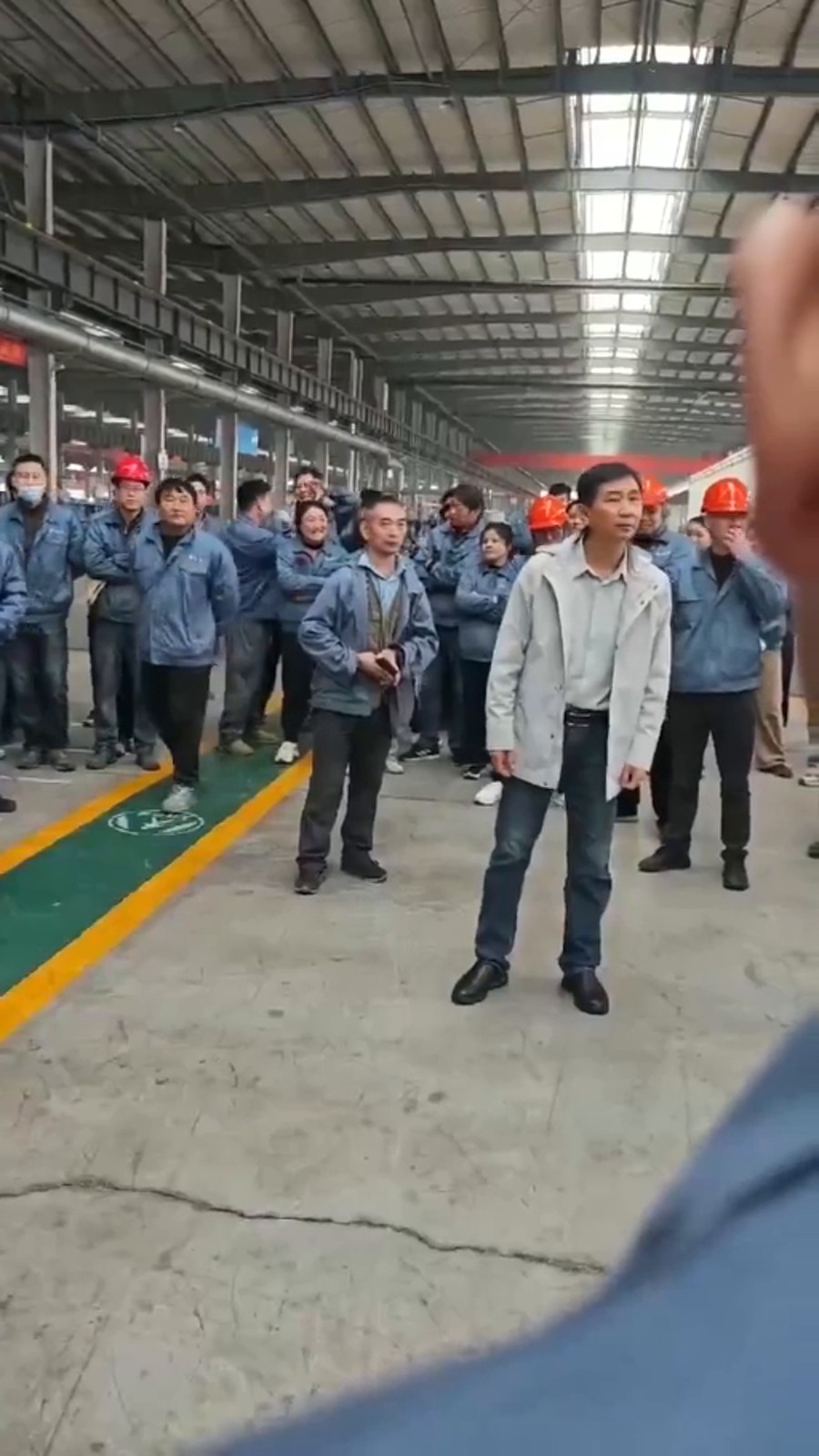
This collective action is directly due to workers ' strong dissatisfaction with the continuous reduction of wages in enterprises. The workers in the group said that the wages had been directly reduced without adequate consultation and convincing explanations.
> > Security is higher than the Gang. The blogger adds:
> "The deaf and dumb are in a hurry. The blogger adds:
"Here's where even the disabled suck their blood. The blogger adds:
> Up, those who do not want to be slaves. The blogger adds:
These statements reflect the anger of some workers. The message, particularly concerning disabled workers, added a concern to the dispute: did the withholding arrangements in enterprises affect disabled workers equally, and did they adequately protect their remuneration and basic rights and interests?
The wages are only 2,500 dollars, and what is the money that the company has taken?
The online wage information is concentrated in September and October
- According to the workers ' statements, some of the employees were reduced by $2,000 each for two months, of which some actually received only $2,500. The reduction of $2,000 per month may mean that, for ordinary manufacturing workers, families cannot repay their mortgages on time or have to reduce their living expenses.
The question is not only whether the deduction is made, but also whether the enterprise is entitled to make such a deduction. What are the names of companies that reduce wages? What is the reduction in basic wages, performance wages, piece income or other remuneration for work? Are the relevant wages negotiated in accordance with the law? Did the employee receive a clear salary calculation? These matters cannot be explained by the business management alone by a “business difficulty”.
The current Pay Payments Ordinance in Jiangsu province expressly requires enterprises to record the wages due, the wages paid and the items and amounts deducted by law, and to provide workers with a list of wages. Enterprises need to provide a specific payroll account to justify each deduction, and not to leave workers to bear unexplained income losses.
The net runs a downfall from the copper price: why does the workers bear the costs of the management decision?
A web-based report circulated on 2 November alleged that the management of the Liu Chai production base of the Jiangyang cable had been problematic, that the company had not purchased copper in time after taking orders and had been faced with a price increase, which had led to increased production costs and a loss in operating operations, while waiting for the price of copper to decline. The report also claimed that a general manager had resigned. The above statement, which is not supported by financial information, personnel announcements and procurement records of the enterprise, cannot be considered as a direct operational fact that has been established.
However, the procurement of copper, stock-taking arrangements, contract pricing and risk management are the responsibility of the enterprise management system. The first-line producer does not determine the price of the bulk of raw materials purchased, nor does it control the risks of running the business. Even if the business has lost business, this does not automatically entitle the worker to a reduction in his or her established remuneration for work. Enterprises should pursue responsibility for management decision-making and approval, rather than requiring workers to bear the consequences of their wages in the absence of a legal basis.
The Cables Company Background: Private Enterprises, Legal Representation, Zing Ding Ding
Open business information indicates that Jiangsu Jiangyan Cable Limited is a limited liability company for natural persons ' investments or holdings, and that its legal representative is Tingmin, not a central or State-owned enterprise. The public documents submitted to the Institute in 2024 show a registered capital of $508 million, or $508 million.
The official website of the enterprise describes the creation of the Jiangyang cable in 1989, which has two production bases in the Vijan Economic Development Area in the Yangzhou city of the Yangjiang region and the Liu Jia Township Industrial Park of the Master Township of the Yangzhou city, with a total area of approximately 1.02 million square metres, and the standardized plant of approximately 360,000 square metres, with products covering various categories, such as electrical cables and control cables.
This is not a small, unorganized, small-scale business, but rather a manufacturing enterprise of a significant scale and size, which has been operating for decades. As the legal representative of the enterprise, the system of enterprise management represented by Ting Qing needs to be explained in terms of the wage management system, the remuneration adjustment process and the handling of labour disputes. If the deduction involves a single decision by management, it should be identified who has initiated it, who has approved it, who has enforced it, and who has made the relevant decision through a legal process.
The company ESG in 2024 reported that it had developed the Pay Management System, the Staff Performance Management Provisions, the Welfare Management System and the Staff Council system. The actual compliance of the wage adjustment with these systems shall be subject to public consultation and to a record of remuneration.
Business unions that used to hold 23.65% of shares, are they on the side of workers?
A public listing response to the request for review published by the Shanghai Stock Exchange in 2024, which identified the stock structure of Jiangsu Jiangyan Cable Limited, is as follows:
原始来源 · shopsource.singoo.cc江苏江扬电缆有限公司ESG报告shopsource.singoo.cc ↗- Jangyang Group Limited has 75.92 per cent of the shares;
- The trade union committee of Jiangsu Jiangyan Cable Limited is 23.65 per cent;
The above historical equity information, which was disclosed in 2024, requires further reconciliation of the latest equity structure.
Under article 48 of the Jiangsu Provincial Wage Payment Ordinance, when a worker is suspended from work for the purpose of withholding his employer ' s wages without cause or for the purpose of paying him or her wages, the union shall intervene on behalf of the employee with the employer.
Are the Jiangyang Cables Union involved in the negotiations on wage adjustment? Do enterprises be required to provide a basis for withholding? If trade unions still hold an enterprise interest, how to deal with the potential conflict of interest between shareholder status and representation of workers in the defence of their rights? Whether or not trade unions actually performed their duties in the context of collective workers' protests is a key clue to responsibility in this event.
原始来源 · static.sse.com.cn上交所2024年股权披露文件static.sse.com.cn ↗Law of Jiangsu: Hard working and no arbitrary deduction of wages
Article 50 of the Labour Code provides that no worker may be paid wages without deduction or without cause; Article 30 of the Labour Contracts Act requires that full and timely remuneration be paid in accordance with the law. Article 12 of the Jiangsu Provincial Wage Payments Ordinance, as amended in 2026, makes it clear that lowering the salary rate due to production difficulties requires a consensus between the enterprise and the trade union or the representative of the employee.
Business difficulties do not imply a unilateral reduction of employees' wages.
Regulation 36 stipulates that failure to pay wages in full and on time shall report in writing to the district social services within five days of the default and propose a programme for its disposal; Article 44 establishes the procedure for the handling of reports by labour inspectors; (a) Article 48 provides that a trade union shall intervene on behalf of the worker when the suspension of work is caused by the withholding of wages; Article 50 makes it clear that the burden of proof for the payment of wages rests with the enterprise.
The enterprise must, in accordance with the law, provide payment of wages, attendance, the wage system and deductions. If a deduction is found to be in violation of the law, the labour administration shall order a remission and shall deal with liability in accordance with the circumstances and conditions of the violation.
原始来源 · jsrd.gov.cn江苏省工资支付条例(2026修正)jsrd.gov.cn ↗The minimum wage in Jiangsu Province has been in force since 1 January 2026, with a monthly rate of $266 per month in the first category, $2430 per month in the second category and $2180 per month in the third category. However, the workers ' claim that 2,500 yuan is the amount of the income on deposit, and that the violation of the minimum wage standard requires further verification of the area of application, the salary due and the legal deduction items, and cannot be judged solely by the amount of the payment.
The labour authorities cannot afford to keep the workers alone to cover the costs of defending their rights
The municipal human resources and social security services, labour safety inspectorates and trade union organizations shall investigate, in accordance with the law, the wage deductions reflected by workers, in particular by publicly identifying:
One. Deduction: Number of employees affected, position, amount and month.
- Decision-making responsibilities: Salary adjustment documents, related meeting minutes, approvals and practitioners.
- Operating reasons: The copper price error and the associated loss anecdotal evidence of a real financial basis.
The Queen of the West is a great country. Trade unions perform their functions: Whether they conduct consultations, negotiations and remedies on behalf of workers. The government has been working on the issue of the death penalty. Salary return: Reimbursement and processing of compensation for unlawful deductions in accordance with the law. The government has been working on the issue of the Internet. Protection of employees: Protection against unlawful sanctions, transfers or dismissal of workers who have participated in collective claims, and attention to the rights and interests of disabled workers.
The labour inspectorate should also protect whistle-blower information in accordance with the law, and prevent further disadvantages to workers for expressing claims for just remuneration.
♪ Who decides to run and who bears the losses ♪
The dispute over the Jiangyang cable revealed a deep problem: management decided on procurement, contracts and operating arrangements, and workers depended on monthly wages for their living. The distribution of benefits is systematically limited when the enterprise makes a profit and the loss of the enterprise is not readily filled by a front-line employee who has no decision-making power.
From “employables even have to pay for their own,” to “in here even the blood of the disabled”, the talk of the workers reflects daily stress on livelihoods and a central reaction to workers' loss of trust in the distribution of wages.
As of 3 November 2026, no formal explanation, conclusions of the labour inspection investigation and final disposition of the enterprise was found in the publicly available information that would complete the deduction. What is now to be made public is who decides on the deduction, what the legal basis is, and what is to be done with the wages that have been withheld.
Enterprises can adjust their business strategies in accordance with the law and can cover the losses caused by market changes, but cannot ignore the labour contract and the payment of wages law, let alone use workers ' remuneration as a tool to cover the losses of their operations.
Workers demand a wage in response, not an additional favour, but a labour right protected by law. Focus China will continue to follow the outcome of the Jiangyang cable deduction dispute and the related accountability.
Article discussion
Verified members can discuss this report publicly and manage their own content.
Checking member sign-in status…