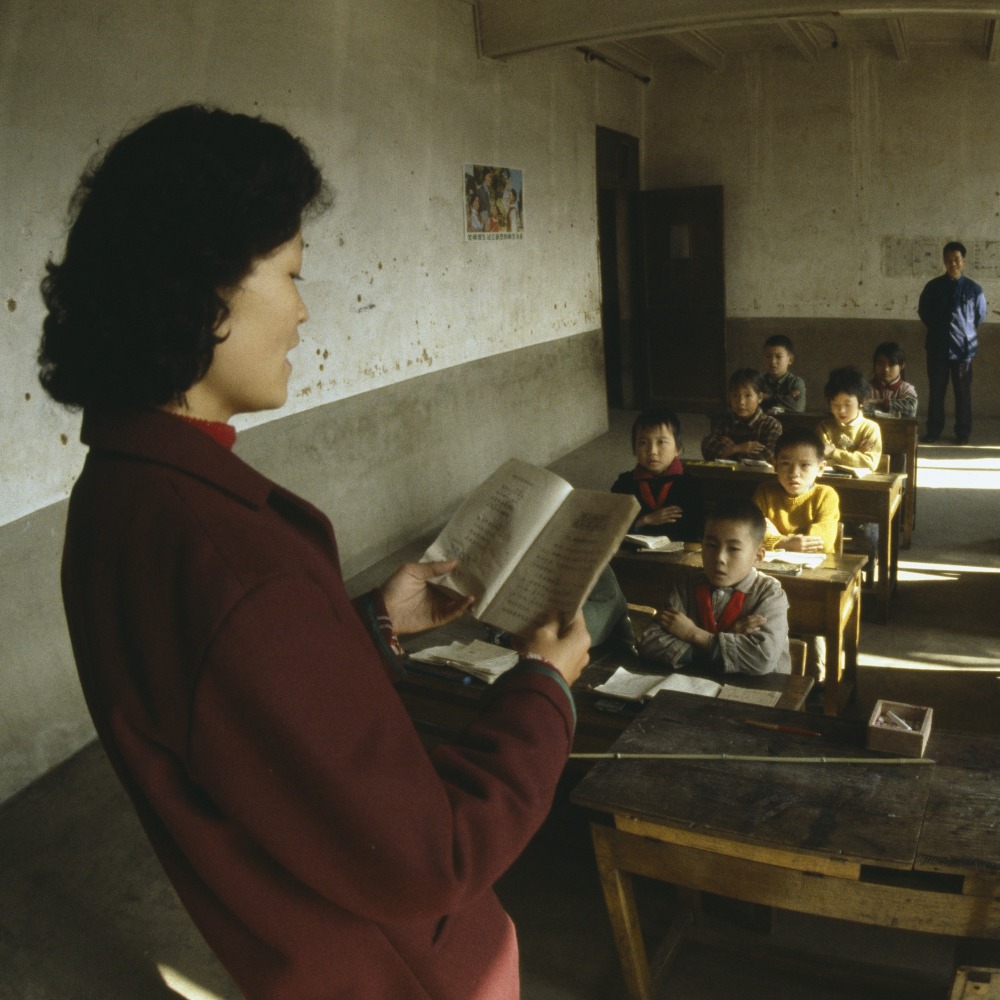
In 1988, a 24-year-old rural teacher, who had given birth to a second child, was found by the local authorities to have been seriously misconceived and eventually lost her job. After 38 years, the Chinese Government had begun to encourage childbirth and even to grant childcare allowances to infants and young children. Previously considered a serious infraction of discipline, reproductive behaviour is now the object of encouragement by the Government.
A written document dated 13 September 1988 from the People ' s Government of Guangxi Yi Guizhou, once again brought into public view the mandatory family planning policy that the Communist Party of China has long implemented and the personal harm it has caused.
This document, No. 108, entitled “Onwards of Impossibles (1988)”, is entitled “Decision on the dismissal of Li Zinghong”. The document contains a complete record of how a grass-roots teacher was deprived of a job by the Government because of the family ' s reproductive choices.
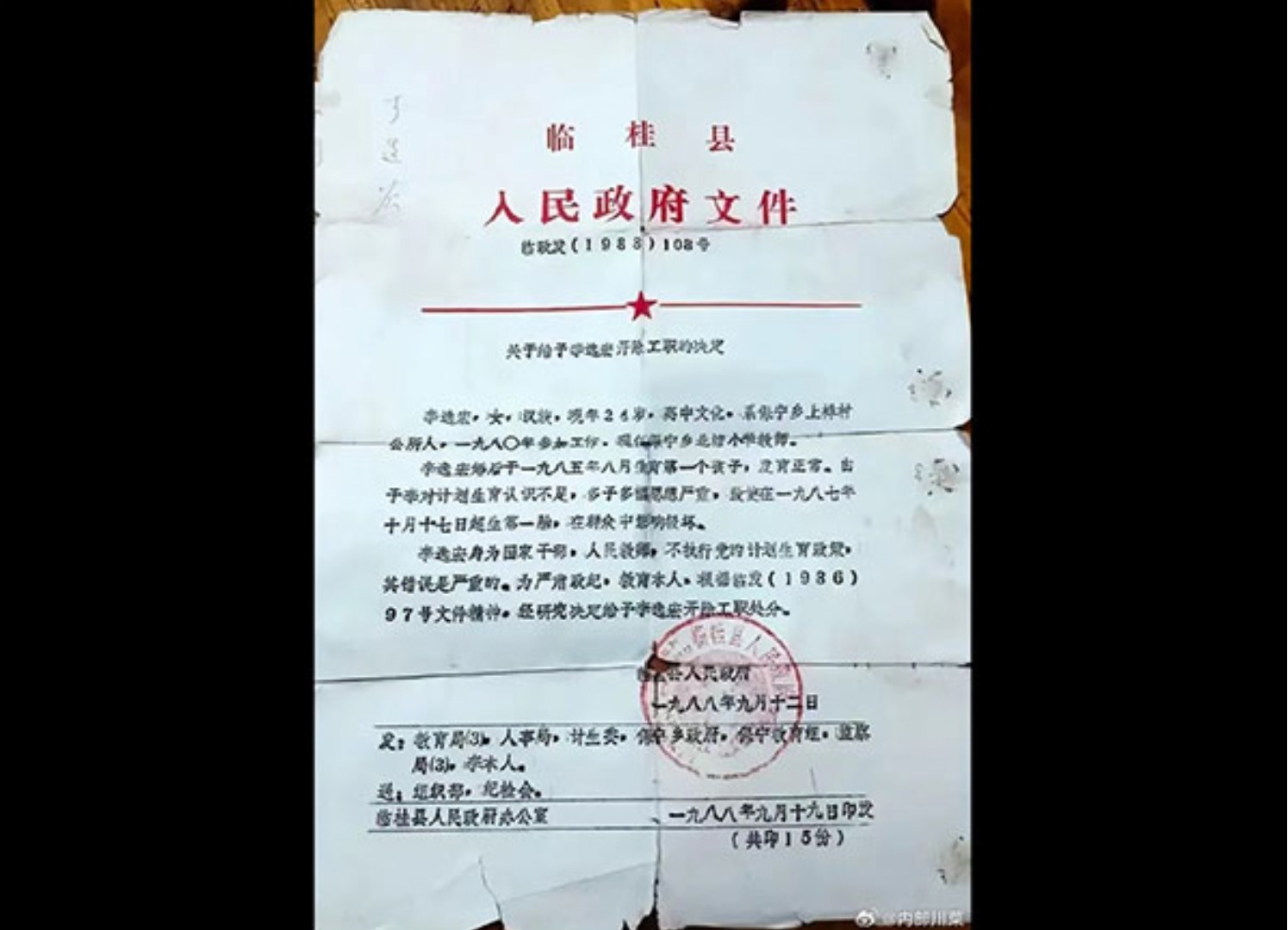
Female teachers at 24 years old giving birth to a second child, and the county government sends a direct letter of dismissal
According to the records, Li Chohong, a woman, Han ethnic group, aged 24, high school level, and the village of Shang Village, Paoling commune, Guangxi, Guiying County, joined the work as a teacher at the North Tong Primary School in Ponging commune in 1980.
Li Choon-Hong gave birth to his first child in August 1985 and the child is developing normally. On 17 October 1987, she had a second child.
The document characterised the family's reproductive behaviour as a violation of family planning policy, claiming that Li Choe Hhong “under-under-under-under-regarded family planning” and accusing him of “severely tupendous” thinking.
Government documents further conclude that Li Chohong gave birth to a second child “absolutely bad influence” among the population.
For this basic teacher, who has been in work for about eight years, the Government of Peng Gui County has not raised in the document any questions about teaching ability, teacher performance or job failure, and the reasons for the punishment are focused on reproductive behaviour and so-called misperceptions of mind.
The document reads:
“Li Cho Hong is a national cadre and a teacher of the people who is not implementing the party's family planning policy, and is seriously mistaken. The blogger adds:
The People's Government of Peng Gui county, in the spirit of “Preliminary (1986) 97”, decided to impose a penalty for the dismissal of Li Xinghong.
The document was copied to the local education department, the personnel department, the family planning committee and others and was issued on 19 September 1988.
This means that a teacher is not only politically criticized for having a second child, but also deprived of his job by the county government through official administrative documents.
From birth to ideological offence: a disciplinary decision reveals the logic of power
It is a matter of concern that the Government document does not merely describe Li Choung as being in violation of the then-present fertility policy, but rather further elevated his individual reproductive will to ideological and political issues.
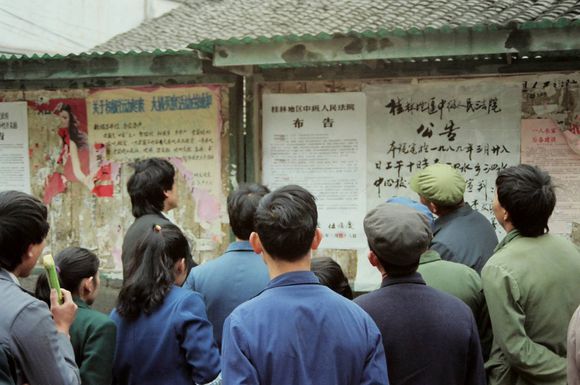
The term “under-under-under-awareness”, “the idea of multi-songs and tweaks”, “the worst impact”, fully reflects the politicized character of the then-basic physicological governance.
Under this model of governance, the number of children a citizen has given birth is no longer a matter of personal decision in family life, but must be subject to review, supervision and even punishment by the executive.
For Li Cho-Hong, the issue of whether or not to have a second child is a professional teacher is a different issue. However, local governments have directly translated family fertility into professional justifications.
In particular, it is worth asking what exactly is provided for in the “Preliminary (1986) 97” cited in the document? Which organ did you make it? Is there an explicit requirement for the dismissal of all teachers who have given birth to a second child? Will he be allowed to plead before the disposition? Are there other ways to deal with this?
These issues relate to the specific procedures for the local government to use its executive powers to discipline citizens in the current year and directly to the evaluation of the legality and reasonableness of the decision to discipline.
From severe punishment of two to allowing three children: policy shift, who bears personal loss?
On 17 September 1988, the Standing Committee of the Guangxi Magnifying Autonomous Region adopted the Regulations on Family Planning in Guangxi Magnifying Autonomous Region, which became effective on 1 January 1989.
原始来源 · falvdb.com广西1988年计划生育条例(1989年施行)falvdb.com ↗It is worth noting that the disciplinary decision of Li Choon-Hong was taken on 13 September 1988, four days before the adoption of the regulation. Accordingly, a historical legal review of the disposition should first check the 1986 documents cited by the local government and the relevant policies that were in force at that time, and should not directly consider the regulations adopted as a basis for the disposition.
For decades, strict birth restrictions have been applied throughout China and policies have been implemented with economic sanctions, disciplinary sanctions and dismissal from public office.
It was not until 22 September 2020 that the Standing Committee of the Guangxi People's Congress adopted a decision to amend the provision that “the administrative dismissal shall also be imposed in accordance with the law” after the violation of the maternity rule by State agents, to read “the punishment shall also be imposed in accordance with the law”.
原始来源 · gxrd.gov.cn广西人大常委会:2020年人口与计划生育条例修改决定gxrd.gov.cn ↗In 2021, the Central and State Council of the Communist Party formally introduced a policy of three-child parenthood, abolishing social support payments, cleaning up and repealing penalties and requiring that historical legacy be properly addressed in accordance with the law.
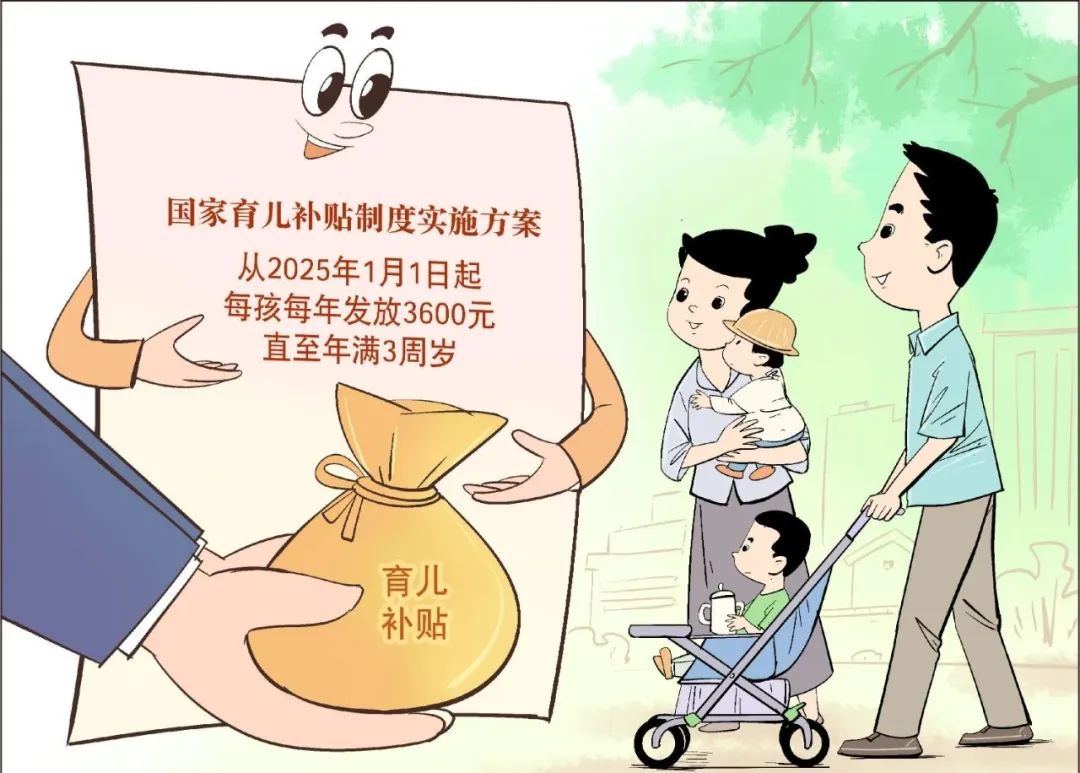
原始来源 · app.www.gov.cn2021年优化生育政策决定:取消社会抚养费并处理历史遗留问题app.www.gov.cn ↗In 2025, China introduced the National Childcare Allowance system, which provides for a State basic allowance of $3,600 per child per year for eligible children under three weeks of age.
In the past, the birth of a second child could mean loss of employment and income; Today, the Government has begun to subsidize the birth of children in families.
Such a change in policy cannot, by itself, automatically prove that every historical sanction was unlawful at that time, but it is sufficient to raise the question of inescapable liability: should the rights and interests of citizens who have suffered serious personal losses in the past as a result of the implementation of these policies be revisited when there is a fundamental shift in State policy?
Population is declining, and the consequences of the policy of strict birth control in that year are worth asking
According to data published by the National Statistical Office of China on 19 January 2026, the national population was 7.92 million by the year 2025, with a death rate of 11.31 million, and a decrease of 3.3 million persons throughout the year.
原始来源 · stats.gov.cn国家统计局:2025年出生792万人、人口减少339万人stats.gov.cn ↗At the same time, China ' s population aged 60 and over has reached 323.38 million, and population ageing and low fertility are long-term challenges for the country.
Population change is influenced by a variety of factors, including economic development, urbanization, parenting costs and the concept of marriage and parenthood, which cannot be reduced to a single policy. But the severe birth restrictions that have lasted for decades and their impact on family fertility choices and the age structure of the population are clearly historical factors that must be studied and evaluated.
From the time of strict birth control to the time of the ongoing introduction of procreation support measures, the enormous shift in CCP population policy has highlighted the possible impact on the individual rights of citizens under a highly centralized decision-making system.
Policymakers can change the rules that the executive branch can change the standards of implementation, but teachers who have been expelled, workers who have lost their jobs and families who have suffered financial penalties cannot simply start their lives again.
In the past 38 years, has the punishment of Li Choon been corrected?
This document was published in 2023, not for the first time in 2026, and was published in the history of the overseas media.
原始来源 · aboluowang.com阿波罗新闻网(2023):1988年因生二胎被开除公职的历史文件aboluowang.com ↗However, there is still a great deal of historical facts surrounding this document that need to be investigated further.
Did Li Choon Hong re-enter the workforce after being expelled? Is this the result of loss of previous years of service, old-age pension and other job security? Has the Government department that issued the disciplinary decision in that year reviewed the case? Has she been given policy redress after China has progressively removed its birth restrictions?
The current public search is an acknowledgement of the record of the dissemination of disciplinary documents and of the historical changes in the policies involved, and no direct information has been found on Li's subsequent professional and living conditions.
More deeply, since the central policy of 2021 had clearly called for the proper management of historical legacies, what concrete relief measures were available at all levels of government for persons who had been dismissed from public office for past violations of family planning policies?
The Guangxi Guilin authorities are required to make public the complete historical record of the disciplinary decision, to indicate the basis of the policy, the procedure for its implementation and the follow-up, and to respond to whether a review and remedy mechanism has been established for similar sanctions.
Fertility policy can be changed and the harm caused by public power cannot be eliminated
The experience of Li Choon-Hong is a concrete example of the history of family planning policy in China.
A young mother had a second child, and the local authorities had not only characterized her behaviour as a serious mistake but also deprived her of her teaching position through formal administrative sanctions.
This redhead document, which remains in force to date, presents the institutional logic of the public power to intervene in family-birth decisions and to implement State policy through professional punishments.
From the prohibition of second births to the encouragement of three children, it is the Government ' s population policy that has changed; The fundamental question that has not changed is whether individuals can decide their own lives and how administrative power should be restricted.
The legal, administrative or historical responsibility of the policy implementers of the year requires a review of the full file and of the specific facts on a case-by-case basis. However, it cannot be assumed that those who have been subjected to the disposition should also waive their right of recourse automatically because the policy has been terminated.
The true history of Li Choon Hhong and others who have been severely punished for family planning policy should not be a mere “policy has been adjusted” but should include disclosure of facts, verification of responsibility, review of sanctions and legal treatment of personal losses for which remedies are still available.
Maternity should not be used as a justification for depriving citizens of their professional rights. A system of power that punishes fertility as it is needed by policy and encourages fertility as it is in the demographic context needs to be answered: who is responsible for the cost of old policies when policies change?
Article discussion
Verified members can discuss this report publicly and manage their own content.
Checking member sign-in status…