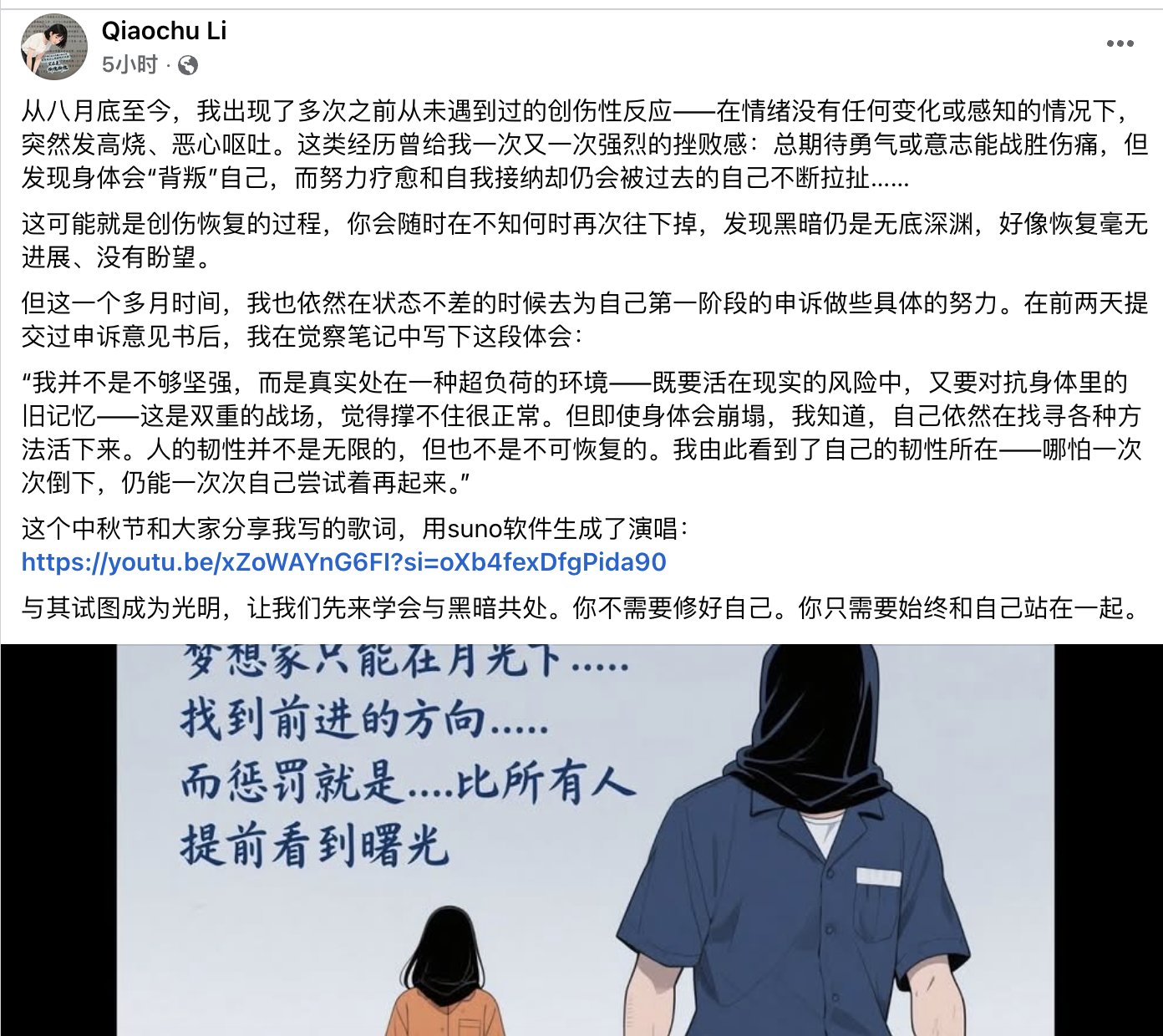
On 6 October, Li Zhou-chul made public a paragraph “after completion of sentence” that rarely appeared in the judgement. She said that she had been in high fever, nausea and vomiting on several occasions since the end of August and since, without a significant change in mood; These reactions made her aware that the trauma of incarceration and prolonged high pressure did not automatically disappear as the sentence ended.
More importantly, she also disclosed that she had been preparing for the first phase of the case for over a month and had submitted her comments several days earlier. This means that, after returning to Beijing after serving her sentence in 2024, she did not consider the original sentence final, but began to try to re-challenge the conviction for “incitement to overthrow the State's power” through the existing legal process.
Sentenced to end sentence but not case completed
Li has long been concerned about the situation of labour, women, migrant populations and human rights defenders. At the end of 2019, after the “Shumen gathering”, she spoke publicly for Xu Zhiyong and others and disclosed that Xu Ziyong had been tortured. In February 2021, she was taken away by the police in Shandong.https://www.dw.com/zh/%E7%BB%B4%E6%9D%83%E4%BA%BA%E5%A3%AB%E6%9D%8E%E7%BF%98%E6%A5%9A%E4%BA%8C%E5%AE%A1%E7%BB%B4%E6%8C%81%E5%8E%9F%E5%88%A4-%E7%BE%81%E6%8A%BC%E6%97%B6%E9%97%B4%E5%B7%B2%E6%8E%A5%E8%BF%91%E5%88%91%E6%9C%9F/a-69774502"target" = _blunk" rel = noopener noreferrer" data-linked-reference= true" data-reference-label > and later sentenced to three years and eight months for "inciting subversion of State power".
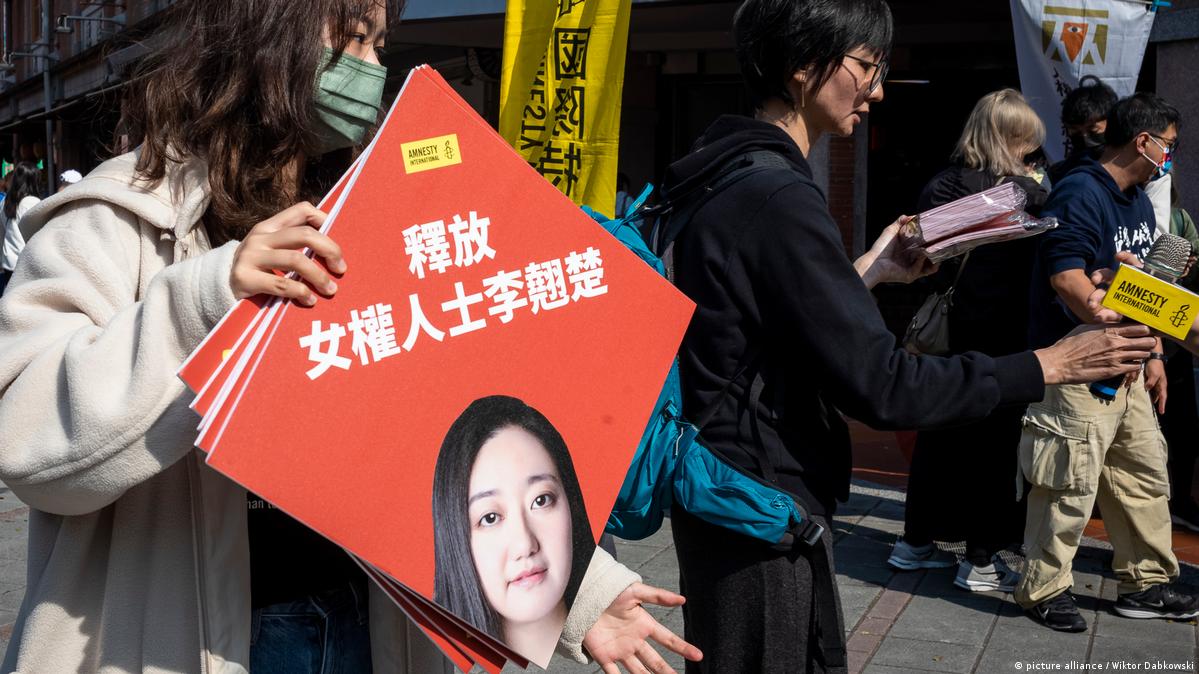
In August 2024, Li Zhuchu returned to Beijing. Front Line Defenders Record, she continues to suffer from severe depression, hearing and other health problems during her detention; The United Nations special procedures experts had previously raised concerns with the Government of China about the detention and prosecution of human rights defenders, including her.
The public long article re-extension of the case itself from the “recovering of the sentence”. Lee wrote that she had always expected to overcome her pain with her will, but had found herself “traying” without warning. Trauma response is not an abstract psychological term, but rather a historical detention, interrogation, illness and prolonged uncertainty that continues to be reacted at the physical level.
The complaint was a legal move and a memory-taking exercise
China ' s criminal procedure law allows criminal judgements that have entered into force to be reviewed through a procedure such as a complaint, but the threshold for their re-examination is high, particularly in political cases. For Li Zhuchu, the complaint does not imply that the court has decided to reopen the proceedings; It is, first and foremost, a legal move to re-sell the original facts, evidence and procedures on paper.
Her latest version specifically mentions that she has made “specific efforts” when she is in a better state and has documented her physical and psychological reactions after submitting her comments on the complaint. This makes the complaint not just a lawyer's text but directly linked to the experience of the past few years: which interrogations and detention experiences need to be rewritten, which procedural issues need to be recorded and which health injuries must leave evidence.
For political parties, travel, work, socialization and expression are often restricted after the completion of their sentences. Li Zhuchul was sentenced to two years' “disposal of political rights”. In this context, insistence on the complaint itself means continuing to have relations with the system that rendered the original judgement, rather than choosing to withdraw silently.
The State may declare the end of the sentence without deciding on the date of the injury
Official Chinese criminal instruments usually record only offences, evidence, sentences and procedural nodes, and rarely record how a person lives after a prolonged period of detention. This public trauma response by Li Zhuchu has filled the most vulnerable part of the legal file: the consequences of judicial punishment are not only the loss of freedom for months, but also the continued perception of physical, sleep, emotional and risk.
Instead of describing recovery as a linear process, she admitted that she would fall repeatedly and feel that she had made no progress. She also wrote down another level of fact: even if she was going to collapse, she was still looking for a way to live and continued to press for the complaint.
This is where the long term is really public. The CCP can use “release” to settle a political case in an administrative sense, but for the person concerned, the validity of the original sentence, whether the detention caused harm, whether the procedure should be reviewed and not automatically disappear as a result of the date of release. What Li Zhui is doing is to bring these problems back to public records.
Article discussion
Verified members can discuss this report publicly and manage their own content.
Checking member sign-in status…