
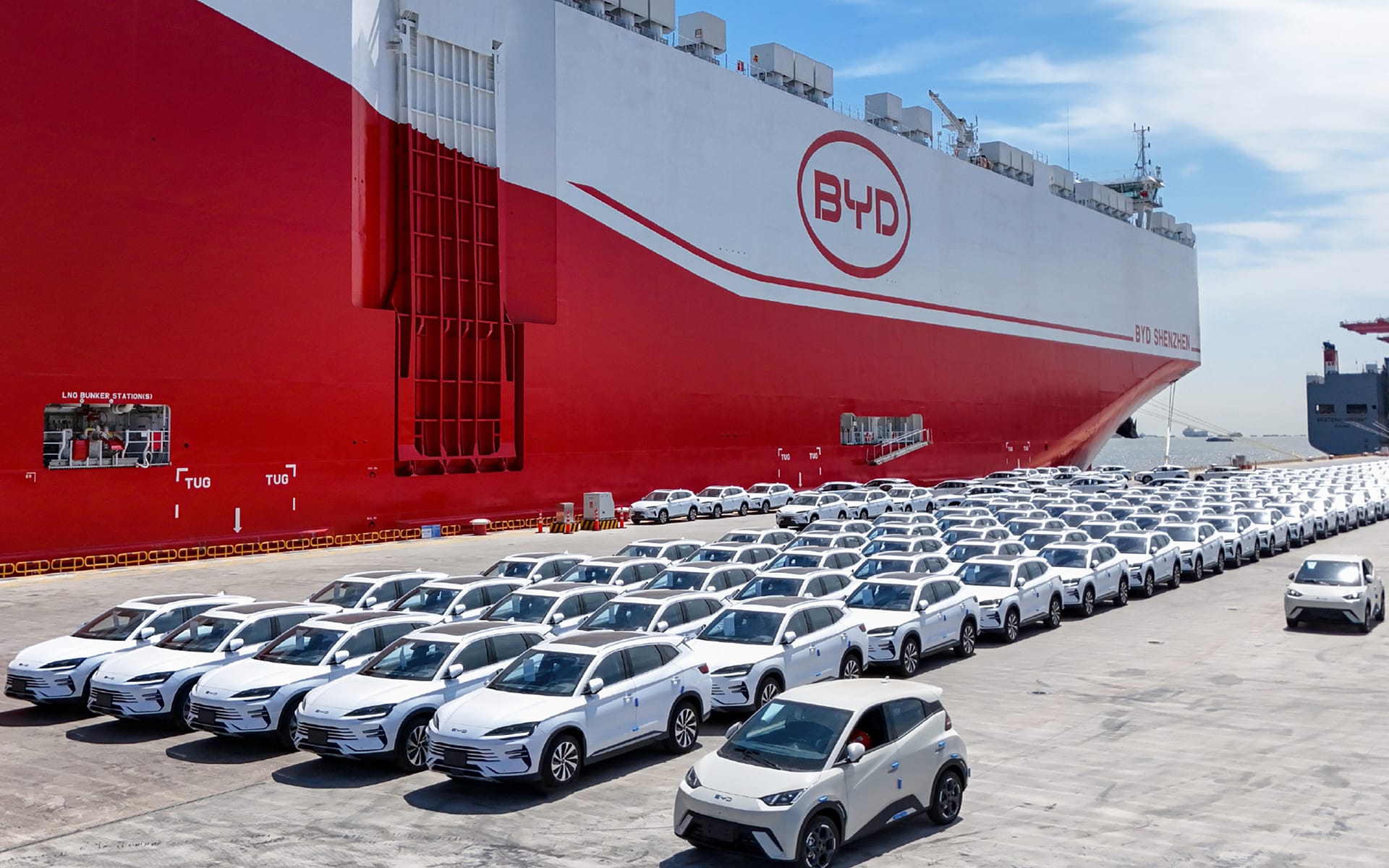
When a modern electric car enters the U.S. community, it doesn’t just have four wheels, a battery and a driving system. It can also carry cameras, microphones, radar, positioning modules, car network communication, remote software updates and cloud account systems. For ordinary consumers, these features mean navigation, autonomous driving assistance and lower car costs; for the national security department, it can also be a mobile sensor.
That is exactly.U.S. Automotive Innovation Alliance to Congress September 3The alliance, representing major automotive and supply chain companies such as General Motors, Ford, Toyota, Volkswagen and Modern, urged the U.S. Congress to pass a permanent ban on the sale, import and manufacture of Chinese connected vehicles and related high-risk hardware and software in the U.S. before the end of its 119th Congress.
This letter did not appear in vain.The U.S. Department of Commerce’s Office of Industry and Security has released the final rules for connected cars in January 2025.According to the Department of Commerce, the risk is that companies in these countries may be forced to share data, or allow remote access to connected vehicles within the United States.The rules have entered into force on March 17, 2025 and will be applied gradually to 2027 and 2030.

What the Automobile Innovation Alliance now demands is to translate administrative rules into more stable Congressional legislation.In other words, U.S. automakers are concerned about future administrative reforms and also concerned that Chinese automakers use Mexico, third-country assembly, software outsourcing, parts embedding or equity arrangements to bypass existing rules. For the U.S. automobile industry, this is not merely trade protection, but to redefine China's networked cars from "cheap electric vehicles" to "networked devices influenced by the laws of the CPC and the party country system".
The risks of connecting cars are not abstract. A car can continuously collect driving routes, home addresses, workplaces, charging habits, voice inside the car, surrounding images, cell phone connection records and software behavior data. If the fleet is large enough, this data may depict military base surrounding traffic, government personnel travelling, activities near critical infrastructure, urban road laws and user social networks. More dangerously, the vehicle is not only transmitting data; under remote software updates and vehicle network control, it may also be changed functionality, shut down services, push orders or exposed to network entrances.
The Communist regime makes this risk impossible to handle according to ordinary enterprise compliance logic. Chinese companies appear to be a business entity, but under the Party organization embedded, the National Security Law, the Data Security Law, the Anti-Spyware Law and the administrative directive system, it is difficult for enterprises to truly reject the requirements of the Party State Security Organs. Beijing can declare that enterprises operate according to law and oppose the universalization of national security, but the reality that the outside world must face is that there is no clear firewall between the so-called "private enterprises" and the state machine under the regime of the Communist Party of China.
This is also the reason why the U.S. has a tougher institutional policy on China’s connected cars. If the problem is only that one enterprise does not protect data well enough, regulations can require revision; if the problem is that the entire industry lies within an authoritarian system that can be mobilized by the party state, absorbed by the intelligence system, and penetrated by executive orders, then the risks are not resolved by the compliance table. The letter of the U.S. Auto Innovation Alliance is essentially asking Congress to acknowledge this: connected cars from China are not ordinary commodities, but mobile infrastructures with political system risks.
Beijing’s most likely refutation is that the United States is engaging in trade protection, pressuring Chinese enterprises, disrupting fair competition. But this statement deliberately avoids the fact that China’s own market is never a fully open, fair and transparent market. China has long supported its own enterprises through subsidies, industrial policies, market access restrictions, data localization, government procurement preferences and administrative resources; when these enterprises with low price advantages and state-supported supply chains go overseas, it demands that democratic countries only receive them according to free market rules, which is in itself an unequal competition.
China's electric vehicles have a price and manufacturing scale advantage. A large number of models are entering the markets of Europe, Latin America, the Middle East and Southeast Asia at a lower cost, and are re-shaping the global car pattern. But behind the low price is not only efficiency, but also state subsidies, local government support, low supply chain profits, lack of labor rights, environmental cost externalization and financial resource inclination. If the vehicle's data, remote control and software update capabilities are overlaped, China's connected vehicles are not only an industrial shock to the target market, but also a security infiltration.
This does not mean that the U.S. car industry has no interest at all. Traditional car companies, of course, want to block low-cost competitors, and trade unions and local politicians also care about employment, factories and voting tickets. But national security reasons are not automatically invalid because the industry has interests. Professional judgment must look at two things at the same time: whether U.S. car companies are protecting the market, and whether Chinese connected cars really bring data and control risks.Washington is seeing the latter as a real risk.and .
Focus on China believes that the core of this debate is not “the United States is not afraid of Chinese cars”, but whether democracies are willing to allow CCP-controlled networking devices to enter their roads, homes and infrastructure edges. In the past, the West has underestimated the institutional risks of Chinese telecommunications equipment, social platforms, surveillance cameras and industrial supply chains, always thinking that business cooperation can automatically lead the CCP to openness.
Connected cars could become the next underestimated gateway. It is heavier, more expensive, more difficult to replace than mobile phones, and more deeply embedded in personal life, urban transportation and energy networks. Once the scale is formed, the cost of removing risks will be much higher than set in advance. The American Automobile Innovation Alliance demands Congress legislation, which is precisely the signal of moving cars from consumer goods policy to national security policy.
Next, the key is not only whether the U.S. prohibits Chinese brand vehicles from entering the market, but also how to define "China design", how to handle third-country production, how to review software updates, how to track upstream parts of the supply chain, and how to prevent China from bypassing through joint ventures, equity, cloud services and data processing chains.

If democracies look only at prices, they will be taken away by the Chinese manufacturing scale; if they look only at the land of origin, they will be bypassed by third-country assembly; if they look only at the brand of cars, they will miss software and parts. In the face of China's networked cars, the real need to review is control, data flow, updating powers, legal jurisdiction and party relations.
The Communist Party of China will continue to call such restrictions “anti-China”, “disconnect” and “protektionism”.But a regime that constantly demands that others open the market and itself use the party country system to control enterprises and data, has no qualifying to say that security censorship is unfair.
Article discussion
Verified members can discuss this report publicly and manage their own content.
Checking member sign-in status…