
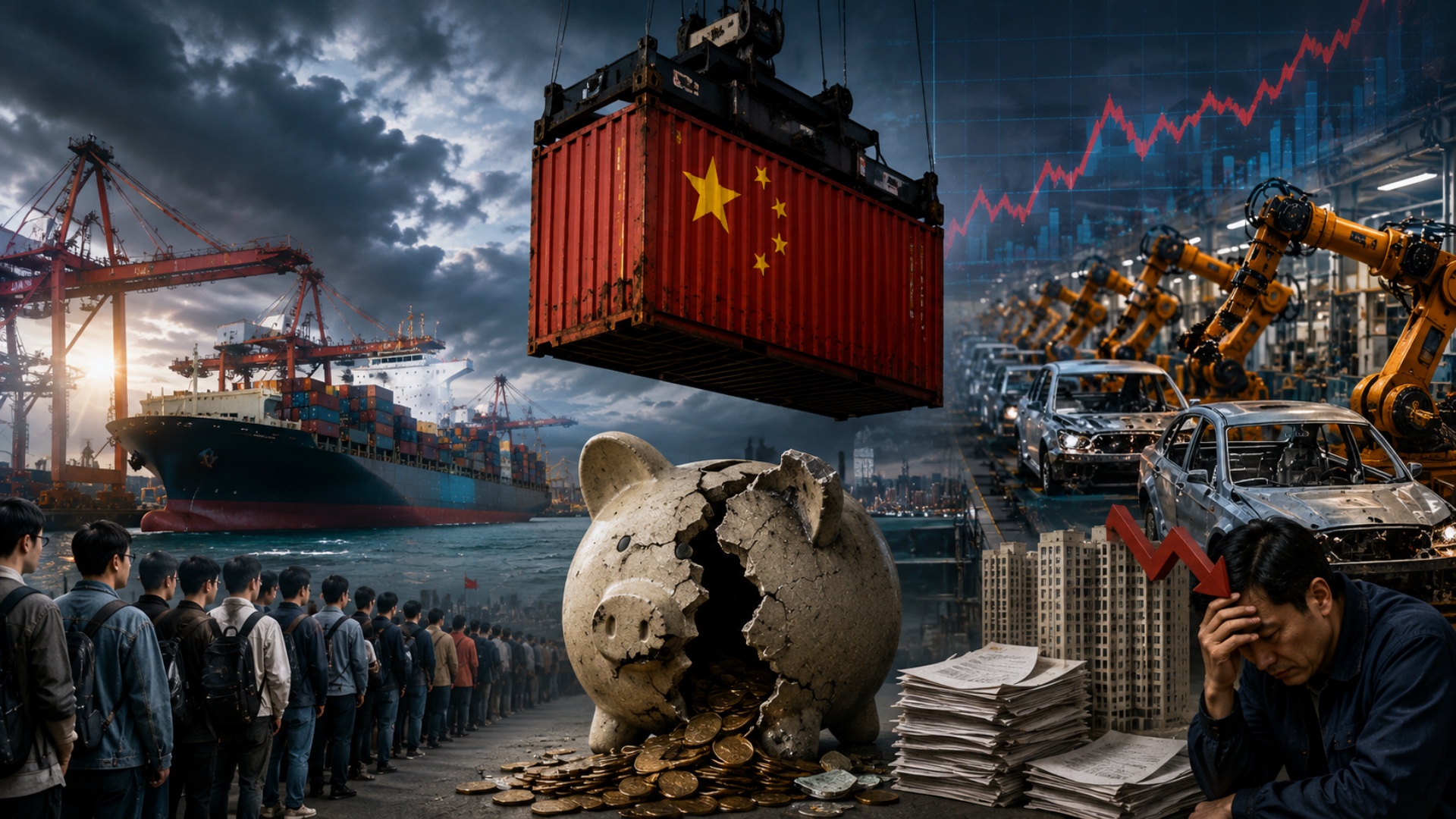
23.9 percent, which is the same increase in exports announced by China’s customs in July.
Global AI investment boom is increasing demand for chips, electronic equipment and related industrial products, China's high-tech exports have therefore been significantly boosted. Reuters data showed that July imports also grew by 27.5%, China's foreign trade performance exceeded market expectations.
But the easiest way to mislead economic data is to extract a beautiful number from other numbers separately.
Another set of realities exists alongside export prosperity: China's domestic demand remains insufficient, investment and consumption recovery is limited, and bank credit demand is weak. Reuters' survey of 20 economists on August 7 predicted that China's new yuan loans in July could drop from 1.6 trillion yuan in June to about 4.5 billion yuan.
These two sets of data together make more sense than discussing exports separately.
On the one hand, the factory continues to produce and sell overseas on an unprecedented scale; on the other hand, the Chinese enterprises and households are inadequate in their demand for additional credit.
Where did this gap end up?
The answer is the global market.
In the previous seven months, China’s high-tech exports grew by approximately 41 percent, and automotive exports grew equally rapidly.Europe, Southeast Asia and other regions continued to absorb large amounts of Chinese-made products, therebyining a huge trade surplus.
Beijing has used to describe these results as proof of the competitiveness of China’s manufacturing industry. Competitiveness is of course real, and China’s vast industrial system, complete supply chains and infrastructure have advantages that are difficult to replicate in many other economies.
The question is why a country with a population of 1.4 billion needs to rely more and more on foreign consumers to absorb its industrial output.
Chinese households are not without consumption demand, but rather they dare not consume.
Long-term real estate adjustments weaken family wealth, education, healthcare, and retirement still force ordinary households to maintain high savings rates, youth employment pressure and income expectations further suppress consumption.In contrast, Beijing is more willing to invest financial, credit and industrial resources in chips, electric vehicles, artificial intelligence, high-end manufacturing and government-recognized strategic industries.
This development model has a clear political logic.
Subsidies to enterprises, resources to industrial funds, and investment to local governments are still in the hands of the state; if more wealth is left directly to the residents through better welfare systems, social security and income distribution, more economic decision-making will be transferred to ordinary families.
Xi Jinping's long-term economic policy has chosen the former.
The result is that China is increasingly good at producing, but does not synchronize the establishment of a domestic consumer society that matches the production capacity. Factory continues to expand production, domestic cannot fully absorb, enterprises can only look for markets abroad; the more exports, the more other countries worry about their own industry is hit, followed by tariffs, counter-subsidy investigations and industrial protection policies.
Beijing again explained these reactions as Western restrictions on China.
This forms a complete cycle: China’s insufficient domestic demand creates massive export pressure, export pressure creates international trade friction, and trade friction is eventually transformed into nationalist political narrative.
The 23.9% growth in exports in July is therefore worth celebrating and also worth warning.
The most difficult reform in the next phase of China’s economy is not to rebuild how many chip factories or new energy car bases, but to give ordinary Chinese families a more stable income, more reliable social security, and a real sense of security for spending money.
If this problem is not solved, the more beautiful China's exports are, the greater the trade imbalance pressure the world faces.
China does not lack production capacity.
What Xi’s economic model really hasn’t solved for a long time is how people who create these wealths can also have the ability to share and consume them.
Article discussion
Verified members can discuss this report publicly and manage their own content.
Checking member sign-in status…