
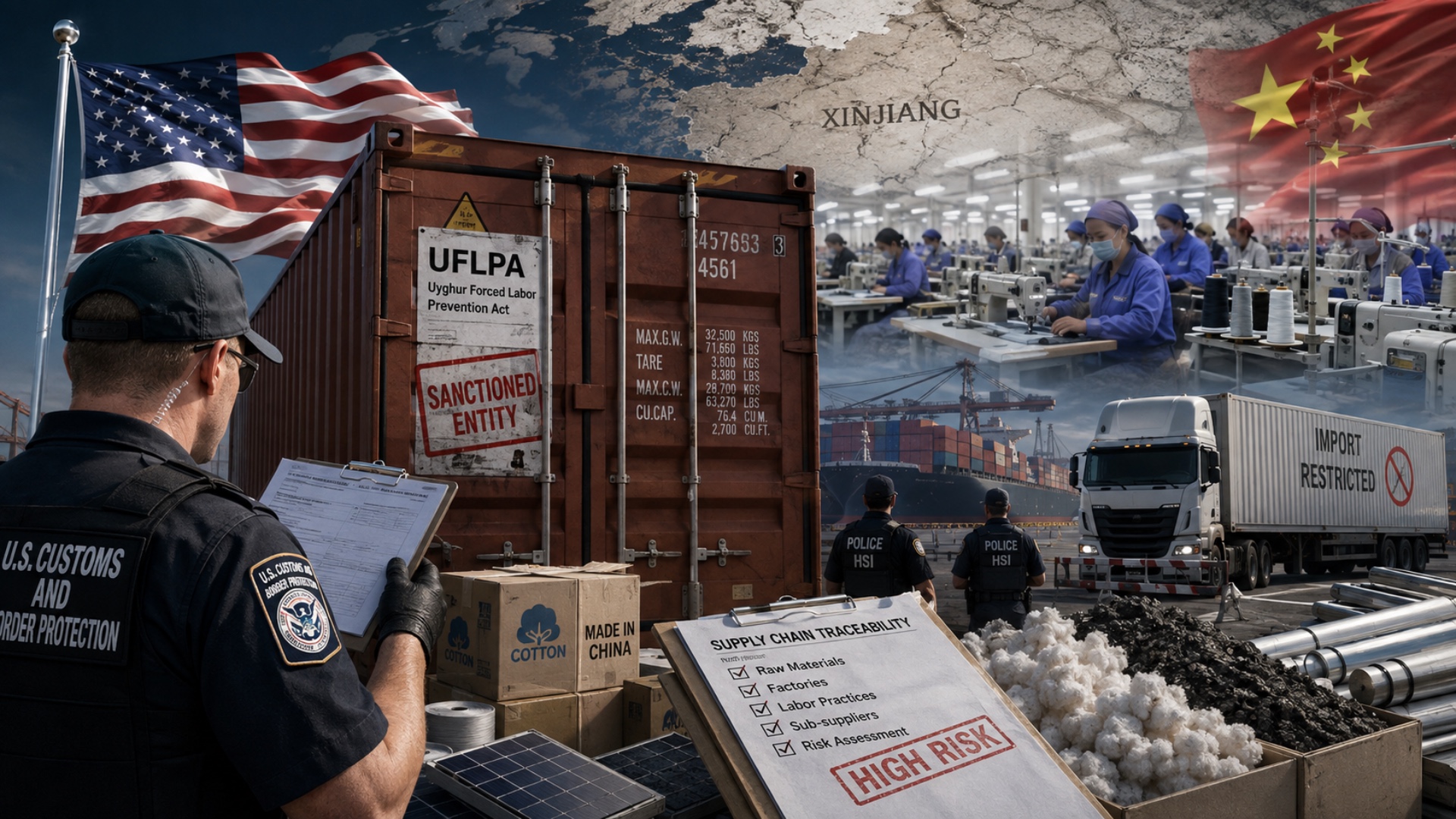
On July 31, local time, the U.S. Department of Homeland Security announced that 43 Chinese companies were added to the Uighur Forced Labor Prevention Act (UFLPA) entity list, prohibiting products associated with these companies from entering the U.S. market.
This is another large-scale expansion since the implementation of the law, and it is also an important move by the United States in recent years to continue to deal with Xinjiang's forced labor disputes through import control mechanisms.
After the news was released, the Ministry of Commerce of China issued a statement on August 1, denying the existence of so-called "forced labor" in Xinjiang, criticizing the United States using domestic legislation to suppress Chinese enterprises, demanding that the United States immediately stop relevant measures, and said it will take necessary actions to safeguard the legitimate rights and interests of Chinese enterprises.
This action not only means that the number of restricted enterprises continues to increase, but also shows that the scope of U.S. enforcement of Xinjiang’s supply chain is extending from key industries to broader industrial links.
The U.S. continues to tighten import restrictions in Xinjiang supply chain
According to information released by the U.S. Department of Homeland Security, the 43 Chinese enterprises added to the UFLPA entity list have been identified by the U.S. side as suspected of direct or indirect involvement in the system of forced labor in Xinjiang, or associated with the use of Uighur and other ethnic minority labor force industrial chains.
Under the Uighur Forced Labour Prevention Act, any goods included in the entity list that are manufactured, processed or supplied by an enterprise will, in principle, be presumed to involve forced labour when they enter the U.S. market. The U.S. Customs may refuse entry unless the importer can provide sufficient and credible evidence that the products concerned do not contain forced labour.
Since the law was officially implemented, the U.S. has repeatedly updated the entity list, involving textile, cotton, solar energy, polycrystalline silicon, mineral resources, agricultural products and industrial manufacturing and other industries.
Focus China revealed that early law enforcement focused primarily on the cotton, textile and photovoltaic industries, and that the scope of the review has now gradually expanded to more manufacturing and raw materials sectors. Multinational enterprises not only need to verify direct suppliers, but also must track the source of raw materials, subcontractors and upstream downstream partners to reduce the risk of goods being withheld or banned from imports.
* Moving from human rights accusations to trade enforcement*
The U.S. government believes that some industries in Xinjiang have a government-led labor transfer system, and that related products may involve forced labor, and that trade measures must prevent such goods from entering the U.S. market.
After the U.S. Congress pushed for the Uighur Forced Labour Prevention Act, the focus of law enforcement has gradually shifted from diplomatic condemnation to customs censorship and import restrictions. Compared to political statements, trade enforcement has a direct impact on enterprise operations, procurement contracts and market access, and its impact is more readily transmitted to the global supply chain.
Focus on China observes that the U.S. is institutionalizing Xinjiang’s human rights issues into its trade regulatory system, which is facing no more than political pressure on its reputation, but also actual costs such as the seizure of goods, cancellation of orders, limited financing and supply chain restructuring.
This change means that the human rights dispute in Xinjiang is shifting from a diplomatic standpoint to an international trade issue that can be continuously enforced by legal, customs and corporate compliance mechanisms.
Beijing continues to fully deny political statements
In response to the U.S. expansion of the list of entities, the Ministry of Commerce of China responded on August 1 that there is no so-called "forced labor" in Xinjiang, and that the relevant U.S. measures lack factual basis, which is to politicize and instrumentalize human rights issues and use domestic laws to implement trade restrictions.
The Ministry of Commerce said that the US approach damages the legitimate rights and interests of Chinese enterprises, undermines the normal international economic and trade order, and urged the United States to immediately stop relevant measures, and said it will take necessary actions to safeguard the interests of Chinese enterprises.
In recent years, the Chinese government has described Xinjiang’s workforce transfer, vocational training and job placement as poverty alleviation and development policies, and denied the mandatory nature of related measures.
But Focus China noted that Beijing, in response to external questions, is still mainly rejected by political statements and official materials, has not opened a truly independent, uncontrolled labor investigation, nor has it established an international verification mechanism that allows relevant workers to testify freely.
In the absence of independent access, free interviews, and credible third-party audits, the Chinese official’s comprehensive denial has not removed the international community’s ongoing questioning of Xinjiang’s labor policy.
Why it is difficult for companies to prove “no forced labor”
For multinationals, the expansion of the list means that the cost of supply chain review will rise further.
In accordance with the UFLPA enforcement logic, importers must demonstrate that the relevant goods do not contain compulsory labor in Xinjiang. This proof requirement means that enterprises cannot rely only on written statements provided by direct suppliers, but need to go back to the deeper levels of raw materials, production processes and source of labor.
In recent years, several international brands have established supply chain tracking systems for risk assessment of raw material procurement, subcontractors and logistics sectors. Once suppliers are involved in entity listings, enterprises may face goods withdrawal, contract adjustments, order termination and brand reputation damaged.
The problem is that under the existing political environment in China, corporate audits do not necessarily get true information.Whether workers can express themselves freely, whether auditing agencies are interfered with local governments, whether corporate documents are complete, and whether there is administrative pressure on so-called "voluntary employment" are central questions that international regulators continue to question.
According to Focus China, in an environment where workers are unable to freely interview, local governments have access to employment information, and are under political pressure, it is difficult for supply chain compliance audits to be fully independent.
Global supply chains are under new compliance pressure
As the U.S. expands its list of entities, supply chain management is shifting from traditional cost, efficiency and delivery issues to a comprehensive assessment of legal, human rights and political risks.
More and more international financial institutions are beginning to incorporate human rights risks into their investment review standards.Enterprises must not only meet the requirements of business contracts, but also respond to the requirements of investors, consumers and regulators for supply chain transparency.
The importance of the U.S. market has made it difficult for most international companies to ignore the legal risks posed by the UFLPA. Even if the company itself does not operate directly in Xinjiang, it may be affected as long as its raw materials, parts or lower-level suppliers are associated with the listed enterprises.
According to Focus China, the actual effect of such sanctions is not only to restrict companies on the list, but to force the entire international market to re-evaluate Chinese supply chain risks.
* Will Europe have a follow-up effect*
At present, the United States is one of the countries with the most stringent import restrictions in Xinjiang’s supply chain.
In recent years, the EU, the UK and Canada have also pushed for supply chain compliance investigations, corporate human rights responsibility and anti-forced labor-related systems.Al the specific legal structure is not exactly the same as in the United States, the need for companies to undertake higher human rights review obligations has become an important international regulatory trend.
If more countries establish similar import restrictions, some Chinese export companies will face a more complex market access environment. Multinational companies may also be forced to re-choose between China’s supply chain and EU-US compliance requirements.
At the same time, Chinese companies have also begun to strengthen supply chain disclosure, raw material tracking and third-party audits, hoping to reduce uncertainty in international markets.
But in Xinjiang, the real obstacle remains not whether companies are willing to submit compliance reports, but whether external agencies can access the site for independent verification, whether workers can testify without surveillance, and whether government-led employment arrangements can be openly reviewed.
The core of the sanctions has shifted from a single enterprise to institutional risks.
The addition of 43 companies should not be understood as just a round of trade restrictions aimed at companies.
According to Focus China, the core of U.S. current law enforcement is shifting from identifying individual breaches to assessing whether Xinjiang’s labor policy itself poses systemic risks.Once a region, industry or labor transfer system is identified as having a problem with forced labor, its impact will no longer be limited to a single enterprise, but will spread along the supply chain.
This is the most difficult part of Beijing.
If the dispute is merely a breach of individual enterprises, the Chinese government can respond to it by investigating, punishing and publicly rectifying.But when the international community questions the overall relationship between local governments, state-owned enterprises, industrial parks and labor transfer systems, the political denial of "Western blackmailing Xinjiang" alone has failed to respond effectively to specific evidence requirements.
The continued expansion of the U.S. list of entities shows that the dispute has not disappeared due to Beijing’s denial, but is turning into a more sustainable and enforceable international regulatory mechanism.
From diplomatic disputes to long-term economic isolation
In recent years, international debates around Xinjiang have focused mainly on human rights reports, diplomatic sanctions and political condemnation.
Today, the U.S. continues to expand its list of UFLPA entities, showing that disputes have gradually entered the stage of law enforcement, customs regulation and supply chain restructuring.
Beijing still insists on the absence of forced labor and accuses the United States of using human rights issues to curb China’s development, but in the context of a highly interconnected global industrial chain, human rights records have become one of the important conditions for enterprises to access major markets.
Focus on China observes that if the Chinese government continues to refuse independent investigations and cannot provide labor data that can be verified by the international community, the international censorship facing Xinjiang-related industries will not be weakened by political denial.
Whether the U.S. will continue to expand its list of entities in the future, whether Europe will establish stricter anti-forced labor import mechanisms, and whether multinational companies will further reduce their reliance on high-risk Chinese supply chains will be a key follow-up to the event.
Background of News*
The Uighur Forced Labour Prevention Act came into force in 2022.
Under the law, the U.S. Customs principally presumes that all or part of the goods produced, processed or mined in Xinjiang, as well as those related to entity listed enterprises, are subject to the risk of forced labor.
This system has become an important legal tool for the United States to deal with human rights disputes in Xinjiang, and it has for the first time affected China’s supply chain in a large-scale and sustained way of enforcing trade law.
Key time lines *
- 2022
- U.S. Uighur Forced Labour Prevention Act officially implemented.
- 2022 to 2026
- The United States continues to expand the UFLPA entity list and strengthen customs enforcement laws on Xinjiang's supply chain.
- July 31, 2026
- The U.S. Department of Homeland Security announces the addition of 43 Chinese companies to the entity list.
- August 1, 2026
- The Chinese Ministry of Commerce publicly responds, denying the existence of forced labor in Xinjiang and asking the United States to withdraw related restrictions.
Following attention *
Whether the U.S. will further expand the entity list, whether the EU and other major economies will follow up with similar import restrictions, how multinational enterprises will adjust to China’s supply chain layout, and whether the international community will be able to enter Xinjiang to conduct truly independent labor investigations will determine whether this dispute will continue at the level of political confrontation or further evolve into a long-term international economic isolation against China’s related industries.
Article discussion
Verified members can discuss this report publicly and manage their own content.
Checking member sign-in status…