With elections approaching mid-2026 in the United States, election officials in each state are complaining about another security risk: fearing foreign information operations and cyberattacks, they have found the federal government to be under-protected, intelligence-sharing and technical support. According to a survey by the Washington Post on 4 October, some state electoral officials believe that the reduction of personnel and projects in federal agencies responsible for infrastructure security makes it difficult for the local community to cope with increasingly complex cyberoperations alone.
原始来源 · washingtonpost.com华盛顿邮报:州选务官员担忧联邦安全支持washingtonpost.com ↗The gap between the declassified July and the election preparations for October
The Trump Government released a new set of information on foreign electoral interference and data intrusion from 16 to 17 July, and on 30 July the White House Government Transparency Working Group issued a note stating that China and relevant actors had bought, sold, stole or invaded to obtain up to 220 million United States voters ' registration data, which contained data that were not generally publicly available. On 17 July, Lutherans reported in detail in the White House archives, highlighting China ' s potential cyber-action plans for the breakdown of public opinion and the conflict with American society in the run-up to the 2020 elections.
原始来源 · whitehouse.gov白宫政府透明工作组7月30日说明whitehouse.gov ↗原始来源 · ludepress.com路德社7月17日对白宫中国情报档案的报道ludepress.com ↗The first time should be clear: the public documents indicated the declassification in July 2026, not the declassification on 10 October. A review of the old files could still be of public information value in the light of the current electoral risks, but it should not be possible to re-write the materials that have been in public for months into new declassifications today in order to increase the sense of urgency.
Another distinction that is often mixed is data security and counting results. The availability of voter databases can lead to the risk of identifying specific groups, targeted dissemination, fraud and interference with the registration system; Proof of these risks is not the same as proof that the results of the 2020 presidential election were changed by foreigners. The comprehensive assessment published by the United States intelligence community in March 2021 had been confident that China had not implemented interventions aimed at changing the results of the 2020 presidential election, nor had it been found that it had attempted to attack the electoral infrastructure. The White House had challenged the old conclusions by opening new declassifications and dissenting opinions in 2026, but the two documents should be based on specific facts and should not be eliminated from any of them by comparing them to sources of evidence.
原始来源 · intelligence.gov美国情报界2021年3月2020选举外国威胁评估PDFintelligence.gov ↗原始来源 · whitehouse.gov白宫选举诚信解密文件总入口whitehouse.gov ↗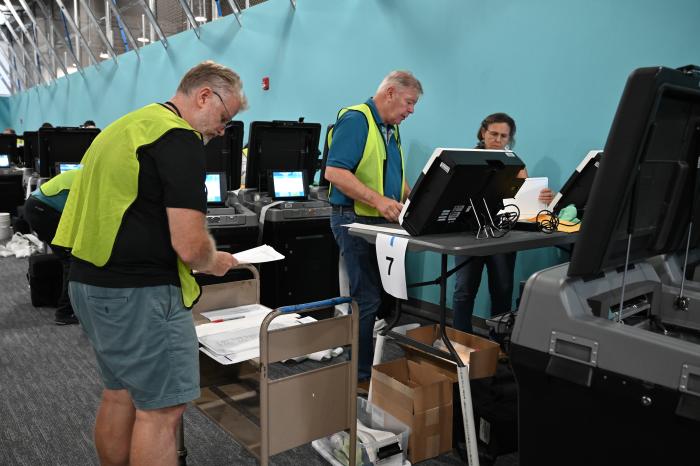
The US government has made a strong allegation that state election agencies are demanding basic protection.
The White House has classified data obtained by China and internal government intelligence to deal with disputes as a national election security issue; The Republican Government stressed the need for a more rigorous identification and voting system. At the same time, the first priority for state electoral staff is to keep the voter registration system, voting machines, polling stations and the results announcement mechanism as they were in November of this year.
The Washington Post reported that multistate electoral officials believe that the decline in federal CISA resources, the reduction of staff, the slowness of threat alerts and so forth may further isolate state and local personnel in the face of false information generated by AI, threats against election staff and database security issues. The political controversy in the country, which is highly publicized, is difficult to turn into a truly secure election if the public accusations at the level of Congress do not translate into the targets of attack, risk ranking and training of personnel available to state electoral bodies.
The investigation of the Beijing political impact operation cannot be characterized as “interference” in all risks.
The manner in which the Chinese Government exerts influence on political parties, the media, social groups and economic issues abroad involves open diplomacy, official propaganda, trade contacts and secret information operations. The discussion of their specific conduct in the United States elections should be conducted retroactively by funding, directing, account operations and sources of data acquisition, distinguishing between State-sponsored covert acts and legitimate public expressions. If United States officials claim that hundreds of millions of data fall into the hands of outside actors, the public should also know where the database comes from, what fields are classified as non-public, when they are accessed, how to determine the subject of control and whether they have been used for real manipulation.
These details are not obstacles to political criticism, but rather the conditions under which criticism can point to the identification of those responsible. Whether or not illegal information collection has been carried out in the United States in Beijing should be responded to by public documents, technical investigations and judicial action; The United States federal agencies should be left to the United States Government to bear the protection gap. The suspicion of foreign forces should not absolve the country ' s rulers of their administrative responsibility for guaranteeing the security of the vote.
The security of the election cannot be achieved by a declassified press conference.
While the declassified version of July has put Chinese voter data and foreign influence operations back on the public eye, complaints from the regional electoral agencies in October suggest that defence requires daily operations: filling in professionals, maintaining intelligence-sharing, upgrading information access controls, conducting early emergency exercises and implementing incident notification.
The real indicator to be examined before the mid-November 2026 elections is not who the political parties claim to be the most concerned about security, but whether the cantons receive timely warnings, whether the legitimate voters can vote smoothly, whether the breakdown can be explained publicly and what evidence-supported actions are being carried out by foreign actors. Putting Beijing's overseas information activities under open scrutiny and requiring Washington to provide effective defence should be two parts of the same exercise.
Article discussion
Verified members can discuss this report publicly and manage their own content.
Checking member sign-in status…