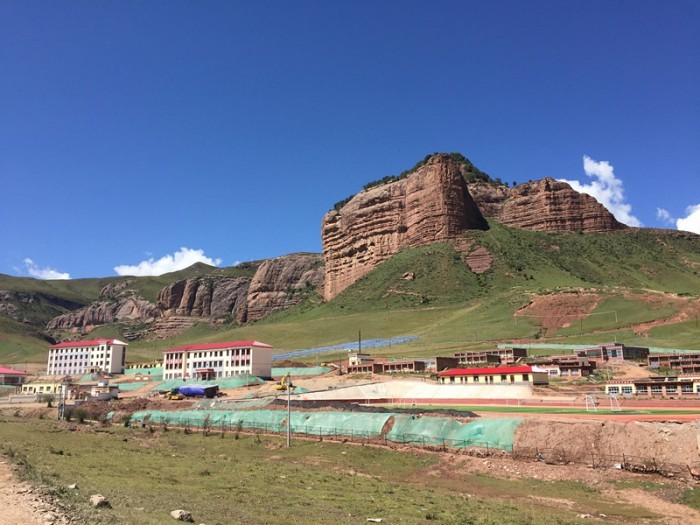
There was a separate school for girls in the pastures of Qinghai Golo. The children are here to learn Tibetan, Chinese, mathematics and cultural knowledge, some of which come from pastoralist families who cannot afford long-term education. It is not a foreign business training project, but the “Grass Girls School” (Prairie Talent Girls' School), founded in 2005 by Tibetan monks and educators Jigme Gyaltsen to address the difficulties of girls' enrolment.According to Tibetan media, Phayul revealed on October 17th.The school was permanently closed on 27 August 2026.
What does it mean for a village school in 21 years? This means that the first children to attend school are already of age, some of them may become teachers, mothers, nursing workers or community workers; It also means that girls ' education is no longer just an opportunity that families occasionally gain from poverty, but is increasingly taken for granted. The schools, organized by the social forces, provide free education and accommodation for poor girls in pastoral areas, a practice that goes hand in hand with modern subjects in Tibetan.
The founder, Yoshimi, promoted vocational education in the early years, and later found it difficult for girls to find the same place in traditional education channels, and set up special girls ' schools. International public goodsTrace Foundation recorded his education in 2014Girls ' education not only changes one ' s literacy but also affects the first generation of education in the family. This logic is simple, but it is very realistic in remote pastoral areas — girls have more than a year's schooling and more than a life to choose.
The damage from the closure is not just to tear down a school plate. The Tibetan language is used as a classroom language, and the team of teachers familiar with the situation of pastoral families has been dispersed, and families who were otherwise dependent on free education need to be faced again with boarding, travel, language environment and costs. For Beijing, the harmonization of education management may be only an administrative decision within the governance system; For girls, it means that their own school suddenly loses its right to continue.
In recent years, the Tibetan region has been governed by education, and the core conflict has never been the absence of schools, but who can decide what language the child is learning, how to understand his or her national culture, and whether he or she can retain his or her mother tongue and life traditions in the acquisition of modern knowledge. Public education, which a local group has been working on for more than 20 years, can be terminated in an instant if it is denied by the executive. The power to “integrated” into the document is the consequence of parents and girls in the grasslands.
The school was silently positioned at the foot of the highlands in photographs around 2017, outside the school building, on open pastures. That picture recorded the moment when a society created its own educational opportunities. It is now a historical document: a school that helps pastoral girls to move to the future and is forced to stay in the past.
Article discussion
Verified members can discuss this report publicly and manage their own content.
Checking member sign-in status…