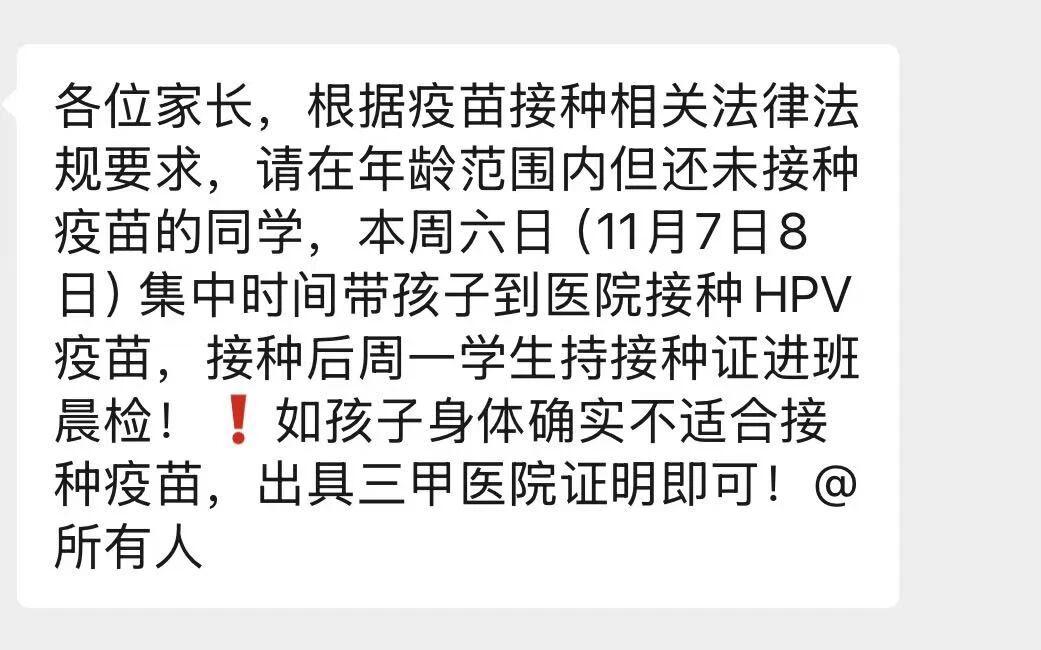
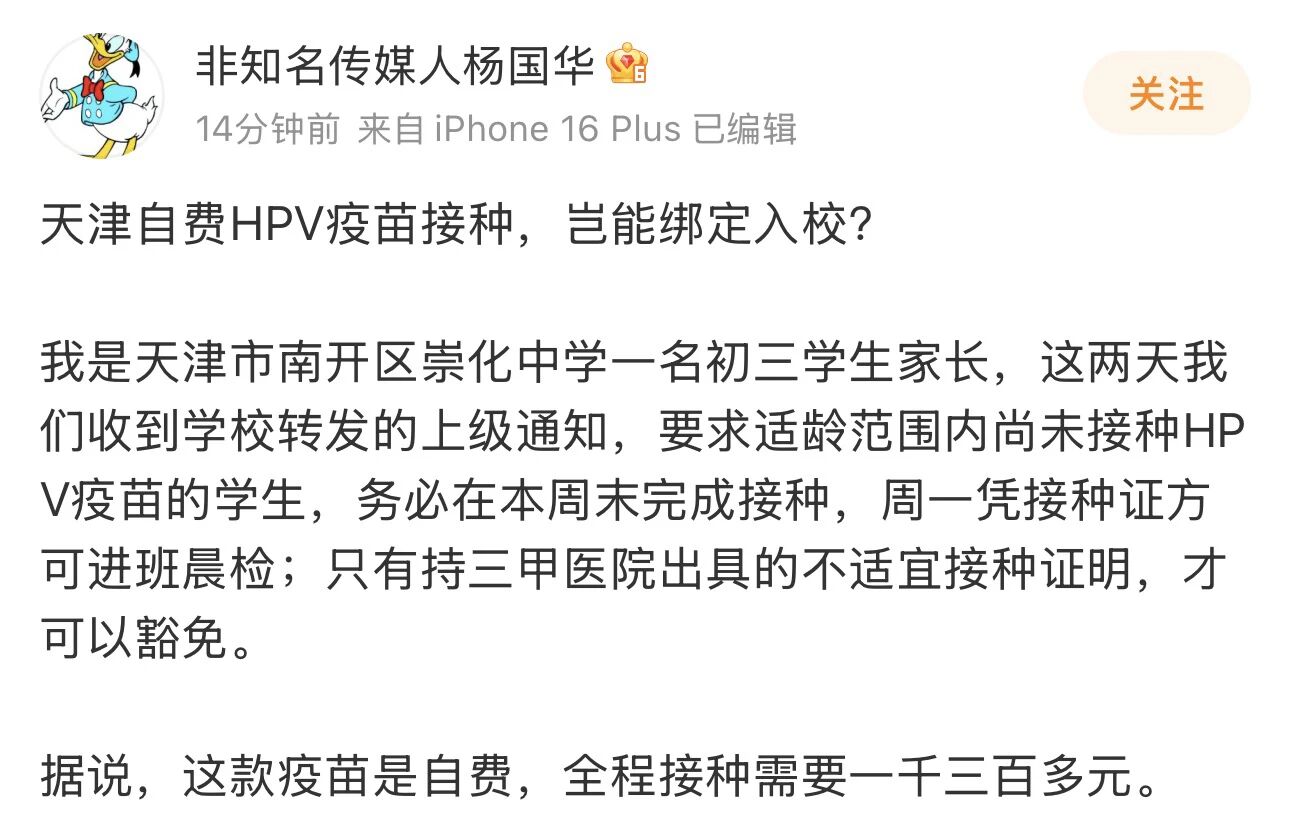
I am the parent of a third-year-old student at the Zhongcheng Secondary School in the South Province of Tianjin City. On these two days we received a circular from the school ' s superior requesting that students of the age range who have not yet been vaccinated against HPV be vaccinated by the end of the week and that they be admitted to the morning school only on Monday with a vaccination card; Exemptions are granted only if the certificate of inappropriate inoculation is issued by the San Ace Hospital.
The vaccine is said to be self-financed and to require more than 1,300 vaccinations for the entire course. I called Tsinjin ' s 12345 government hotline for feedback questions, and the operator informed me that the request was from the Tianjin City Health and Welfare Commission and the Tianjin City Education Commission for a joint circular that students of appropriate age needed vaccinations as required by the documentation. I have repeatedly questioned the fact that HPV is a second type of vaccine and that it should be voluntarily administered in accordance with the relevant provisions of national vaccine management. However, the hotline replied that, according to this joint document, the compulsory vaccinations had been carried out in Tianjin and that parents who had recently consulted on the issue were not in the minority.
Having heard this response, I was filled with confusion and anxiety, and the pressure of the notification was passed on to the children who were preparing for the test. The child is anxious and has difficulty sleeping at night because of the statement that “you cannot go to class without a needle”. School teachers are also currently under stress and, under pressure from their superiors, are not allowed to repeat their parents ' work. I do not deny the positive value of HPV for the prevention of cervical cancer, and the introduction of cancer prevention programmes for adolescents and specialized inoculation services are all positive health initiatives.
However, the possibility of breaking through national laws and regulations and of converting self-funded type II vaccines into near-mandatory requirements is a central issue that deserves careful consideration. The Law of the People ' s Republic of China on Vaccines clearly defines immunization as a vaccine of the type to be administered in accordance with the requirements; Non-immunized vaccine, i.e. type II vaccine, is voluntarily administered by the population.
The Law of the People ' s Republic of China on Compulsory Education stipulates that children and adolescents of school age have equal rights to compulsory education in accordance with the law and that no subject may arbitrarily impose pre-conditions that prevent regular attendance at school. Health promotion documents are available at the local level, which can provide guidance and guidance in the area of health, but they do not have the right to adjust the characteristics of vaccines themselves, to break the upper law framework and to set the self-funded category II vaccine as a rigid threshold for students to enter classes.
The current set of implementing rules has in fact had a coercive effect: regular attendance at morning classes is either self-funded or a self-inoculation at the San Ace Hospital to obtain an inoculation certificate. Pressure is transmitted from top to bottom, schools and teachers are caught between documentation requirements and parents, and repeated reminders are made to urge parents to end up in anxiety on their children. Also in consultation with the policy boundaries, Beijing replied explicitly that HPV self-funded type II vaccines were voluntary and that no compulsory vaccination was allowed in schools. The two contrast in the scale of implementation of the same matter.
The promotion of vaccines was originally intended to protect health and, once tied to the depth of school admission, good things can change. The core of health advocacy is informed, fully respected, and not driven by the right to attend school as a means of forcing parents to pay. We have no objection to the HPV health-care programme in schools and support for the provision of easy access to vaccination for families who wish to be vaccinated. We question the manner in which self-funded vaccines and student attendance are tied to the implementation of the qualifications. I have to wonder if there's any profit behind this?
It is important to know that local documents cannot go beyond the red line set by national law and that administrative circulars cannot change the basic principle of voluntary self-financing for category II vaccines. The length of schooling for the first three children is invaluable, and the right to education is a legal right granted to every young person of appropriate age by law and should not be subject to such a fee-paying vaccination threshold. I hope and ask the Tianjin City Health and Welfare Commission and the Tianjin City Education Commission to correct their mistakes as soon as possible, to review the compliance of this document, to clarify the policy of implementing the border, to return to the principle of informed voluntary participation in category II vaccines and to eliminate the requirement of HPV vaccinations for admission to classes.
Children are in critical times of their third year, and parents are not being oppressed by the way they are coerced into teaching. To return cancer prevention to softening, to remove unnecessary psychological burdens on children and to allow them to enter the classroom and study.
Original source
- Original title
- 天津自费HPV疫苗接种,岂能绑定入校?
- Original author
- 一位媒体人
- Source account / outlet
- 微信公众号“京兆府前殿”
- Originally published
- 2026-11-06 21:20
- Content treatment
- Republished
- Original article
- View original ↗
- Published by China Focus
- 会员发布
Article discussion
Verified members can discuss this report publicly and manage their own content.
Checking member sign-in status…