
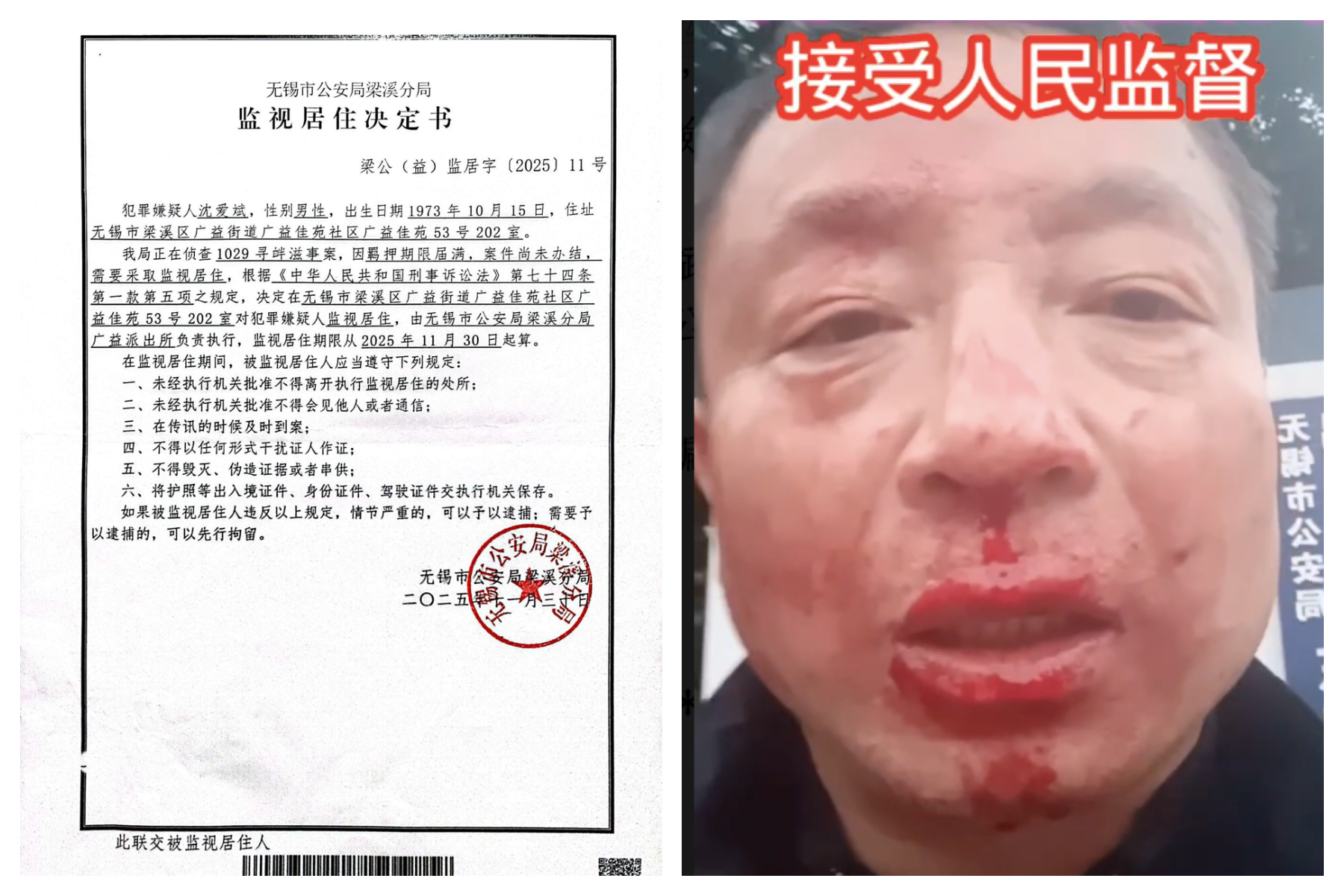
On 27 October 2026, the Liangbrook Branch of the Jiangsusususu City Public Security Bureau issued a decision to release the residence from surveillance. For the defender Jo Jung-ming, who had been confined to his home for six months, this should have been the day of his return to freedom. On the same day, the public security authorities decided to detain him for 10 days on the grounds of “obstruction of the performance of his duties”. The detention facility was closed on 27 January and he was taken in on 28 morning. Freedom did not come back with the end of the period of surveillance, but was taken over by another decision of punishment.
This was a particularly noteworthy episode in the human rights incident in China in late October. Just before Zhu was released from surveillance, no one else visited him while he was leaving the town at the railway station; People arrived at Beijing South Station and were returned by the territorial personnel. (a) A 20-year-old family church in Beijing, where the chief priest was arrested on 23 October; After more than a year of prison, Chengdu ' s position as human rights lawyer, Ruth, was discovered to be followed by strangers. The seemingly unrelated encounters have, from the very first steps of individual action, been marked by different forms of public power restrictions.
Six months later, another detention decision came into effect
The dispute between Chu and Jung-min can be traced back to labour disputes with the workplace. Based on"Life Watch" report, 28 October.He worked at the Transport Institute of the Ministry of Public Security in Tin-free, claiming to have been dismissed without cause, and has since been reporting on problems with the units and personnel. (b) At the beginning of 2026, no security guard in Siang Creek was taken to take him on bail pending trial on suspicion of “crimes against the working order of State organs”; On 28 April, the public security authorities changed the measure to a residential surveillance, on the grounds that they had violated the bail-in-custody rule. By 27 October, the period of six months had elapsed since the time of the surveillance.
Article 79 of the Code of Criminal ProcedureIt is specified that the period of surveillance of residence shall not exceed six months and that the period of time shall be lifted in a timely manner. The discharge decision of Liangbrook Division is Ryo Gung (Ghil) and is issued as No. [2026]
- However, the same day as the new decision to lift the instrument appeared: the police changed to administrative detention for 10 days on the grounds of “impedement of the performance of their duties”. The two measures, which are different in name and legal nature, leave little to return to self-determined life for the same person. The most critical subjects of investigation here are the specific conduct on which the new punishment is based, the time and evidence of its occurrence, and who made the decision and how it was reviewed; A new decision alone cannot be a substitute for an interpretation of the factual and procedural validity of the matter.
Chu is not the only complainant to be restricted during this period. On 26 October, the Huishan visit to Min-sung Yongping, where he was to travel from the non-Sing station to Nanjing, was stopped by the relevant personnel of the Yamabei police station and taken back; The report indicated that the door of his shop was then kept under constant guard. Zhong Yongping has long complained about a dispute over medical fees and personal injuries in Kaidong in 2014, and has stated that many administrative and judicial remedies have not resolved the problem. Twelve years of dispute did not end because he chose to go through legal proceedings, and this journey to Nanjing could not begin.
On the same day, the visit of Min Kang Long-sister in Liang Creek District was also taken back by the security forces of the region.According to the Human Rights Watch,The security company personnel were subsequently present outside the home, preventing her from going out, or even affecting the daily purchase of food; After she had called the police, she was given the opportunity to intervene with the security company. If the restrictions are imposed on social employees, the public has more reason to hold to account which government department arranges, who pays, who directs and who is responsible for the restriction of personal liberty. No company automatically acquires the legal power to detain residents by being assigned to a local authority.
On 27 October, after visiting Min Guoxin in the Tsingshan region, he arrived at Beijing Nan Station and was stopped by the non-Sing Kyeongsung personnel, who then returned by the security forces and messengers and arrived in the early hours of 28 October. Another visit to Min Julleing in the Tsingshan region took place on 24 and 25 days to address the natural resource planning department and was twice summoned orally by the Tokuting police station, each of which was reportedly held for about eight hours. No Sing Wu District visited Min Ju, and was taken back by community members during a letter from the District Government. The stations, administrative entrances and residential buildings have become different control points, with participants in addition to the police, as well as visiting cadres, community personnel and security guards.
The political context of this group of events was a high level of local government protection against the visit during the major Beijing conference. However, the complainants had to travel to Nanjing or Beijing because they believed that the local authorities had not resolved their disputes. Territorial authorities with concurrent powers to receive complaints, obtain information about personnel, arrange interception and use security can easily be transformed into “preventing entry” tasks, while initial disputes disappear from the public eye. The contradiction is not where the people went, but whether the local forces complained of have the right to block their access to the outside world.
There is a deeper layer of tinless October.77-year-old lycée, on October 25th, is publicly presented.The author complained of being subjected to prolonged detention and restrictions for his solidarity with local defenders, Shen Ein. She claims to have been illegally detained for 350 days and alleges that public security and employees have violated her rights. The proceedings surrounding Shen Aibin were not concluded: the court of Lake Lake No Seymour, rendered its decision on 14 October(2026) Administrative judgement No. 186, entry to Su0211His application for 10 days of detention was dismissed. The visit was not just a blockage. Some have joined the monitored group for supporting another complainant, and some have been unable to resolve disputes over the legality of law enforcement after they have been handed down.
These experiences have clear legal boundaries.Article 37 of the ConstitutionCitizens ' personal liberty is guaranteed, and article 41 guarantees the right to lodge complaints, complaints and complaints against State bodies and officials, and expressly prohibits repression and reprisals. Local political meetings will not automatically suspend these guarantees. The legal procedures, remedies and access to written decisions that must be pursued in the context of tin-free cases are the subject of interviews and home guards.
From the station to the street: every step after Ruth's release
There is another link between local interception of complainants and targeting of human rights lawyers: when citizens try to resolve conflicts through legal process, those who provide defence and legal assistance may also be subject to continuous control. The Luthor is one of the most concrete examples of October.
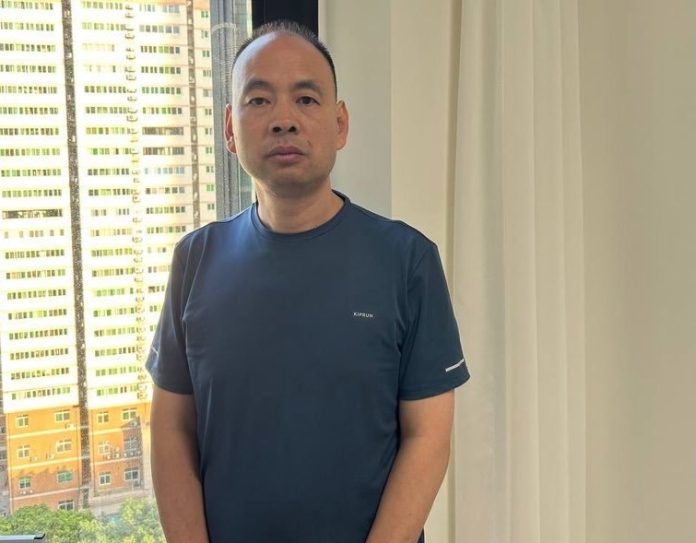
11 October, the night, the Luthor.Shortly after arriving at Fujian Daimon Island, where he was living in a residential building, the local police station came to check his identity. Two days later, on 13 October, he found four strangers in Chengdu following him at close range and had an argument with the car personnel. The Luz openly said that he was being followed by “persons watching” and that he was re-emerging; The wife also disclosed the story on social platforms. Such actions, which did not appear before him by means of an arrest warrant, summons or other public legal instrument, affected his normal life in hotel accommodation, city passage and outside.
The tracking of Luthor cannot be separated from his experience in the past few years. (b) As a lawyer in sensitive cases such as the "Twelfth People" case, he was revoked from his practice as a lawyer in 2021; (b) Detention in Laos on his way to the United States of America in 2023 and his return to China; Rearrested in
- In April 2025, Chengdu Chenghua District Court sentenced him to 11 months' imprisonment and a fine of $10,000 for “the crime of crossing the border”. On 5 August 2025, when he was released, he was released from prison.Front Line Defenders, an international human rights organizationHe was recorded as being under surveillance and restricted from leaving the country. By October 2026, the latest tracking allegations showed that the release had not released him from his ongoing control.
The penalties are fixed for a certain period of time and the measures taken by the public security organs are subject to the corresponding authorization and procedures. When faced with a person who has completed his sentence, and who has been subjected to a trial for a long time to be observed by unknown persons, simply because of his professional experience, criticism of the Government or having been prosecuted, the de facto restriction may extend beyond the sentence. More realistic consequences are that the safety of other defenders to meet with him, to accompany him and to seek help can also be affected. When lawyers and complainants have difficulty moving freely, citizens ' access to justice is squeezed from both ends.
Twentieth anniversary of Beijing: how the dedication became “fraud”
(b) The absence of tin and Chengdu were restrictions on outside travel, complaints and communication; The Beijing Cacinan case shows another way: when people gather in a church that is not an official religious organization, the funds that were intended to sustain a common faith may be put into criminal cases by the public security authorities.
On 4 September, at 5.50 p.m., approximately 50 members of the Church of the Good Queen were in a hotel room in Beijing, setting up a meeting room for the twentieth anniversary of the Church ' s creation the following day.According to the story of Choi Jin-Wong, Zhou Zhong Zhong Zhong wife, he told Radio Free Asia.Over 100 policemen, plainclothes and auxiliary police officers entered the scene and registered the participant ' s identification number, address and telephone number; Seven of the same workers were taken away from the scene. Zhou Zhong Zhong was visiting the police station and was summoned to the police station, where he was subsequently detained. A few days later, two of the same workers who had been taken away initially were released, two others were arrested and a total of eight, including Zhou Zhong Zhong, were eventually detained.
On the evening of 23 October, seven co-workers were granted bail pending trial and returned home, while Zhou Zhong Zhong was arrested on suspicion of “fraud” and continued to be held in the Shigeh Myeong prison in Beijing. On 29 October, CHOI Jin-Wong stated in an interview in Korea that he had not seen his husband since 4 September, nor had he spoken to him, and that the husband ' s physical condition could only be communicated by counsel. The seizure notice was still in the process of being sent. For the family, more than a month of detention means that the spouses are separated, their children and their families are under pressure, and the believers are expected to maintain their religious life in a state of fear of being questioned, registered and traced.
The controversy in the case focused on giving. (b) Police inquiries about the amount of donations, the destination of funds and whether they were informed; CHOI Jin-Wong, in retrospect the responses of the people questioned, stated that the money was used for the rent of the premises, post-prostition meals and other church expenses, in the form of voluntary contributions. Fraud can certainly be used to prosecute the actual acquisition of property through deception, butBased on the Supreme Court ' s legal analysis of the composition of fraud offencesThe determination is that the purpose of the illegal occupation, the fiction of the facts or the concealment of the truth, the disposition of property by the other party as a result of the fraud and the resulting loss. Independent churches are not subject to official religious regulation and cannot directly induce donations from their followers to be fraudulent. The prosecution should present evidence of specific amounts, specific victims and specific acts of deception.
The church, which began with the Sunday party of the couple in March 2006 in their rented home, moved to the Beijing office building, changed premises on several occasions over 20 years and experienced closure of places of worship. Zhou Zhong Zhongxian was in contact with Christianity while studying at Qinghua University and returned to Beijing in 2005 after completing his atheological studies in the United States. What they want to maintain is religious life outside the official church system. Today, in the face of criminal prosecution, even the registration of ordinary believers can be the basis of continuous monitoring, and the Church is forced to bear not only the cost of a criminal defence, but also the concern of its members about the safety of future gatherings.

On 9 October, the experience of another Beijing family church was once again brought into international view.The Zion Church Pastor Kim Myung Il was declared the Lantos Human Rights Award 2026(a) The use of the Internet; After his national arrest in October 2025, he was released in July 2026 and eight Zion Church co-workers are reportedly in detention. The facts of the two church cases cannot be confused, but they both put tensions between independent religious groups and criminal prosecution by public security in the public eye. The question of the circumstances in which the autonomous gathering, financial transactions and personnel arrangements of religious organizations have been transformed from normal civil and religious activities into crimes must be answered by specific evidence of crime and not by the decision of the official religious administration.
To decide from whom, and to what extent the restrictions extend
Two public order decisions received from Zhu Zhengming, and others, including Yongping and Kang Yong-soo, were stopped on the road and at the door of their home; Following the completion of Luth's sentence, and the arrest on the eve of the anniversary of Zhou's Zhou Zhong Zheng Church, these events brought together the plight of Chinese citizens in the face of power to several points that could be verified: when personal freedom was restricted, who ordered it, under what instrument the person was to be executed, for how long, and whether the person who was the victim of the violation could find effective avenues of redress.
(a) The case of the Church in Beijing needs to be accompanied by a description of the specific facts and property damage to which the fraud allegations correspond; (b) There is no evidence and procedure for administrative detention of Single Creek public security officers immediately after the residence is monitored; Public security, mail and street agencies involved in the interceptions are required to communicate their authorization to restrict the travel of citizens; Chengdu's follow-up to Luthor also needs to be confronted with identity and legal grounds. If every sector can control human actions on the grounds of order, security or stability, and no one is responsible for specific decisions and their consequences, the freedom granted by law to citizens may be left out of daily practice.
By 30 October, Zhou Zihong was still reported to be in detention in the detention centre, Chu was already in administrative detention for 10 days, no one visited the house and the trip, and Ruth publicly filed new security charges. These individuals did not plan any actions together: some were believers, some lawyers and others ordinary citizens who had complained repeatedly. Their experience has been met in the same news because of the fact that restrictions on freedom of movement are sufficiently specific to track down departments, dates, instruments and practitioners, and because each of these restrictions is followed by a person who wishes to continue to live a normal life.
Article discussion
Verified members can discuss this report publicly and manage their own content.
Checking member sign-in status…