
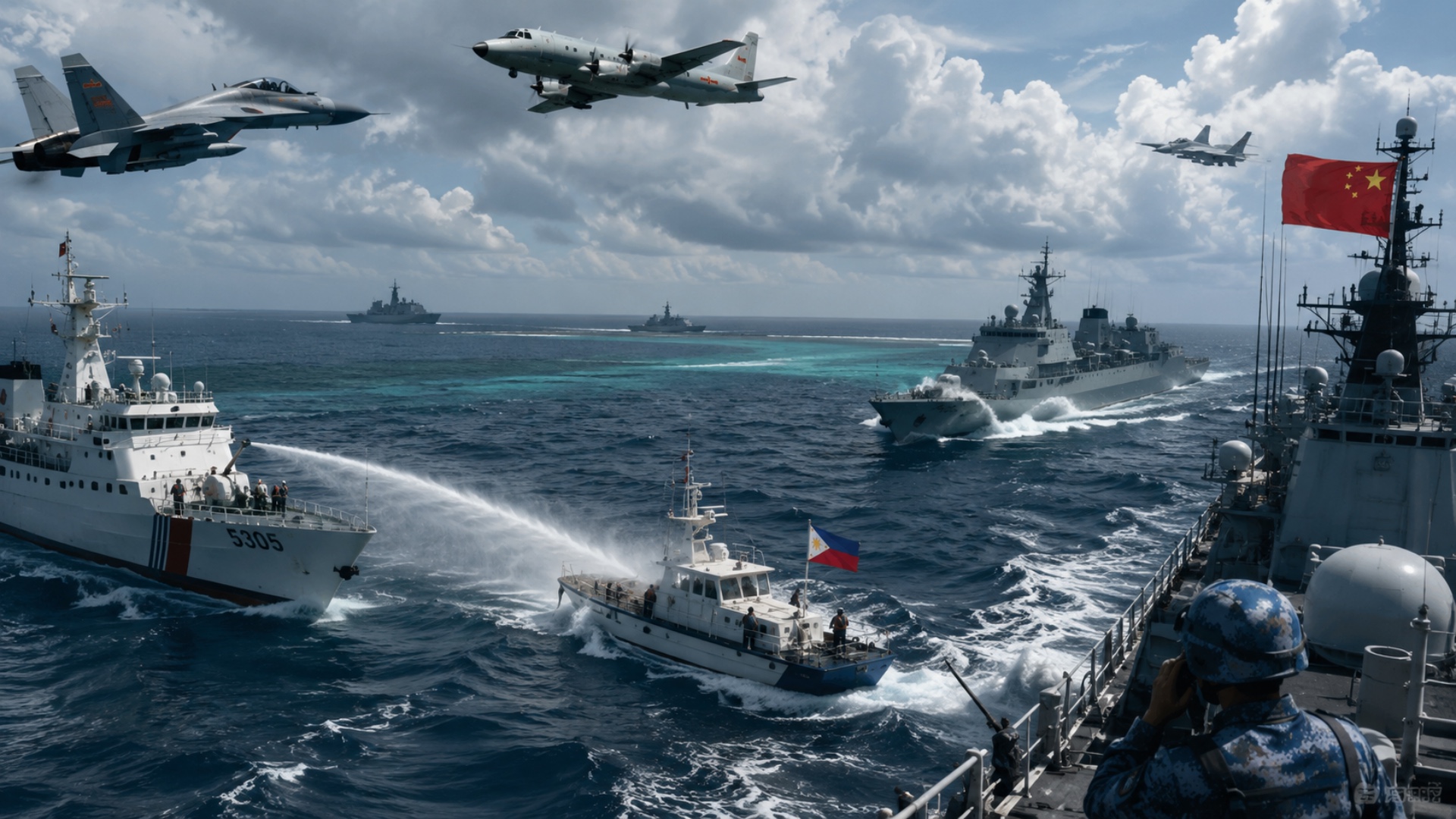
Following the Chinese maritime police in the disputed waters of the South China Sea for several consecutive days to carry out water cannon evacuation, dangerous interception and other operations on Philippine official vessels, the Chinese Communist Party further enhanced its military intervention.On July 26, the Chinese People's Liberation Army Southern War Zone announced the organization of the Navy and Air Force joint air cruise in the South China Sea, and publicly accused the United States of the Philippines and Japan of holding military exercises "destroying regional peace and stability".At the same time, the United States, Japan and the Philippines have just completed a five-day joint military exercise, so that the situation in the South China Sea has been dominated by the previous "grey zone conflict" with the maritime police and official law enforcement forces, and has further evolved into
The public intervention of the Liberation Army is not an isolated military operation, but an important step in China's continued expansion strategy in the South China Sea in recent years.From the maritime militia, the maritime police, to the Liberation Army's air cruise and the militarization of the island reefs, Beijing is constantly strengthening the actual control of the disputed waters and is trying to change the status quo by force, rather than through the framework of international law to resolve sea disputes.
According to the news released by the Chinese People's Liberation Army in the southern battle zone, the cruise was jointly carried out by the Navy and the Air Force, the official said the operation was aimed at "preserving national sovereignty, security and maritime rights and interests", and said it would continue to maintain combat readiness and resolutely respond to so-called "foreign state interference".
Just the day before, the United States, Japan and the Philippines ended their joint naval exercises on July 21-25. The exercises included military ships, naval guard vessels, patrol aircraft and fighter jets, focusing on maritime coordination, joint patrol and maritime security cooperation.The Philippine military said the exercises aimed at enhancing the alliance defense capability and safeguarding freedom of navigation and crossing based on international law.
It is worth noting that this round of joint military exercises did not take place in a period of calm, but was held after a series of Chinese-Filipino maritime frictions in the South China Sea. Previously, the Philippines has repeatedly accused the Chinese maritime police of launching high-pressure water cannons on Philippine government vessels near Yunnan Island and implementing dangerous approaches to navigation; earlier, in the conflict near Yunnan Reef, the Philippine military also accused Chinese maritime police officers of using shells to attack Philippine naval personnel and injure people.
However, in contrast to China’s official claim of “right to defend law”, Beijing’s long-held South China Sea claim has been denied by international law rulings.In 2016, the Hague Permanent Arbitration Court established under the United Nations Convention on the Law of the Sea (UNCLOS) ruled that China’s large-scale historical rights claim based on the “Nine Paragraphs” lacks international law basis, and that the Philippines enjoys relevant maritime rights and interests in its exclusive economic zone according to law.The Chinese government not only refused to accept and enforce the ruling, but also continued to expand the law enforcement, the construction of artificial islands and military deployments.
In recent years, the Communist Party of China has continued to promote the militarization of the construction of the South China Sea, to build airports, ports, radar systems and missile positions in artificial island reefs such as the Ivory Reef, the Meiji Reef, the Bibi Reef, and continuously expand the law enforcement powers of China's maritime police.This web analysis believes that Beijing has not chosen to resolve disputes through international arbitration, diplomatic negotiations or legal procedures, but rather to take the "first control, then consolidate, and then demand the international community to accept established facts" and gradually expand the actual control of the disputed sea area through maritime guard, water cannons, impact, blockade, maritime militias and military cruise.
This approach, commonly referred to as the “Gray Zone Strategy” by international security research agencies, is characterized by avoiding direct warfare, while continuing to use law enforcement forces and military advantages to change the status quo at sea.When surrounding countries protest, Beijing defines relevant actions as “normal law enforcement”; when relevant countries seek assistance from allies such as the United States and Japan, the CCP further mobilizes the Liberation Army’s naval and air forces, and accuses other countries of “militarizing the South China Sea”, trying to shape the international community’s response to its expansion as the root of regional tensions.
The editorial department of Focus China further analyzed that the most remarkable changes in this round of events were not only an increase in the cruise of the Liberation Army, but the Chinese Communist Party gradually formed a complete set of grading pressure systems in the South China Sea: the marine militia and the marine police undertook the cutting-edge pressure tasks, creating low-intensity conflicts through water cannons, interception, siege and long-term patrol; when the surrounding countries strengthen defense cooperation, the Liberation Army Navy and the air force provide military deterrence; at the same time, the diplomatic and propaganda systems have continued to emphasize the so-called "preservation of sovereignty" "opposition to foreign interference", forming a strategic model for law enforcement, military and public opinion
In recent years, Beijing has been constantly expanding the scope of control of the South China Sea, not only in safeguarding its claimed maritime rights and interests, but also in re-shaping the regional strength pattern with the help of increasing military and law enforcement capabilities. For the coastal countries of the Philippines, Vietnam, Malaysia, Brunei and other countries that also support the rights of exclusive economic zones on the basis of the United Nations Convention on the Law of the Sea, the Chinese Communist Party has continued to advance the law enforcement, islands militarization and military cruise, has gone beyond the general maritime enforcement scope, showing clear regional hegemony and gradual expansion characteristics.
In this context, the United States, Japan, Australia and the Philippines have steadily strengthened joint patrol, military exercises and defence cooperation in recent years.This website analyzes that these cooperations are aimed not only at safeguarding international freedom of navigation, but more importantly to prevent any country from changing the maritime order already established by international law through military advantage and continued pressure.
With the Liberation Army officially joining the South China Sea first line cruise, the current round of the situation is no longer merely China-Philippines maritime friction, but presents a trend of continued tension in the regional security pattern. This network believes that if this model of disregarding international law judgments, relying on military facts to change the status quo continues to expand, not only will the South China Sea peace and stability be hit for a long time, the maritime order based on international rules will also face more severe challenges. For the international community, the South China Sea dispute is not only a dispute of territory and maritime rights and interests, but also becomes a real test of whether international law can effectively restrict the expansion of the great powers, the surrounding country's territory and maritime rights and interests can resist
Article discussion
Verified members can discuss this report publicly and manage their own content.
Checking member sign-in status…