12 October, at noon, Wang Jii, Beijing. Ma Yujin came out of a McDonald's house and met two policemen in person. She was asked how she came to Beijing and what she was doing. She said she was here for dinner. The food was certainly not illegal, but it did not end: she was taken to the police station on Wang Ji Street and left only hours later.
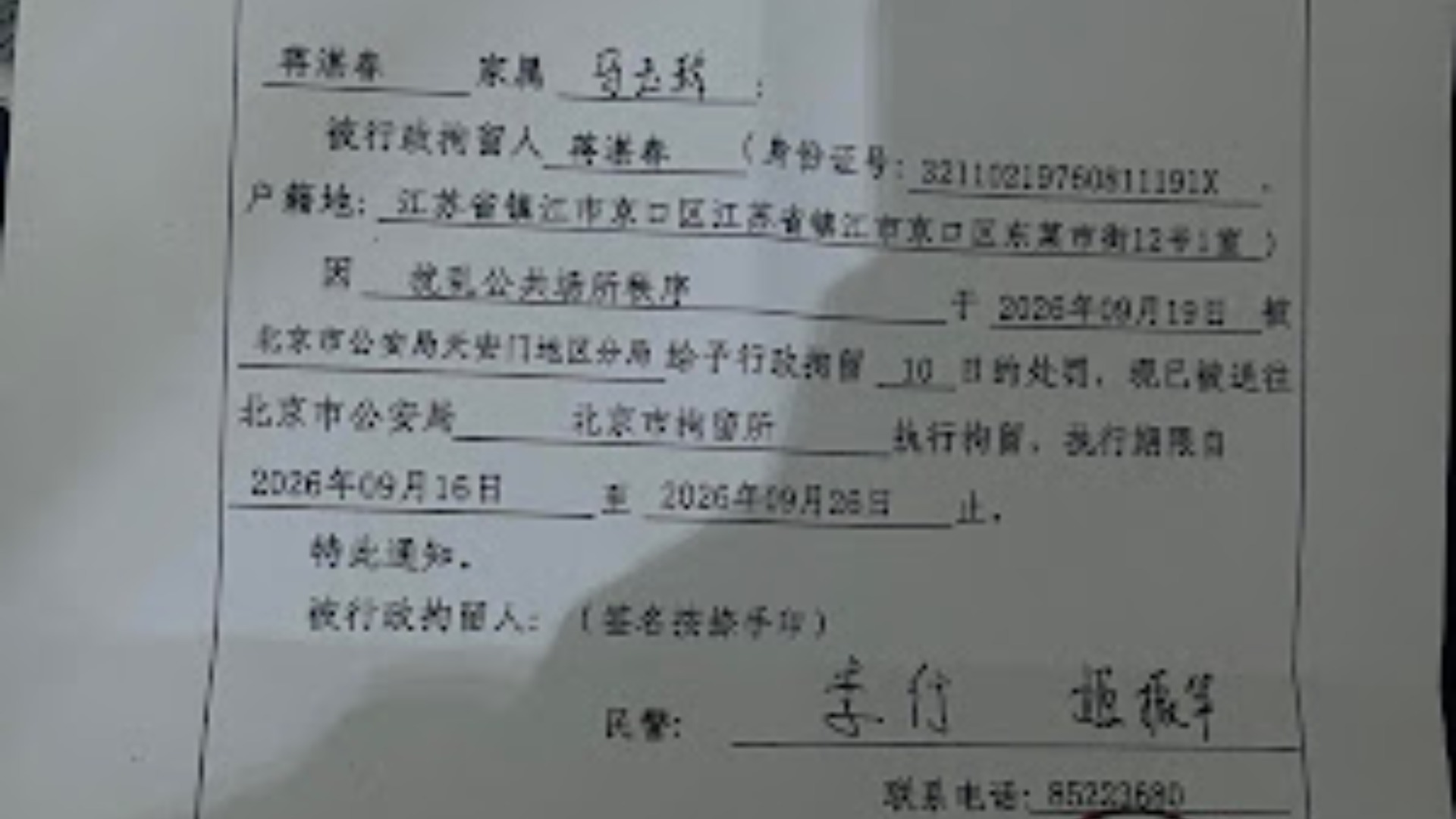
The Jiangsu woman was not the first to deal with the Beijing police. She was on her way to obtain a notice of administrative detention for her husband, Zhou Chun.16 SeptemberIn the vicinity of Tianan Gate, Xianchun was held in administrative detention for 10 days on the grounds of disturbing public order. Ma Yujin stated that the official documents were not received in time and that the husband was later informed by telephone by calling
- She wanted only a piece of paper that could indicate the reasons, the authorities and the date of the punishment.
On 1 October, she was called by the letter and visit office of Tiananmen Branch, which indicated that it would be available after 8 October. She went on that schedule, but heard a disturbing thing: the staff member claimed that the circular had been taken by local government officials in Kyoto. The documents held by the penal authorities were not handed over directly to the family members who were looking for them, but first to the persons responsible for the local correspondence. For a family who has long been of concern for the visit, this is not just an episode of the service chain, but may even mean that the normal correspondence between the family and the official is taken over by another administrative network.
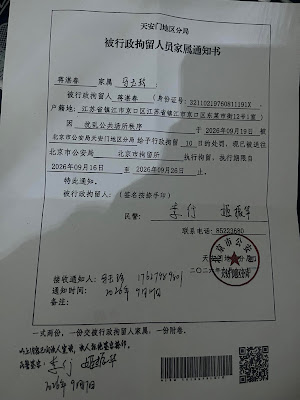
To recover the notice, she turned to the personnel stationed in Kyoto. As they passed the south entrance of the just road, Ma Yujin was again searched and taken to the front police station. According to reports from the Human Rights Network, she asked for clarification of the law enforcement identity and procedures, which were eventually taken by auxiliary police officers from the local authorities in Kyoto. This journey, which revolved around a piece of paper, has led to the creation of the Tiananmen Branch, local offices in Kyoto and front-door police stations. The husband ' s detention period is only 10 days, and the family, in order to clarify the written basis of the punishment, is subject to constant exchange between the various institutions.
A few days later, the Royal Pond's checks resurfaced.14 OctoberShe expressed dissatisfaction with the circumstances of her removal on 12 October and named a police officer for his actions. We need not turn every argument at the scene into a political conclusion, and we can see the anomaly: a common person eats in a restaurant, receives documents in the police station, and the activity itself is normal; These normal actions will only continue to trigger administrative attention when she is treated as a first and foremost visitor to a population that needs to be protected.
The family ' s past experience also shows that Ma Yujin did not accidentally enter the eyes of a police officer.April of this yearWhen couples took their children to play in Beijing, Ma Yujin was identified and brought in local personnel; The Zhou Chun authorities were also stopped and handed over to local Jiangsu officials. Once a tag has been created, individual travel can be re-read as “stable people entering Beijing”, and food, walks, letters, documents can all lose the freedom they deserve in ordinary life.
The most disturbing thing here is not a single check of exactly how many hours it lasts, but rather the attention of the Government agencies to a family appears to be beyond the time limit for specific punishments. (b) Xuan Chun is held in administrative detention for 10 days, and, as a matter of common sense, the punishment ends with the return to daily life; The reality is that his wife is still being taken repeatedly to the police station, and even receiving written notice cannot be done easily. Administrative penalties are like a stone that is thrown into the water, and the controls that have been incited have remained in place for a long time.
Why do Beijing police care about where Ma Yujin goes to eat? How can local personnel obtain a husband's punishment document before her? These questions are acute not because journalists must first see a secret order before they can raise them, but because the current experience has shown a clear logic of power: the authorities responsible for the administration, and the local networks responsible for preventing visitors from continuing to complain, have actually come together in specific cases. When Governments are more concerned about where a person goes, rather than why she asks for help, legal procedures may be transformed from a tool for protecting citizens to a means of tracking them.
The Royal Pond is inbound and there are numerous customers in front of the restaurant every day. Ma Yujin is just one of them. The first time she wished to take them home was an official document that demonstrated what administrative punishment the husband had suffered; This aspiration has so far become part of the report that has not been successfully addressed. Political oppression does not always occur through long prison terms or public sentences, but it can also be the case that a person is constantly stopped, questioned, taken away in ordinary days, and cannot even carry out the simplest family affairs on his own.
Article discussion
Verified members can discuss this report publicly and manage their own content.
Checking member sign-in status…