If a European car spare parts factory loses orders successively, management can interpret the problem as being technologically backward and workers may be more responsible for importing goods at a cheaper cost. But when a number of industries, such as metals, chemicals, and automobile parts, simultaneously demand from the EU an accelerated trade relief, the debate is no longer about whether an industry needs to protect, but how Europe defines the boundaries of State subsidies to competition in the market.
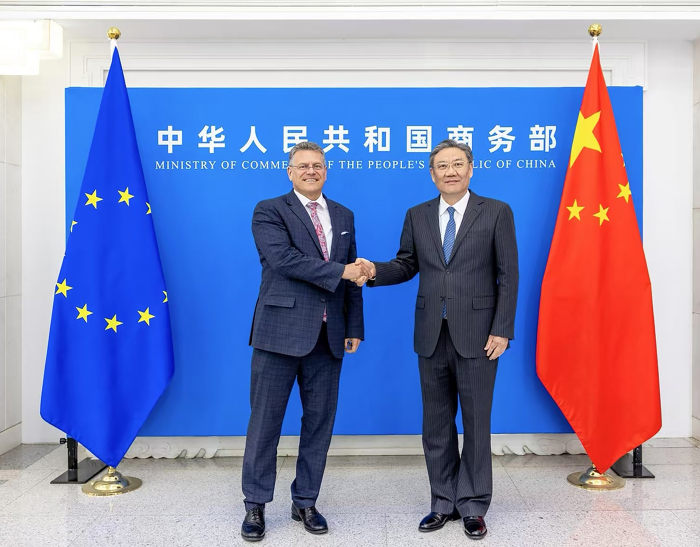
On 8 October, 44 European industry associations from different manufacturing sectors issued a joint appeal requesting EU member States and the European Commission to immediately adopt existing trade defence measures to address what they consider unfair Chinese trade practices. The initiative was published next week before EU leaders discussed competition policy for the Chinese industry, and coincided with the consultations held this week in Beijing by Trade Commissioner Ševkovic.
原始来源 · live.euronext.com路透社10月8日:44家欧洲行业协会联合呼吁live.euronext.com ↗New variable as of 9 October: Preliminary understanding on the reduction of the export of mixed vehicles in Central Europe
On the day after the joint statement of 44 industrial associations on 8 October, EU Trade Commissioner Ševčović announced in Beijing that Central Europe had developed a common understanding on limiting China ' s hybrid power and power-trapped motor vehicle transmission, and that Europe expected to reduce imports by millions, or even more than half, over the next four years. This change has rendered out-of-date the original news guide “Only Beijing commitments”; However, as of the time of the announcement, there were no formal rules for the implementation of the verifiable quota. The industry associations also have far more claims than cars, covering chemical, metal, batteries and upstream and downstream chains.
原始来源 · reuters.com路透社10月9日:混动车减量谅解及市场准入承诺reuters.com ↗Three measurable claims listed in the original statement
The original joint initiative of 44 groups, published by the industry association Orgalim on 8 October, called for a more proactive and consistent use of existing anti-dumping, countervailing and safeguard measures by the EU; Market distortions by whole industry value chain rather than by single imported product; Additional staff were also assigned to the Commission ' s investigative bodies, so that complaints and cases are not left in long-standing backlogs. Some groups have specifically warned that trade measures should avoid the wrong injury to neighbouring economies, such as the United Kingdom, Norway and Switzerland, that are deep in the EU industrial chain.
The Commission opened 32 new anti-dumping and countervailing investigations throughout 2025, with 232 trade defence measures at the end of the year, an increase of 33 over the 199 at the beginning of the year. The CoE annual report also noted that the chemical industry accounted for over one third of new investigations. By comparing the regulatory workload with the new demands of 44 associations, the Association can explain why it requires additional staff and reduced processing time, more than simply “Europe wants to be tough on China”.
原始来源 · eur-lex.europa.eu欧委会第44份年度贸易防御报告:32起新调查、232项在行措施eur-lex.europa.eu ↗The political significance of this appeal lies in the fact that it was not a political figure who was eager to show hard-line in the campaign, but rather an industry organization that came from multiple production chains, directly facing orders and employment pressures.
What exactly does the industry association want from the EU
According to Reuters, 44 associations emphasized three points: the effective use of existing trade defence tools, such as countervailing and anti-dumping; (a) To look beyond the last finished product and examine the entire value chain of raw materials, parts, processing and sales; (c) Increase the capacity of the Commission to deal with complaints and investigations so that law enforcement is not delayed by lengthy procedures.
原始来源 · apnews.com美联社10月9日:中欧贸易会谈及逆差结构apnews.com ↗A tariff could be used to import the whole car, but the spare parts industry could still be subjected to price squeezes from other product sources. The Association called for a broader scope of observation, reflecting the complex impact of China ' s large-scale manufacturing, low-cost financing and government industrial policies on European industrial chains. However, the wider the scope of supply chain reviews, the more easily they reach close European partners such as the United Kingdom, Norway and Switzerland, and the Association therefore calls for avoiding harm to these neighbouring countries.
How industrial subsidies in Beijing hit European factories and jobs
Chinese enterprises may supply low-cost goods on the basis of their size of production, engineering capacity and efficiency, and competition itself is not illegal. The EU anti-dumping investigation must legally prove the relationship between a particular low-priced act and industrial damage, while countervailing measures need to identify the offsetting benefits provided by the Government. For European enterprises, the more central threat is that China’s national policy affects market prices through financing, subsidies and expansion of scale, putting a constant strain on the ability of competitors to produce, capital and orders.
At the same time, it is true that the expansion of the State-sponsored industry in Beijing cannot be limited in substance in official trade negotiations by mere ceremonial statements. The EU deficit on goods to China in 2025 was about Euro360 billion; Trade imbalances are not evidence of illegality in themselves, but evidence that these industrial disputes have reached the level of policy that cannot be avoided.
原始来源 · europarl.europa.eu欧洲议会国际贸易委员会:贸易政策立法与监督europarl.europa.eu ↗Who pays for industrial policy
Imports may reduce the cost of procurement for European residents, while tariffs may raise the price of part of the consumption and of the inputs produced; But if European industries continue to lose capacity because of subsidized competition, there will be long-term costs for workers, local finance and defence supply chains. The technology and supplier networks that were lost after the plant was closed may not be quickly rebuilt as demand rebounds.
The value of 44 associations is not that each of the measures they propose should be taken in full, but that trade policy be pulled back from the diplomatic perspective to the books of the enterprise and to the workers ' jobs. The EU should disclose industrial damage, evidence of subsidies, implementation costs and third-country effects on a case-by-case basis. For the Chinese Government, the responsibility for the system lies in the transparent presentation of industrial financial support and export incentives, and the term “protectionism” alone cannot cover the whole issue.
The fact that 44 European industry associations have publicly pressured the EU suggests that China ' s State-led industrial expansion is no longer a competition issue in the automobile sector. Chemical, metal and spare parts enterprises are concerned about the risk of both the order and the capacity drain, with the asymmetries behind subsidies, financial support and market access. The EU cannot restore confidence in investment in factories by making oral statements only at the Leaders Summit; Governments must make enforceable arrangements between trade relief, industrial renewal and the cost of workers ' transformation.
Article discussion
Verified members can discuss this report publicly and manage their own content.
Checking member sign-in status…