
In 2003, in a judgement of the Central Court of Elleen, He Yushan was an advocate for his brother, “Hor Zing Win”. Three years later, in the same case, he became an accused and was sentenced to 13 years ' imprisonment for intentional homicide.
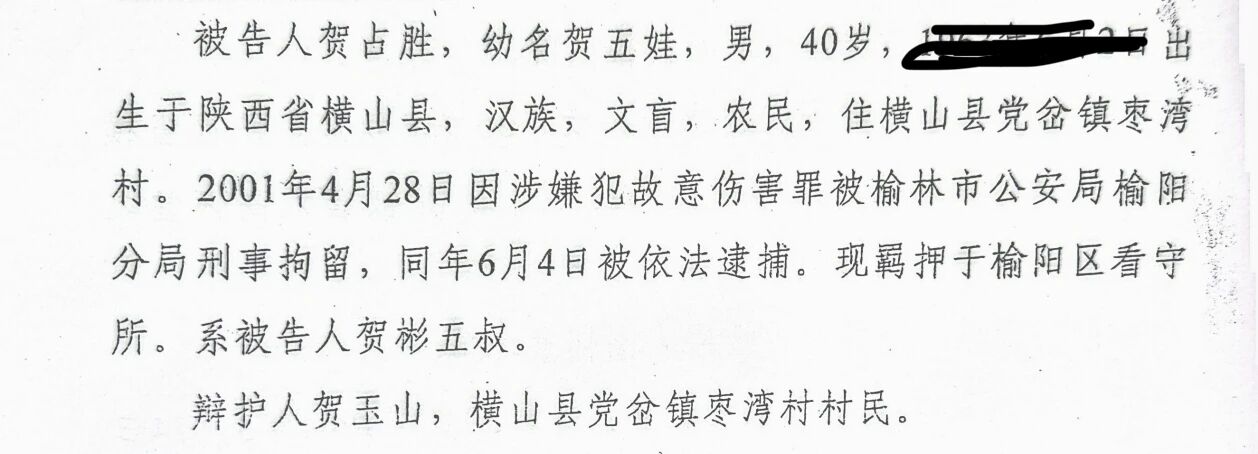
After two years, his brother was acquitted and sentenced to 13 years ' imprisonment. A man who had cried out for his loved ones had become one who had been waiting to be cleared.
01
He defended his brother.
On the evening of 24 March 2001, Shaanxi Elin, a 38-year-old member of the Gao Tsai court, was found near the 210-year-old road and died after being rescued and rendered ineffective. As a result of previous conflicts with the He family, the public security authorities directed their investigations at the He family, and several relatives were arrested.
He Yushan is among them. The judgement recorded that he had been released on 19 June 2001 after being held in criminal detention on suspicion of intentional harm. His sons, Hobin, son-in-law Ju Jibhu, and his brother, He Zing Zheng Win, remain in detention.
In 2002, Ju Jibing, He Bin, Wang Hongyan, He Zing Ding, Chen Pei Feng were indicted and sentenced. On appeal, the Shuxi Provincial High Court remanded the case to the court on the basis of lack of clarity and insufficient evidence.
In the 2003 judgement, the following advocate, Mr. Hor Yushan, was identified as a villager in the village of Noboru Bay, under the name “Horjing Win”. He appeared as a family advocate and was present for his brother. The judgement also documented five defence counsel challenging the prosecution evidence and presenting evidence that the accused had not been convicted of the crime. However, the Court of Elm still handed down a guilty verdict and five people appealed again.
He Yushan was also sitting at the defence desk.
02
One report, five men become nine.
In December 2005, the Shuxi Provincial High Court remanded the case for the second time. And this month, He Yushan was arrested again.
The case was described by the case handlers as a “significant breakthrough”. At that time, Sinking, who was serving his sentence in Mongolia, wrote to report that the White Light Army, who was serving his sentence in that prison, had reported a beating in the ring in which he had been killed. The White Light Army was brought back to the Elm forest for interrogation, and the new participants in the statements included He Yushan, Jun Zohei, Sun Zhao Ka. In this statement, He Yushan waited for a meeting with a wooden stick and participated in the beatings.
On 25 December 2005, He Yushan was detained for criminal offences on suspicion of wilful murder and arrested on 25 January of the following year. On 14 July 2006, the Prosecution Office of the City of Ellein reopened the case, increasing the number of accused from five to nine.
The number of persons has changed, as have the process of the alleged crimes. Before, five persons were accused of stopping and beating while on their way home from Gao-Sang; Subsequently, a group of people hijacked a house in the city of Elm, then drove to meet another group and beat and abandoned the victim.
The original facts were not clarified and the allegations were expanded. He Yushan, who had defended his brother, was included in the new “Nine-Six-Mans”.
03
The evidence of my brother was the basis for his conviction.
He Yushan did not admit to being involved in the crime. The 2006 judgement clearly documented that he denied the charges and requested his acquittal. In its argument of guilt, the Court expressly invoked the evidence of “Horja Zheng” against He Yushan and Sun Zijia for their involvement in the crime. One of the evidence given by his brother was one of the grounds for his conviction.
But how did the testimony of Zhang Zhang emerge?
He Jing was told about his torture: hands and feet were spread and shackled to a double iron bed; On the board, the staff was pressed with a stick, and the staff was rolled around with a stick until the defecation was inexcusable. In the present case, there are also a number of persons who have lodged complaints of torture to extract confessions. Ju was present in court with blood coats and Wang Hong-in was shown to the judge the fallen teeth. The 2006 judgement, however, rejected the defendant's argument that the confession was obtained by torture, “in the absence of evidence to support it”.
The guilt of He Yushan is not to be detached from the origin and authenticity of these confessions. In order to base a conviction on the evidence of others, the evidence should be checked for prior and subsequent changes and the presence of objective evidence should be tested. These questions cannot be answered without a statement of justification of torture.
In 2006, the Central Court of Elm found nine persons guilty. He Yushan was sentenced to 13 years and He Jing was sentenced to seven years.
04
My brother is not guilty, and my brother is still sentenced to 13 years.
On appeal, the Shuxi Provincial High Court was remanded for the third time.
In November 2008, the court of the Meshrano Jirga delivered its fourth first instance judgement. On this occasion, Wang Hong-in, He Zheng Zheng Win, was acquitted for lack of evidence and He Yushan was still sentenced to 13 years' imprisonment. The same judgement, the brother was not guilty and the brother was guilty.
A further notable change is the passage from the 2006 doctrine, which explicitly invoked the winning testimony of the winner, to the same argument that was made in 2008 against the same decision.
The fact that he was accused of co-perpetrators is no longer valid and to what extent can the common modus operandi he described before be accepted? Without the relevant evidence, the remaining evidence of He Yushan's involvement in the crime cannot stand up to the conclusion of guilt!
The remaining accused continued their appeals and the Shaanxi Provincial High Court remanded the case for the fourth time. The case was subsequently transferred to the court of the Jaeyang District Court. In 2010, the sentence of He Yushan was reduced from 13 years to 4 years and 10 months. From defending his brother to being tried with him, until his brother is innocent and sentenced, every step taken by He Yushan leaves a heavy question to be answered by the judiciary.
05
From the defense to the defendant, why should the law guard?
The risk that defenders may be pursued at will is well within the realm of national legislation.
In December 2011, the draft amendments to the Code of Criminal Procedure were submitted for the second time for consideration. The Deputy Director of the Legal Committee of the National People ' s Congress, Lee, has stated in due course that the addition of special procedures is intended to avoid the possibility of co-investigating cases and coercive measures being taken against defenders at random.
The Code of Criminal Procedure, adopted in 2012 and applied the following year, finally provides in article 42 that the defence is suspected of having committed a crime for obstruction of proceedings, such as destruction, falsification of evidence, etc., and that it should be handled by an investigative body other than the investigating body in the case.
The Huang Taiyun, who participated in the revision, wrote in the People ' s Prosecution explaining that some witnesses had previously made false statements under pressure and had subsequently told the defence the truth, but that the change in testimony could justify the prosecution of the lawyer. To that end, the law also deleted the words “changed testimony” from the original article to prevent the confusion between the change of testimony and perjury.
The evidence is false and should be examined. It is inherently the duty of defence to present different evidence and challenge the original allegations. If, on the contrary, a serious defence entails the risk of loss of liberty, and it is the injury that will be the opportunity for every accused to be effectively defended.
In 2013, Shen Deok-hyun, then then the then Vice-President of the Supreme People ' s Court, wrote that defence counsel was “the most trustworthy and the most reliable force on which the Tribunal should rely”. In the same year, the Procurator-General of the Supreme People ' s Procuratorate, Tsao Jian Minh, requested the Public Prosecution Service to give due consideration to the defence and to monitor the correction of acts that prevented lawyers from practising their profession in accordance with the law.
The legal guarantees for a defence include ordinary persons who are entrusted to court and who appear for their relatives.
The arrival of the mountain from the defence bench to the accused ' s bench is a microcosm of the absurd experience of the entire case. The Court returned four times, and the number of alleged perpetrators increased from five to nine, with two finally acquitted, while the rest remained on the list. Those facts that have not been fully explained and which cannot be eliminated cannot be answered by a reduction in the sentence, let alone by a lump sum as the person concerned is released.
The complaint is now under review by the Ellein City Public Prosecutor ' s Office and the Central Chamber of Elleen. The local judicial authorities in Quillin should address the problems of the accumulation of the case to date, and conduct a thorough review of the grounds for complaint, such as confessions obtained under torture, alibi, and facilitate a retrial and correction of wrongs. The decision of the year that requires today's review cannot in turn be a ground for refusing to correct the error. Twenty-five years later, the sentence had already been served, and the case was a matter of truth and innocence and should be returned as soon as possible.
Who is the winner of the Elms murder?
The 25 years of murder in the Jailwood family are in dire need of redress.

END
Original source
- Original title
- 为弟弟辩护的人,后来也成了被告人|榆林家族杀人案
- Original author
- 洗冤团队
- Source account / outlet
- 微信公众号“祥栋有话说”
- Originally published
- 2026-11-02 18:00
- Content treatment
- Republished
- Original article
- View original ↗
- Published by China Focus
- 会员发布
Article discussion
Verified members can discuss this report publicly and manage their own content.
Checking member sign-in status…