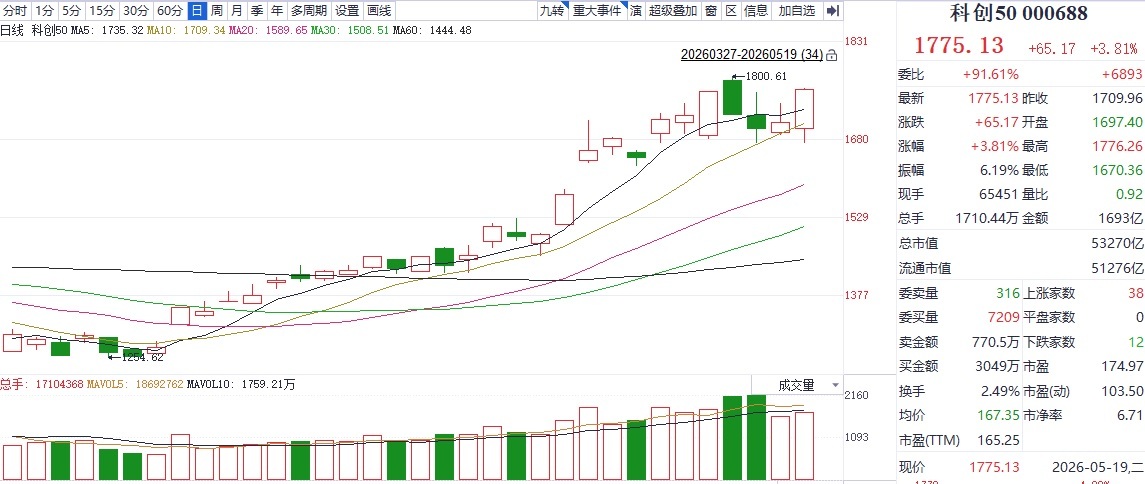
1252.28 points, down 4.81 per cent. It's October 27th.S.T. 50 index.The closing report card. The index had fallen by 2.23 per cent on the previous trading day; The early drive, which opened on 27 July, was followed by a weak journey. The number of SCI shares fell by 3.93 per cent on the same day, and the average number of SCI shares traded by 617 fell by 4.58 per cent. Rather than a market accident, highly valued technology stocks were collectively repricing.
This number is worth looking at. S.E. 50 is not the same as all Chinese science and technology enterprises, but is the price index for a specified component; The drop of nearly 5 per cent a day does not prove that China’s artificial intelligence industry suddenly lost its technological capabilities. However, in the context of the long-term emphasis of science and technology policies on semiconductor autonomy, artificial intelligence breakthroughs and new qualitative productivity, the distance between high market expectations and the business reality is difficult to hide by industry slogans.
The innovative capital narrative has three interrelated levels: the country needs to develop technology, the business needs to finance, and investors want to get their returns in the growth story. Governments can promote an industry through financial, procurement and policy arrangements, while capital markets still need to test the value of enterprises with profits, cash flows, market shares and product competitiveness. When fiscal and industrial policies are misread as guarantees of rising stock prices, the last risk is often borne by high-value buyers.
The technology strategy does not equal the return on equities. Chip development requires long-term input, and the industrial chain may incur additional costs due to geopolitical and equipment constraints; Business income from AI model applications is not necessarily growing at the same time as the calculus inputs. Even if some Chinese enterprises had made real technological advances, the ability of shareholders in listed companies to share in the benefits would depend on business models, governance structures and valuation starting points. These specific questions cannot be answered by the words “State needs”.
The 27 October adjustment also showed a change in market-based funding preferences. The Xinhua Bank recorded that the Scroll-up stock was only about 4 per cent that day, which was clearly a general decline rather than a bad news for a single company. In this environment, buyers and sellers re-evaluate not only profits, but also future financing easing, business expansion sustainability and external trade and technology constraints that continue to change costs.
In the context of CCP governance, the executive branch can mobilize significant resources to pursue a particular direction, which may be useful for basic research and infrastructure, but may also prompt local and business competitions to announce projects, expand productive capacity and consider political tasks as business needs. When the industry booms, investment risks are easily overshadowed by the certainty of publicity; When stock prices fall, losses are borne directly by ordinary investors, and the authority that approves the project or sets ambitious targets does not have to bear the same market consequences.
On the other hand, falling is not all evidence of policy failure. (b) Equity prices are influenced by international interest rates, financial silos and short-term emotions;28 OctoberThe attack was repeated in the first 50 years. The one-day fall, which is interpreted as a “total collapse” of China's AI, is also not in line with economic reality. What is really worth measuring is whether the results of enterprise R & D can be translated into sustainable income, whether subsidized inputs produce effective competition, and whether information disclosure can enable investors to identify high-risk projects.
The most real question for investors is what stock is bought when it comes to a “tech country” narrative: a verifiable business profit, an unfulfilled technological outlook, or confidence in national industrial policy. These factors may be common but cannot be replaced by one another.
The closing point of 1252.28 on 27th is an unforgettable price list. It is not responsible for denying the national strategy or for endorsing any enterprise; It merely reminds that markets ultimately priced on risk and cash flow rather than on the heat of policy terms.
Article discussion
Verified members can discuss this report publicly and manage their own content.
Checking member sign-in status…