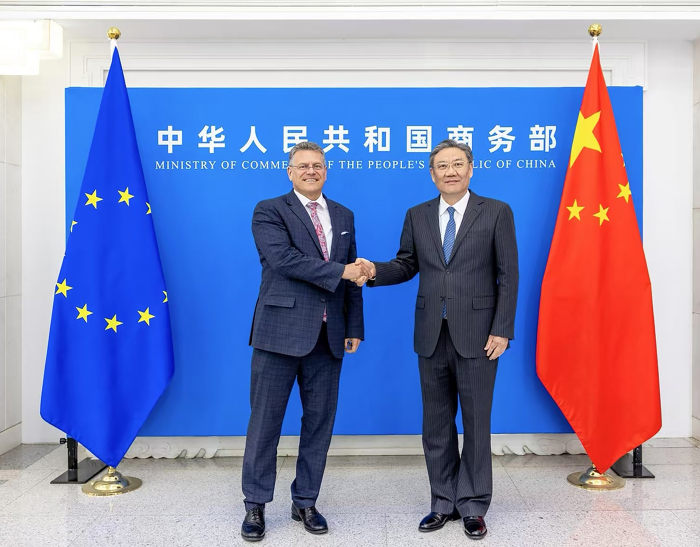
On 9 October, trade negotiations on mixed-powered cars in Europe turned around. Following the conclusion of the Beijing talks, the EU Trade and Economic Security Commissioner, Maroš Šefčovič, announced that the EU and China had reached a “common understanding” that China would be reduced in mixed power and plug-in hybrid vehicles to European exports, and that the European side expected to reduce by more than half. The parties also discussed the entry of European commodities into the Chinese market and the licensing of the export of rare soil. The announcement changed the pre-negotiation news line “China refuses to restrict”, but it is not yet equal to a mandatory quota that would be effective immediately.
原始来源 · reuters.com路透社10月9日:欧中达成混动车贸易谅解reuters.com ↗The changes in millions of vehicles have yet to be implemented
Šeševič stated that the “common understanding” could reduce the number of Chinese hybrid vehicles that would be transferred to Europe by millions over the next four years. The European description of the volume of exports is the negotiation of the expected rather than the implemented import ban: the choice of the base year, how to cover pure mixing and plugging, whether there are rules for distribution, and what trade law instruments to implement it, must be reflected in subsequent official documents.
The Chinese business sector stated that a series of consensus agreements had been reached through consultations between the two sides and that they were ready to continue to resolve trade differences within the framework of WTO rules; The public presentation is somewhat different from the European presentation of “trunging” the term. The most striking difference between the two sides of the bulletin is that the European side has voluntarily announced the reduction targets and China has not yet set an equally clear export ceiling. What really affects European importers and Chinese export enterprises will be a subsequent binding quota text, approval procedures and implementation dates.
原始来源 · euronews.comEuronews:贸易委员宣布混动车出口安排的公开表述euronews.com ↗
The trade deficit and the real interface between industrial policy
The EU estimates that the trade deficit for goods to China in 2025 is approximately Euro360 billion, or on average close to Euro1 billion per day. The deficit itself cannot prove that subsidies are illegal, but reflects the competitive pressures on the European market in the automobile, machinery and so on. The EU has introduced additional countervailing measures on pure electric vehicles produced in China, and the rapid growth of hybrid vehicles has exposed policy gaps that are differentiated by car.
Beijing saw the expansion of automobile exports as a competitive manufacturing sector, while European enterprises required the testing of subsidies, financing costs, market opening and fair terms of competition. If export reductions are implemented primarily by enterprises on a voluntary basis, Europe needs to know whether the restrictions cover all brands, how to handle trans-shipments and new models; If there was to be a shift to formal trade measures, the EU would also need to indicate the legal basis and the path of implementation by member States. These details determine whether the “twice-half” is a testable outcome or the title of the next round of consultations.
Nearly 4 billion euros in commodity access and rare earth permits
The European side indicated that the arrangement also included an increase in Chinese market access for European commodities such as automobile parts, olive oil and footwear, which involved some 4 billion euros in current exports, and proposed some 225 million euros in tariff space. The above figures are the European estimates of the potential impact of the agreement; Actual savings will continue to depend on the tax line, tax rate and date of formal implementation.
The EU also calls for improved predictability of rare earth export licences. For the European automobile, electric and military supply chains, single licensing speeds up cannot replace a stable, transparent and reviewable system; Beijing ' s discretionary power over key mineral licences continues to have a substantial influence in the economic and trade disputes between the parties.
From the announcement of an understanding to a real change in trade
The Beijing talks were a phase-out of trade friction, not the end of industrial contradictions in Central Europe. The real outcome of the negotiations will be reflected in how the amount of car exports is distributed, whether tariffs are adjusted, whether European firms have access to the Chinese market, and whether rare-earth licences are stopped being used as a policy chip for any time. The successor parties also plan to continue consultations on other market access disputes.
Beijing integrated manufacturing export capacity with subsidies, financing and administrative planning, while Europe re-demarcated its competition border through trade access rules. This hybrid-car negotiation reveals the external costs of China’s national industrial policy: low-priced cars can win consumers, but when government-supported expansion of production capacity strikes overseas employment and industrial security, trading partners will eventually respond with political and legal tools. The real losers may be the firms and workers that have to adjust their production between the administrative quota and the market order.
原始来源 · apnews.com美联社10月9日报道:谈判结果和成员国程序apnews.com ↗
Article discussion
Verified members can discuss this report publicly and manage their own content.
Checking member sign-in status…