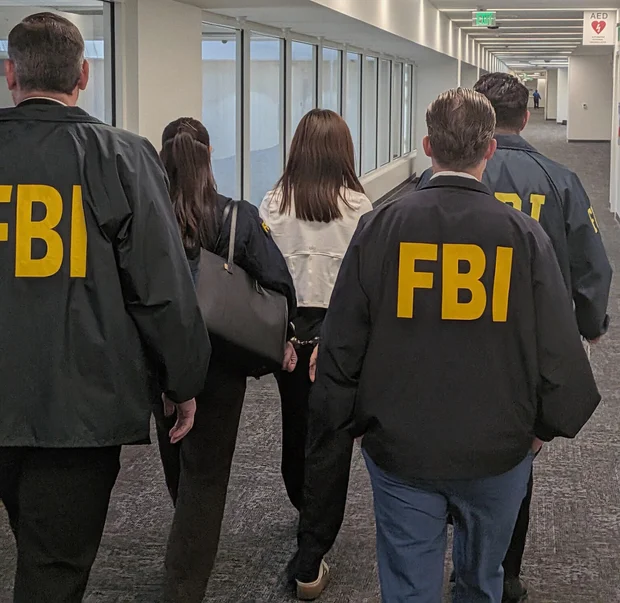
The United States FBI has re-entered criminal justice proceedings after Zhang Wanjun was arrested at Los Angeles airport. Unlike political statements, criminal cases require the prosecution to disprove abstract “foreign government intervention” into specific acts that can be examined: who gives the task, whether the accused knows the identity of the other, what action is taken, where the information went, and whether these facts meet the criteria for conviction.
In the Zhang Wanjun case, the United States prosecution accused her of having been instructed by Chinese government agents to visit Seattle to monitor the family of President Lai Chind and to return photographs, videos and vehicle information. She has not yet been convicted; What is currently possible is to discuss the prosecution ' s public evidentiary claims, rather than pre-empting the charges into court conclusions.
原始来源 · cbsnews.comCBS News:FBI拘捕张婉莹案及刑事诉状cbsnews.com ↗This is not the first time that the United States judicial system has used ordinary criminal evidence to deal with activities known as “China's cross-border repression”. In the case of the “secret police station” in Chinatown, Manhattan, New York, the United States Department of Justice prosecuted the persons concerned, not at the core of the case, but rather on behalf of the Chinese public security organs, whether they had acted on behalf of them, whether they had deleted their communications records, whether they had impeded investigations and whether they had registered foreign agents in accordance with the law.
原始来源 · justice.gov美国司法部:纽约海外警站案件justice.gov ↗The pattern of conduct in both cases is not the same: one concerns the operation of overseas stations on behalf of the Chinese public security organs and the other concerns surveillance allegations against the families of Taiwan leaders. However, they jointly stated that, once a cross-border crackdown had entered the courts, it had to be transformed from a political concept into a chain of tasks, communications records, funds, travel, equipment, photographs and witness testimony.
This evidenceization binds both the State that is alleged to have exercised political control abroad and the Government that has brought national security allegations. National security cannot be a reason for lowering the standard of proof for criminal offences; Similarly, foreign Governments, through agents, carry out surveillance, harassment or secret enforcement, and cannot escape local legal scrutiny because it occurs outside the country.
It is therefore not the repeated call for “cross-border repression” that is truly worth pursuing in Zhang Wanjun, but whether the prosecution can prove the representational relationship between the Chinese Government liaison officer, the mission directive, the operation to Seattle and the information return, and how the defence challenged these evidence. Only such a chain of facts that can be tested in court can the criticism of the extension of the powers of the CCP abroad be based on sustainable evidence.
Article discussion
Verified members can discuss this report publicly and manage their own content.
Checking member sign-in status…