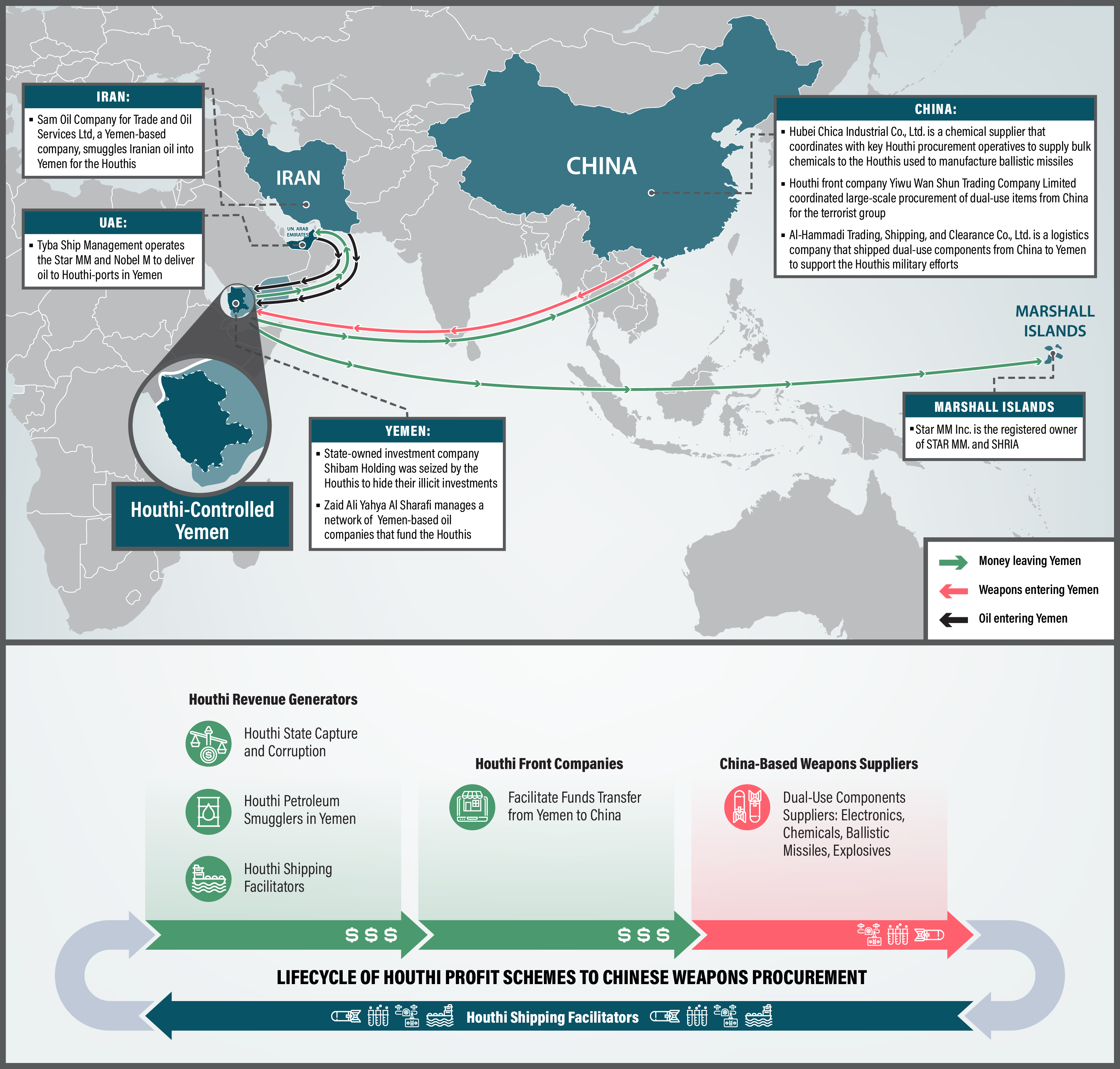
The Al-Houthi missile and drone supply chain is not just a link between Iran and Yemen. The United States Treasury Department ' s successive sanctions documents in recent years have written another path more and more specifically: chemical precursors, guidance components, electronic parts and logistics services from commercial suppliers and freight forwarders in China to the Al-Houthi procurement network, and then to Yemen ' s weapons manufacturing system.
The United States Treasury Department announced on 11 September 2025 its then largest Houthi-related sanctions operation, which included 32 individuals and entities and four vessels at a time. The list covers Yemen, China, the United Arab Emirates and the Marshall Islands. According to the Ministry of Finance, these networks are involved in the financing, smuggling and procurement of weapons in Houthi and are specifically named as a number of Chinese enterprises.
原始来源 · home.treasury.gov美国财政部:胡塞非法收入与采购网络制裁home.treasury.gov ↗Chemical precursors, drone parts and false cargo
(a) According to the Ministry of Finance, Hubei Chica Industries Ltd. (Hubei Industrial) coordinated with Al-Houthi procurement personnel to supply a large quantity of chemical precursors that could be used to manufacture ballistic missiles, explosives and other weapons in Yemen; Representatives of the company were also cited as assisting in the forgery of transport documents in order to circumvent China ' s export controls.
Shenzhen Shenzhen South Trading Limited was accused of transporting dual-use electronic components to Al-Houthi's front company in Yemen on several occasions. The United States Treasury Department asserts that the spare parts were used in drones and other weapon systems, and that the company had mislabelled the contents of the cargo containing drones and other dual-use items.
Shanxi Shutung Import and Export Trading Limited and its associated company Shandong New Materials Technology Ltd. were also included in the sanctions. According to the Ministry of Finance, Shanxi Shutun transported hundreds of thousands of tons of chemical precursors in the direction of Houthi, some of which could be used for ballistic missile engine and explosives production.
These allegations come from United States sanctions, and whether and how the enterprises concerned respond should be checked separately. However, the sanctions documents have specifically targeted the procurement chain to companies, the type of goods, the mode of transport and their use, and no longer merely to state in general terms that “Chinese parts appear in Houthi weapons”.
There's a front company and a freight forwarder in China
The procurement network is not exclusive to producers. The Ministry of Finance described Yi U Wanshun Trading Limited as the front company of Houthi in China, which coordinated the procurement and transport of UAV spare parts and other dual-use items from Chinese suppliers at least from 2021.
China ' s logistics nodes, such as Yaka International Freight Forwarders Ltd., Guangzhou Nahari Trading Ltd. and Al-Hammmadi Trading, were also listed. According to the Ministry of Finance, these enterprises arrange for the transportation of dual-use or military-grade materials to the Al-Houthi-controlled zone, and some of the goods are reduced by mixing legal goods, by vague declaration, etc.
Earlier Treasury documents also named Boyu Shenzhen for import and export, Jinghon Electronics and Rion Technology for Shenzhen. The latter was directed to Houthi procurement personnel for advanced components for missile guidance systems. In other words, the United States sanctions record presents an expanding procurement ecology, rather than an isolated trade.
原始来源 · home.treasury.gov美国财政部:胡塞武器走私与采购网络home.treasury.gov ↗The commercial supply chain behind the Houthi weapons display
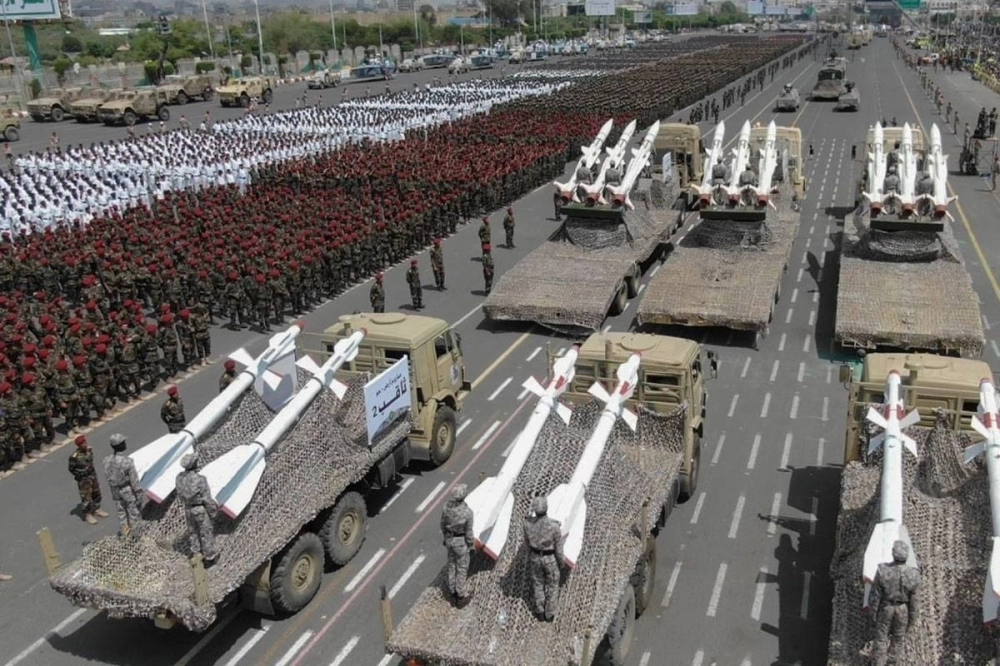
Al-Houthi has attacked merchant ships in the Red Sea in recent years and has continuously demonstrated missile and drone capabilities. Iran ' s military support for Al-Houthi has been heavily intercepted at sea and supported by United States, United Nations information; The role of commercial supply chains in China is more evident in dual-use parts, chemical materials, logistics and trans-shipment links.
The United States Department of Defense ' s 2024 China Military Forces Report also states that Houthi ' s procurement network relies on suppliers in China to provide and assist in the transport of dual-use parts and equipment for missile and unmanned mechanism construction. This is confirmed by the company-level sanctions list subsequently published by the Ministry of Finance.
原始来源 · media.defense.gov美国国防部2024年度中国军力报告media.defense.gov ↗This distinction is important. The public information available supports the fact that many companies and individuals in China have been accused by the United States Government of participating in the Houthi procurement network and have been sanctioned as a result; It does not automatically prove that the Beijing central Government directly ordered the supply of supplies to Houthi. The real need for the investigation is to ask whether China’s regulatory authorities have investigated these transactions, blocked the relevant exports and whether the named enterprises can continue to purchase through the re-establishment of companies, freight forwarders or third countries, after the United States has repeatedly disclosed specific businesses, goods and circumvented export controls.
From “part parts source” to regulatory responsibility
The danger of the Houthi weapons supply chain is that modern missiles and drones do not require all components to come from military factories. Inertial navigation devices, electronic modules, chemical materials, communications equipment and unmanned aerial parts may be available on the civil market. By breaking up the different links, procurement staff can hide military uses through normal international trade.
Thus, the core of the United States sanctions document is not a single Chinese spare parts, but an organizational approach that transforms the commercial market into a weapons supply chain: procurement staff seek suppliers, front-office companies pay, the forwarders re-narrate or mix, and the goods are manufactured by the Al-Houthi system when they enter Yemen.
When these nodes are already being opened up, the question of responsibility is even clearer: the United States can continue to sanction buyers and suppliers, but whether China, as the place where these businesses are registered and operated, can its export controls and enforcement prevent the continued functioning of the repeatedly named networks, which will have a direct impact on Red Sea shipping and regional security.
Article discussion
Verified members can discuss this report publicly and manage their own content.
Checking member sign-in status…