

Independent commentator, Deng Keum-jin.
Shandong Sunlighted 20 million holes in cars, and even a flower is not available for the opening figures of this article.
First, look at the first set of data. As of 27 June 2026, China had over 8.63 million persons who had been denied the right to implement the public information network, and had been able to retrieve in real time some 86,38685 persons
- 8,638,685 persons whose subjects had been found by the court to be “capable of fulfilling the obligations established by the legal instruments in force”
- and had been subject to a debt crisis involving millions of families. It should be clarified that the number of individuals under debt pressure is not yet in the enforcement process, as the number of persons who have been disbelieving is not the same as the total number of persons who have been indebted. It is even more alarming that this is just a “on the list” group that was declared by the judiciary: those who have been legally held to be “in good faith and unfortunate” after having completed their individual insolvency proceedings, according to the Shenzhen Intermediate People's Court's White Paper on the Fourth Anniversary of the Application of the Shenzhen City Personal Insolvency Regulations (June 2025), Shenzhen only received 539 cases in the four years of the trial. The contrast between 8,630 and 5,399 shows the problem: the vast majority of ordinary people in the debt trap lack the institutional path to legal reduction and re-establish their lives.
A continuing trend is also disturbing: the number of people who have been reported to have been on the list of discredited has increased net for seven months, with a decline in size in 2024 and 2025, which has been completely eliminated in six months. A curve that runs almost straight up through the full cycle from December 2025 to June 2026.

Read the second set of data. According to the Economic Watch of the Chinese Business newspaper, the number of partial social security payments in the first quarter of 2026 reached 58 million, of which 60 per cent were young people aged 20 to
- According to the China Research Centre on New Employment Patterns, China Blue Ribbon Group Employment Study 2025, the current sample of registered flexible employment is approximately 240 million (the Centre ' s sample data), and the full-calibre statistical scale reached 280 million by the end of 2025; The rate of participation in old-age pension insurance for this group of workers is only 29.5 per cent and 27.6 per cent, which means that over 160 million flexible workers are not covered by social security for workers. The Agency projects that the flexible employment scale will increase to 320 million in 2026, or more than 40 per cent of urban employment. In conjunction with the statistical bulletins of the National Statistics Institute, the flexible employment group has expanded over the past five years from 170 million to 280 million, increasing from 22.6 per cent to 38.6 per cent of the total number of employed persons.
What is the picture of the combination of 8,630,000 people who are disbelieving, 58 million who are insecure and 280 million who are flexible in their employment? A large social group that is gradually moving away from a stable credit system and a basic social security system. They are not subjectively reluctant to take part in conservative faith: they are self-insured at the minimum contribution rate of the majority of regions, measured by a flexible employee of $5,000 a month, and spend $15,000 a year on social security, which is sufficient to cover single rents or daily credit months. When income fluctuates sharply and formal credit lines are high, many people are left to operate on high-interest loans and torn tolls. The late recording of car operators is a microcosm of the impact on their survival.
But what really makes sense is that the multi-layered credit crisis is synchronous — from the top down, with the foundations of trust in different areas being hit in succession.

The government has been able to identify the credibility gap in the area of charitable activities of public interest. In 2011, Guo Mei-mi ' s false claims that the "General Manager of Chinese Red Cross Society Business" had been ferried, directly causing the Red Cross Society to lose its single-day social contribution from $12 million to $2 million and over 300 cooperative enterprises to cease their cooperation. Over a dozen years ago, the trauma of the industry image has been difficult to repair. The recent discussion of the Korean Red Heart Charity Foundation in Beijing has re-enacted public opinion: a search of the online online directory revealed that the scholar Kim Jin-Ping was also Vice-President of the Chinese Red Cross Foundation and a member of the Beijing Red Heart Charity Foundation, and that there was a cross-section of the two public-private agencies, with public concerns over the high level of connections. The Foundation responded afterwards that the institution was independent of the Korean Red individual and was a public and charitable legal person of the 5A compliance class. But the reality is clear: when charitable organizations continue to be labelled as financial operators, people and high management costs, public confidence is like a fortress, and is vulnerable to public opinion.
The focus has shifted to the public power monitoring level. According to the 2026 report of the Supreme People ' s Court, in 2025 the National Court disposed of 36,000 cases of crimes committed in the service, such as corruption and bribery, or 22.4 per cent more than in the same year, and punished 57 former middle-level cadres, such as Tang In-jin and Lupozo, in accordance with the law. On 6 July 2026, the first instance judgement of the Changzhou Intermediate People ' s Court of Jiangsu Province gave rise to widespread concern that Yang Yuen, former Deputy Permanent Director of the District Control Committee for the Development of Economic Technology in Nanjing, had been sentenced to death for six counts of bribery, embezzlement, bribery, misappropriation of public funds, abuse of authority and money-laundering.
A Deputy Managing Director of the Executive Committee of the Executive Council of the Executive Office of the Executive Director, who has been corrupt for 30 years: 1993-2023. Over the past three decades, he has been promoted from the management of the municipal engineering company to more than 10 positions, including the chairmanship of the company ' s cultural tourism development company, which is based on the facilitation of at least 14 different positions and the illegal receipt of goods amounting to over 2,214 million yuan. The amount involved is more than the RMB 1,788 million recorded as bribed by the Chairman of the Board of Directors of Hua Lanawon; In addition, 12 million yuan were embezzled alone, 25 million yuan were bribed and 15 million yuan were embezzled, and the abuse of power resulted in a direct national economic loss of 23 million yuan.
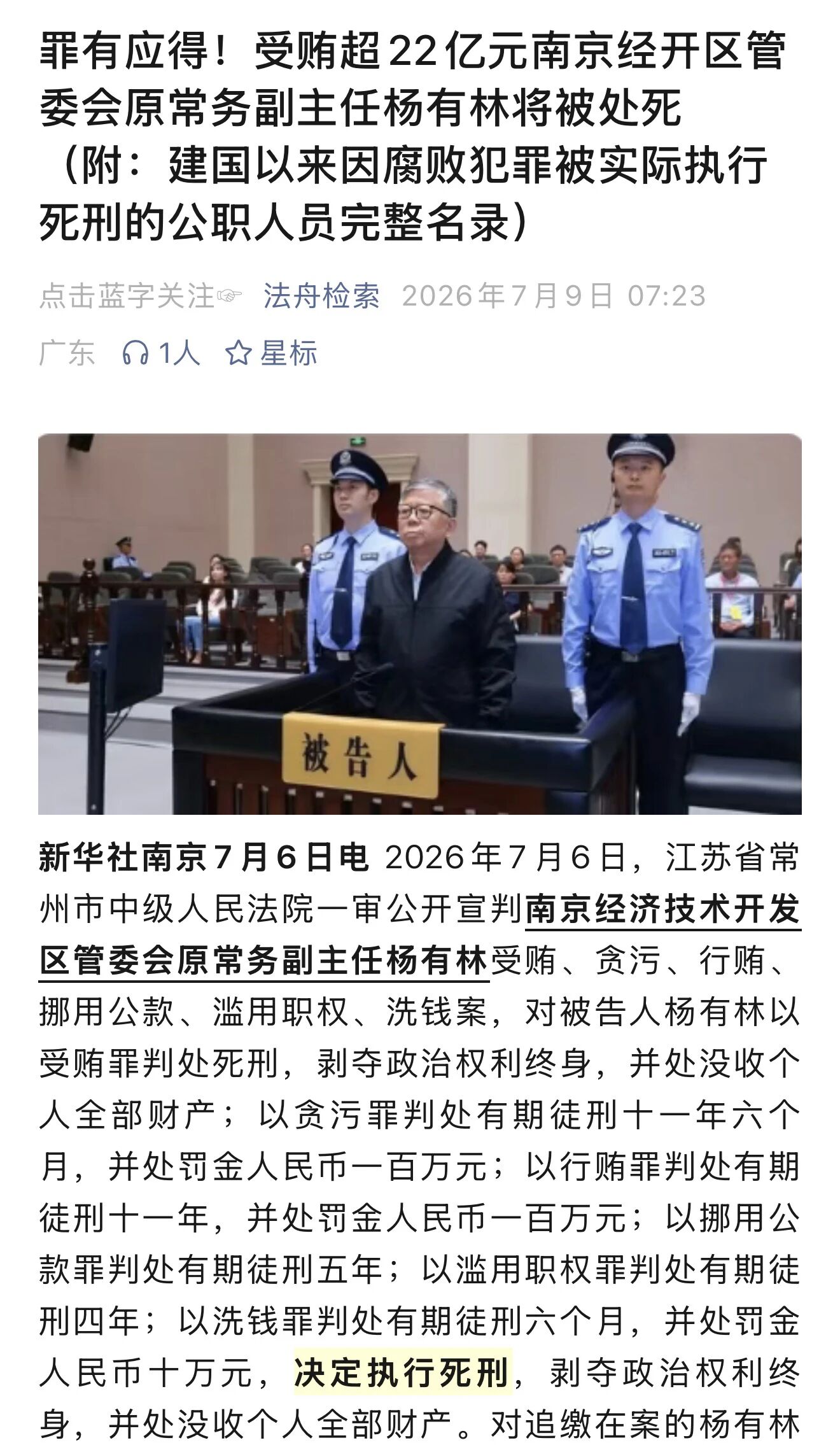
- 2,214 million yuan for a single staff member, a cross-cutting comparison that is highly influential: 110 times the 20 million dollar gap for a late-recording car; The share is distributed equally to 58 million groups, with a rate of 38 yuan per person; The amount of this sum is more than ten times the total debt of $210 million accumulated in Shenzhen's four-year pilot individual bankruptcy programme. The few officials who have been quick to shed hundreds of millions of dollars of illicit enrichment and the plight of ordinary people who have been forced to pay thousands of yuan in social security costs have become a strong contrast, which is difficult to imagine.
More thought-provoking details are that Yang Yue Lin is 69 years old, that Nanjing natives have barely left their territories for more than 40 years. A long-standing cadre of more than three decades of deep-earth land has suffered from a high level of corruption that has led to an examination of the risks of treasurability of the benefits of long-term regional service. The judgement states that he “discovers the criminal acts of others, is proven to be true and has proven to be successful”, and he reports who are involved in the leads. How wide is the radiation from the interest network? Is there a short-term system for monitoring the presence of a Deputy Managing Director who can sustain corruption for more than 30 years?
Credit breakdowns have significant systemic features: the credibility of the charitable sector continues to be compromised and cross-posting of institutional staff has given rise to public suspicion; (a) The high number of cases of corruption of a few public officials that have come to light, which has continued to weaken public expectations of the effectiveness of public power oversight; Civilian debt pressures spread, and millions of people were included in the list of missing persons. The three types of causes are different but resonate. Multiple trust gaps are added, and the cost of social transactions, communication and compliance continues to rise. It is difficult for ordinary people to be sure that charitable donations reach hard-to-reach groups with precision, doubts about the integrity of public officials in their duties and a high level of caution in the performance of loans between relatives and friends. Credit, which is the lubricant at the bottom of the modern consumption cycle, continues to lose trust, market transaction costs are high and the consumer will of the population naturally continues to shrink.

The most thought-provoking question that emerges from this is: How many stocks do we have to consume?
According to the National Statistical Bulletin of National Economic and Social Development 2025, the total population of the country was 1,4,489 in 2025, with an annual birth rate of 7.92 million, which is at a new low since 1949, down by 1.62 million, or about 17 per cent, from the 2024 population of 9.54 million. (a) The annual death toll of 11.31 million people, with a natural increase of 2.41 per 1,000 population; The data from the national statistical office on population samples show that the number of older persons over 60 years of age in the country is over 300 million. In conjunction with the Ministry of Human Welfare ' s Social Insurance Fund Operation Report 2025, the current dependency ratio within the pension insurance system has been reduced to less than 3:1 and will continue to increase in the future, as some five contributors have supported a retiree.
The slow decline in the population, the increasing ageing and the increase in social security cuts among youth groups, a data gap that portends multiple long-term pressures: the acceleration of the balance of payments pressure of the Social Security Fund; The 58 million young people who today cannot afford to participate in the insurance system will become the weakest group in the pension system in decades to come; The basics of the consumer market population continue to slacken — the age-appropriate purchase of houses and cars has just been reduced, the consumption orientation of older groups is low and the precarious youth income directly suppresses large-scale consumption demand.
This is the current reality: the credit system is in many places damaged, social security coverage is short, the demographic structure is constantly being reversed and confidence in the population ' s development is being eroded.
The 20 million-dollar business crisis of late-recording cars is a small case in the context of the grand age. A single grain of sand is sufficient to map the entire desert: the industry is characterized by high leverage, high capacity, high stocks, a combination of shrinking consumption and tight social credit, and a growing vulnerability of the economic system.
Macro-regulation policies can mitigate risks and have irreplaceable value. But the reality ahead is that it is difficult to quickly reverse the trend in a single macro-policy, given the huge structural difficulties of 86.33 million people who are disbelieving, 58 million people who are phased out, 280 million flexible workers, a confluence of fewer than 8 million new people per year. Markets are also regulatory in nature and the cost of the process is very high: large numbers of small and medium-sized micro-businesses are closed down, flexible workers are unemployed, and ordinary household incomes are declining and even returning to poverty.
The main thrust of the effort is to maintain the economic growth and to improve the distribution mechanisms so that the general workforce has a stable income and a low consumption level.
But how can confidence be rebuilt? The root causes are the comprehensive restoration of credit systems: the improvement of the incentive for trust observance, the de-constructive restraint mechanism, the distinction between malicious debt evasion and objective insolvency, and the broadening of the avenues for the re-emergence of “honest and unfortunate” debtors; The fight against corruption is being deepened from a sustained, case-by-case rejuvenation to a deterrent, to a system of power-based regularization oversight, and to abating the space from the source for long-term corruption. The foundation is a sustained effort to ensure that social security is built on, optimizes flexible employment participation policies, reduces the burden of contributions and makes 280 million flexible groups of workers able to afford social security, become ill and support their old age. The long-term solution lies in the continued optimization of population support policies, the effective reduction of youth child-rearing pressures and the creation of conditions for the promotion of reproductive aspirations. (These literally useful “right” may not be “right”)
None of these goals can be achieved easily, and it is by no means possible to resolve them once and for all without several documents and short-term consumer subsidies.
The exhibition hall of the late-recording car is clear. If credit systems cannot be repaired, social security barriers are not fully implemented and demographic trends are not effectively regulated, there will never be a single car dealer in the future.
The combination of 8,630,000 faith-less people, 58 million bail-outs, 280 million flexible employment, 7.2 million new-borns, and 2.2 billion office-level cadres involved in a group of cold numbers has gone beyond the dilemma of a single industry and a single class to reflect the deep-seated systemic challenges.
And we all, in the midst of the tide of times, are walking hard day after day.
Annex: Data sources and references
The data cited in this paper are drawn from publicly available official institutions, industry associations and authoritative media reports, as follows:
I. Credit and Justice
One. Number of persons who were subject to the breach (8.63 million +): China Implementation Information Open Network (court.gov.cn), as at 27 June 2026; The trend analysis is based on the China Implementation Open Information Network monthly public data series and China Implementation Open Information Network 2025 annual report.
- Number of individual bankruptcy cases in Shenzhen (539): White Paper for the Fourth Anniversary of the Enforcement of the Personal Insolvency Regulations in Shenzhen City (published in June 2025), Shenzhen Intermediate People ' s Court.
- (c) Data on the disposition of cases of crimes committed on duty (36,000, or an increase of 22.4 per cent over the same period) and 57 former middle-level cadres: Report on the work of the Supreme People ' s Court in 2026.
The Queen of the West is a great country. (a) The Yang Yue Lin case (bribery of 2,214 million yuan, death sentence): public sentence at first instance (6 July
- by the Intermediate People ' s Court of Changzhou City, Jiangsu Province; Sources of coverage: Osei, Shining Network, China News Network, Red Star News.
The government has been working on the issue of the death penalty. Kim Jinping is also Vice-President of the Red Crescent Society and a member of the Korean Red Foundation: the list of members of the Chinese Red Cross Foundation Network of Officials and the list of members of the Red Heart Foundation of the Red Heart Foundation in Beijing.
The government has been working on the issue of the Internet. The Guo Mei-Ming incident and the fluctuations in Red Cross contributions: China Red Cross Society annual financial report, and the consolidation of public re-discovery coverage in mainstream media.
. Social security and employment categories
- Number of people with social security defaults (58 million, first quarter of 2026): According to the Chinese newspaper, Economic Watch, the industry research information was quoted.
- (b) The different statistical caliber sizes of persons in flexible employment (sampling 240 million, full-calibre 280 million, projected to increase to 320 million in 2026): China ' s Research Centre on New Employment Patterns, Study on Employment of the Blue-collar Group of China 2025 (published in March 2026); Global Times, June 2026.
- Pension insurance coverage for flexible employment workers is 29.5 per cent and for workers 27.6 per cent: China Research Centre on New Employment Patterns, China Survey on Employment of the Blue Ribbon Group 2025.
- The change in the size of flexible employment (to 280 million, or 22.6 per cent, to 38.6 per cent) was organized by the National Statistical Institute (INE) in the Statistical Bulletin on National Economic and Social Development.
- The contribution measure for the flexible employment scheme (the monthly salary of $5,000 and annual participation expenditure of approximately $156,000) is a comprehensive estimate of the contribution base for the flexible employment scheme and the open contribution rate for the country as a whole, with a reference to the scenario only.
III. Population category
- Total population, 7.92 million births, 11.31 million deaths, natural growth rate
- 2.41 per 1,000 at the end of 2025: National Statistical Bulletin of Economic and Social Development 2025, National Statistical Institute.
- Population of 9.54 million born in 2024: National Statistical Institute, Bulletin of National Economic and Social Development 2024.
- Over 300 million people over 60 years of age: National Statistical Office, National Sample Population Survey, 2025.
- Changes in the dependency ratio within the pension insurance system: Report of the Ministry of Human Resources and Social Security on the operation of the Social Insurance Fund 2025.
Qu Qatar.
- Volatility of Red Cross contributions, changes in cooperative enterprises: Chinese Red Cross Society external financial disclosure, consolidation of public media coverage.
- Legal criteria for the administration of public funds: Article 60 of the Law of the People ' s Republic of China on Charitable Activities.
V. Annotations
One. The full-text data count is as of July
- There are differences in the statistical calibre of different agencies, with a potential for small deviations in the same indicators and a uniform selection of publicly available mainstream data in the body text.
- “Seven months of net growth” “almost straight-line rise” is a qualitative description of the economic commentary, based on the monthly series of implementing officers' monthly data, based on the December 2025-June 2026 period.
- The cost-of-living and social security burden measurements in the text are scenario estimates, which vary from official census data.
The Queen of the West is a great country. The author has made every effort to cross-check the public material and, if the revised data are subsequently published, all will be subject to the latest publicity by the authorities.
Retrospected from previous periods
The blade of success: the curse of Qin's infuriation and wealth


Original source
- Original title
- 863万失信人、5800万断保者、2.8亿灵活就业——我们还有多少存量可以消费?
- Original author
- 土家铁拳
- Source account / outlet
- 微信公众号“土家铁拳”
- Originally published
- 2026-07-14 07:22
- Content treatment
- Republished
- Original article
- View original ↗
- Published by China Focus
- 会员发布
Article discussion
Verified members can discuss this report publicly and manage their own content.
Checking member sign-in status…