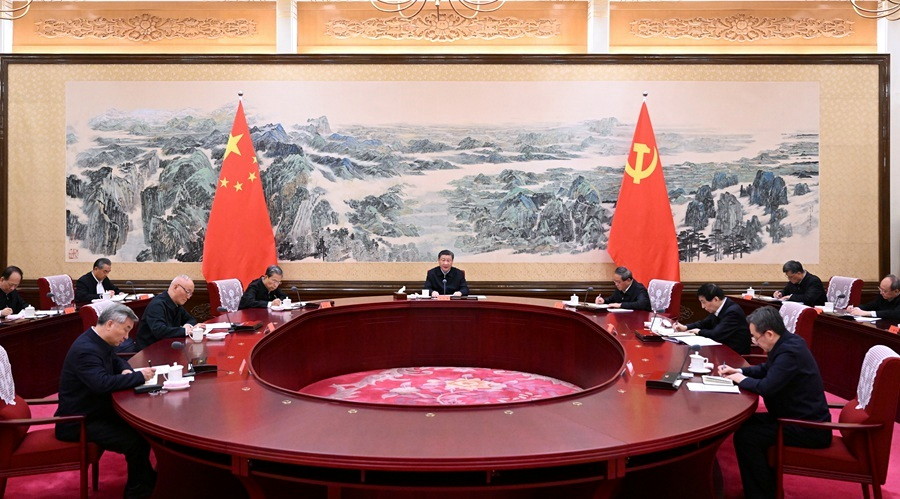
The CCP-5 plenary session has not yet opened, and there was a shock in the local office. On 24 October, the Secretary of the Hunan Provincial Council was replaced by Wang Zhijun, who had been travelling for a long time between the Central Department of Finance and Economics and the Office of the State Council, while the Secretary of the Yunnan Provincial Commission was replaced by Mogay, who was of the central information system. The change in party positions around the same day in the six provinces is not the number of names, but the simultaneous re-allocation of political power by the central authorities on both organizational and ideological lines of economic governance.
Reuters News, October 24th.The round of changes, which covered six provinces, was published immediately after the five-day plenary session, held from 26 to 29 October. Six provinces are involved in party posts at different levels: Hunan and Yunnan re-engineered the provincial secretaries, while others are involved in the positions of deputy secretaries of provincial committees, party secretaries of provincial governments, etc. Central personnel decisions are made first and then the administrative transfer is carried out by the respective bodies, which constitutes the institutional path for this change of posts.
I. Hunan: Why did the State Council's Executive Officer change to the Provincial Secretary?
Based onCommuniqué of the Hunan Leadership Conference(a) Deputy Minister Hao Jun arrived to announce the central decision: Wang Zhijun is the Secretary of the Provincial Council and Shen is no longer the Secretary, Standing Committee and Commissioner of the Provincial Council; Mao Wei Minh is no longer Deputy Secretary, Standing Committee and member of the Hunan Provincial Council. The readjustment of the provincial secretary and the provincial government leadership means that the next economic planning, organizational personnel and administrative implementation relationship in Hunan will be re-engineered.
Wang Zhijun was a former head of the Economics Bureau and the Economics Directorate of the Central Office of the Chief Finance and Economics Group in 1965, and was also Deputy Minister of Industry and Information Technology and Deputy Secretary of the Provincial Council of Heilongjiang. After June 2023, he served as Under-Secretary-General for day-to-day work in the Office of the State Council, with experience in central economic coordination and day-to-day government operations. Unlike officials who have been promoted to the single-place system for a long time, their curricula vitae cover three levels of work of the Central Macroeconomic Policy, Industrial Management and Local Party Committees.
Shen was the Governor and Secretary of the Provincial Council of Henan Province and served in Hunan in
- The public statements handed over by Hunan and the old chief of the police have placed a high emphasis on compliance with the party ' s central decision; The political statements made at the provincial assembly of cadres are part of the organizational relationship within the party and not the mandate of local voters, which was formed through the election campaign and public debate.
II Yunnan: The propaganda system officials enter the highest party positions in the border provinces
The blogger says:Xinhua's announcement on the Yunnan Provincial Council AdjustmentIt is clear that Mogay was replaced by Secretary of the Yunnan Provincial Council and Wang Ning no longer holds that position. After Mogai's long-standing responsibility for advocacy and external narratives, and his transfer to the border provinces, Yunnan's social governance and information control has also reached a point of convergence of policies that deserves close observation: Yunnan's border trade, ethnic affairs, cross-border governance and public opinion management, which connects South-East Asia, has a much greater role in local leadership than general public information. Yunnan shares the border with South-East Asia, and cross-border economic, ethnic affairs and border governance are the practical tasks that the new provincial secretary must take over. Mo Gai ' s curriculum vitae in the central communications system makes local public opinion governance and key policy messages a concrete window of view of how they will be governed in their tenure.
From the Central Office of Finance and Economics and the State Council to the Central Communications System, the two new provincial secretaries have come from different directions, pointing to the same political realities: the key appointment and removal of the local party chief, determined by the Central Organization of the Communist Party, and the local community has no direct means of electing to the post. This system reinforces, first and foremost, the chain of responsibility of the superior to the subordinate; Local people lack a reciprocal power portal for how to evaluate the public service and policy failures of a leadership.
Three, six provinces synchronized: how the Provincial Secretary and the Secretary of the Government Party allocate power
New staffing arrangements in six provinces can be observed in terms of specific posts:
- Hunan: Wang Zhijun is the provincial secretary; Sheweijiang is the Secretary of the Party of the Provincial Government, which means that the post of Governor will be in the hands-over process.
Yunnan: Mogai, from the central information system, was replaced as the provincial secretary. Fujian Guo Ninging is the Party Secretary of the Provincial Government, Lin Too is the Deputy Secretary of the Provincial Council and Qin Hae-shang is the Deputy Secretary of the Provincial Council, who is the Deputy Secretary of the City of Fukuzhou. Qinghai: Zhuge Wujie was transferred from the position of Deputy Secretary of the Hubei Provincial Council to Deputy Secretary of the Qinghai Provincial Council and to the Member of the Provincial Government. Jiangxi: Chen Yongqie was the Party Secretary of the Provincial Government, following an investigation conducted by Governor Ye Jianchun in August. Hebei: Zhao Zhi Zhiqiu, Deputy Secretary of the Provincial Council and Secretary of the Provincial Government Party, foretold that the main head of the provincial government would be re-elected.
Consolidated records aboveReuters personnel list as at 24 OctoberI'm sorry. The party secretary of the provincial government is a party leader, while the governor is required to perform the statutory appointment and removal procedure. When the personnel list is published, local people tend to face well-defined organizational candidates. This arrangement, which is decided by the party organization and is followed by the State institutions, constitutes a key element in the CCP cadre system in the leadership of local government.
Fujian was involved in several positions in the same round of adjustments, including the provincial government party, the deputy secretary of the provincial council and the secretary of the city of Fukuzhou. Major investments in provincial capitals, land concessions and public budgets are managed by different institutions, and the succession of changed projects, budgetary responsibilities and major administrative decisions of leaders are all related to the extent to which local taxpayers can obtain public explanations.
The appointment of provincial secretaries in Hunan and Yunnan, together with the restructuring of the government party groups in Fujian, Qinghai, Jiangxi and Hebei, demonstrated how the central organization system coordinates the local party political leadership. The boundaries of power of party members, deputy secretaries of provincial commissions and provincial secretaries vary, and subsequent statutory appointments and division of labour in government determine who actually manages finance, industry and social affairs.
Hunan has long faced problems with industrial upgrading, local finance and capital project management; Yunnan is responsible for border trade, regional transport and ethnic area governance. The transfer of cadres did not erase the policy responsibilities that existed: what were the key decisions that the outgoings had been involved in, how were the losses and benefits of local projects accounted for and what were the public indicators that their successors would be tested for? These are the six provinces that will be relevant to the local population.
Central appointments can change the provincial power landscape, but they cannot be a substitute for accountability for major public decisions: who signs, who approves, how the losses are dealt with, and who should have the right to know.
Four, five-plenary: organizational loyalty and political contradiction of local accountability
The current round of redeployments took place on the eve of the Fifth Mid- Plenary Meeting, once again highlighting the control of local positions by the central organizational authority under Xi Jinping. Provincial governors are appointed through party appointments, and candidate reasons and policy capacity assessments are rarely fully disclosed to the public. While one official can be quickly transferred to another province, the major policy consequences of his or her place of origin are difficult to publicly account for.
Taiwan Central ServiceHis career as a candidate for the State Council and the Central Economic System was consolidated, and this experience provided an important background for his entry into Hunan power hub. From the central office to the post of Registrar of the provincial councils, the coordinator of policy became the final person in charge of local political decision-making.
The P-5 plenary session has not yet officially opened, and Hunan and Yunnan's chief political candidates have shown the user-oriented orientation of Xi Jinping to local governance: experience in financial and economic coordination and political advocacy qualifications have been put at the provincial power centre. The appointment of cadres can be completed on paper, while past capital investments, local debt, border governance and social management do not disappear with the departures. The policy results behind these curricula vitae will be more indicative of what the central staffing structure means than the statements made at the new Congress.
Article discussion
Verified members can discuss this report publicly and manage their own content.
Checking member sign-in status…