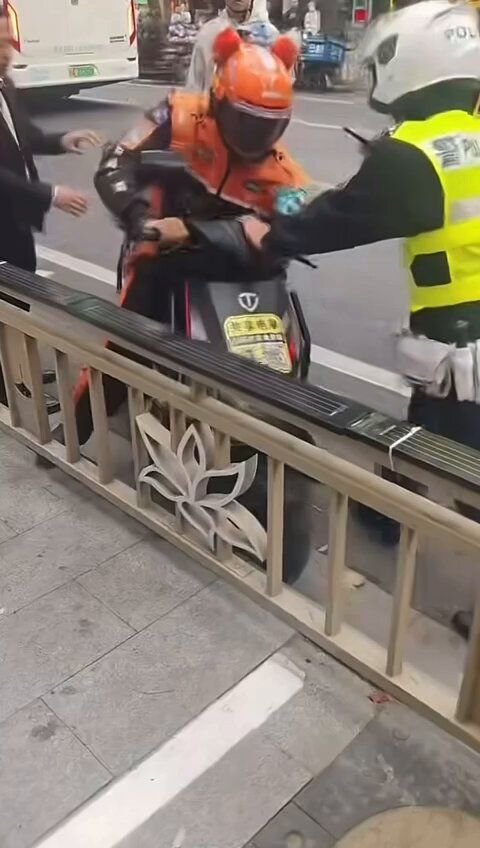
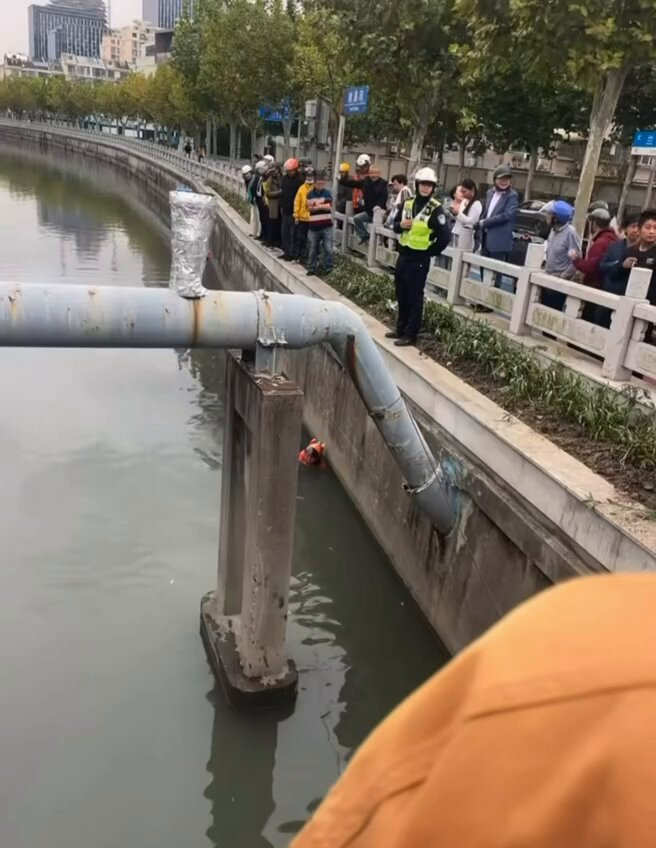
On 3 November, a sad scene occurred in the streets of Shanghai. A delivery rider was stopped by a traffic policeman while he was delivering his meal and then jumped into the river. Police, fire and rescue personnel arrived at the scene to carry out rescue operations. The incident, which was made available online, generated considerable attention and discussion.
According to information published in Platform X account number “Señor Li is not your teacher”, the incident occurred near Three Creek Road in Shanghai and the rider suspected of jumping off the river because of a fine. The live video showed a rider in an orange delivery suit sitting in an electric vehicle, in contact with a person in a police uniform, and another scene of a riverway near the scene of the incident.
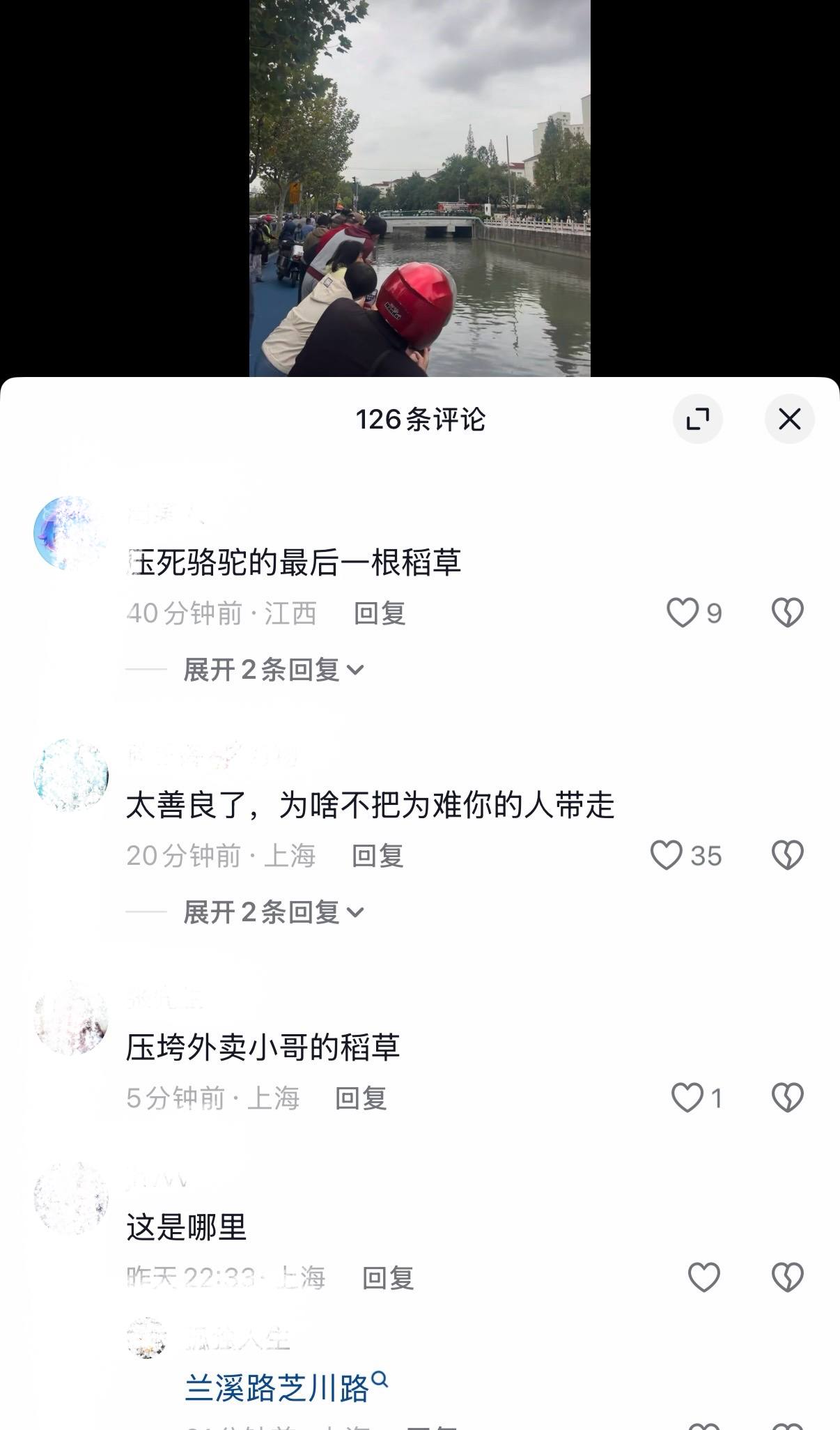
The last straw that's been squeezed on the delivery boy. The blogger adds:
This phrase reveals a concern behind the incident: Why is there such an extreme reaction when a common worker faces traffic law enforcement?
How much pressure does a man who earns his living by delivering?
For those with stable incomes, the sum of dozens or even hundreds of dollars may be a general expense in life.
However, the situation may be quite different for out-sale riders who depend on one to the other to provide for their livelihood.
They travel daily through the streets of the city and fight for a second to deliver their meals. The number of orders determines income, the timing of distribution affects the appraisal, and congestion, customer waiting, bad weather and platform rules can put economic pressure on them.
A single traffic penalty may mean that the income from a few or more orders is lost. If vehicles are suspended by law, it may also have a direct impact on the continuation of work.
Of course, the delivery riders must comply with traffic regulations and road safety should not be ignored because of the hardship of workers.
But we must ask: The purpose of urban traffic management is to safeguard public safety or to make punishment the main instrument of governance.
The law grants the traffic police the power to enforce the law, while requiring that administrative penalties be based on the principles of fairness and reasonableness, and that they be combined with education.
If a way of governance emphasizes only the absolute penalty for the offence, while ignoring the real causes behind the offence and the actual costs incurred by the ordinary worker, it is worth revisiting.
Platform uses algorithms to push riders, traffic cops punish riders on the road, who will protect their basic rights?
There is a long-standing contradiction in the Chinese out-sale industry.
The platform hopes that the riders will be delivered faster, that consumers will want the take-aways to arrive on time, and that city authorities will require that the riders strictly observe the rules of the road.
These three requirements are not in themselves contradictory, but if the distribution time frame is unreasonable and the appraisal mechanism is inflexible, the riders may be under pressure to work together with the business and regulatory system.
Of even greater concern is the fact that official open information in Shanghai has shown that the cyclist traffic traffic violation record may be linked to the platform ' s security rating and the billboard restriction mechanism.
原始来源 · shanghai.gov.cn上海市场监管局:骑手安全评分与平台派单机制shanghai.gov.cn ↗This means that the consequences of a traffic violation sometimes extend beyond the payment of a ticket by the police to the subsequent job opportunities of the riders.
The traffic authorities are responsible for enforcing the law, and the platform enterprises are responsible for allocating orders, but how much room do they have for the riders who are in between two management systems?
Who is responsible for the conflict between the system when the order is over-time and may affect income and traffic violations may result in penalties?
This is not to require that the riders enjoy the privilege of traffic violations, but rather that the platform enterprises assume responsibility for the reasonable allocation of time for distribution and that the administrative authorities, while enforcing the law, safeguard the legitimate rights and interests of workers.
A big city, why can't it be enough for a normal worker to survive?
Shanghai is one of China ' s most prosperous cities, with high-rise forests, a well-developed business and a large consumer market.
However, there are countless ordinary workers who support the day-to-day functioning of the city.
They may live on the outskirts of cities, and are carefully cost-saving and rely on long hours of work to earn income each day.

In such a state of life, a fine, a stoppage, an accident could further increase the otherwise uneasy financial burden.
The incident of the rider jumping was of concern not because the public thought that the rider could not comply with traffic regulations, but because many people saw their own life pressure from his situation.
There are those who see fines, those who think of unemployment, and those who think of rent, debt and household expenses.
These problems should not simply be attributed to a lack of individual psychological capacity.
The way a society treats workers in economically disadvantaged situations is the test of whether the system of public governance respects human dignity while maintaining order.
The power of law enforcement needs to be restrained and the dignity of workers more secure
Under the current political system in China, the executive enforcement power is highly centralized and ordinary citizens are often in a relatively vulnerable position when faced with law enforcement agencies.
For flexible groups of workers such as out-of-home riders, they are subject to both administrative control by the traffic authorities and business management by platform enterprises.
Under this dual constraint, the public question of whether workers have access to and are effectively and subject to oversight of the system of administration is unavoidable.
The Chinese Communist Party authorities have long placed emphasis on people-centred governance in accordance with the law. But it is important to assess whether these political slogans are meaningful, not only what official documents write, but also what is being done in real life.
The real importance a regime attaches to people is not how it promotes urban prosperity, but how it treats ordinary people who are running daily for their livelihoods.
Cruisers are, of course, obliged to observe traffic regulations, and traffic police have the duty to maintain traffic order in accordance with the law. But law enforcement cannot be done in isolation from the principle of proportionality, let alone ignore the fundamental rights of the subject of law enforcement.
In one such incident, the public requested that the authorities explain the situation, explain the basis of the law and safeguard the rights and interests of the riders, which was a reasonable social oversight, rather than a denial of normal traffic law enforcement.
After the rider was rescued, not only his health, but also his ability to continue working, to obtain the necessary help and to reflect on the regime.
An ordinary person who lives on labour to support himself and his family should not be left in a state of collapse between the urban management system and the pressure on survival.
The real question left by Shanghai is: who will guarantee the fundamental rights of a vendor when traffic enforcement, platform testing and economic pressure fall on a vendor, and who will really hear the voices of the bottom-up worker?
This is the core of the story that deserves to be constantly pursued.
Original video and extended reading
- Lives and 3 videos: Post on the Shanghai Rider Incident from platform X, “Student Li is not your teacher”. -Official policy paper: Response of the Shanghai Market Supervision Authority on the Spousal Riders Rating and Billing Mechanism, May 2026. Same incident information (not in Shanghai): News reports on the 2021 arrest of Hangzhou ' s ex-cavate riders and police reports.
- Intra-industry regulatory background: Central Network Office information on the governance of platform algorithms for life services, May 2026.
Article discussion
Verified members can discuss this report publicly and manage their own content.
Checking member sign-in status…