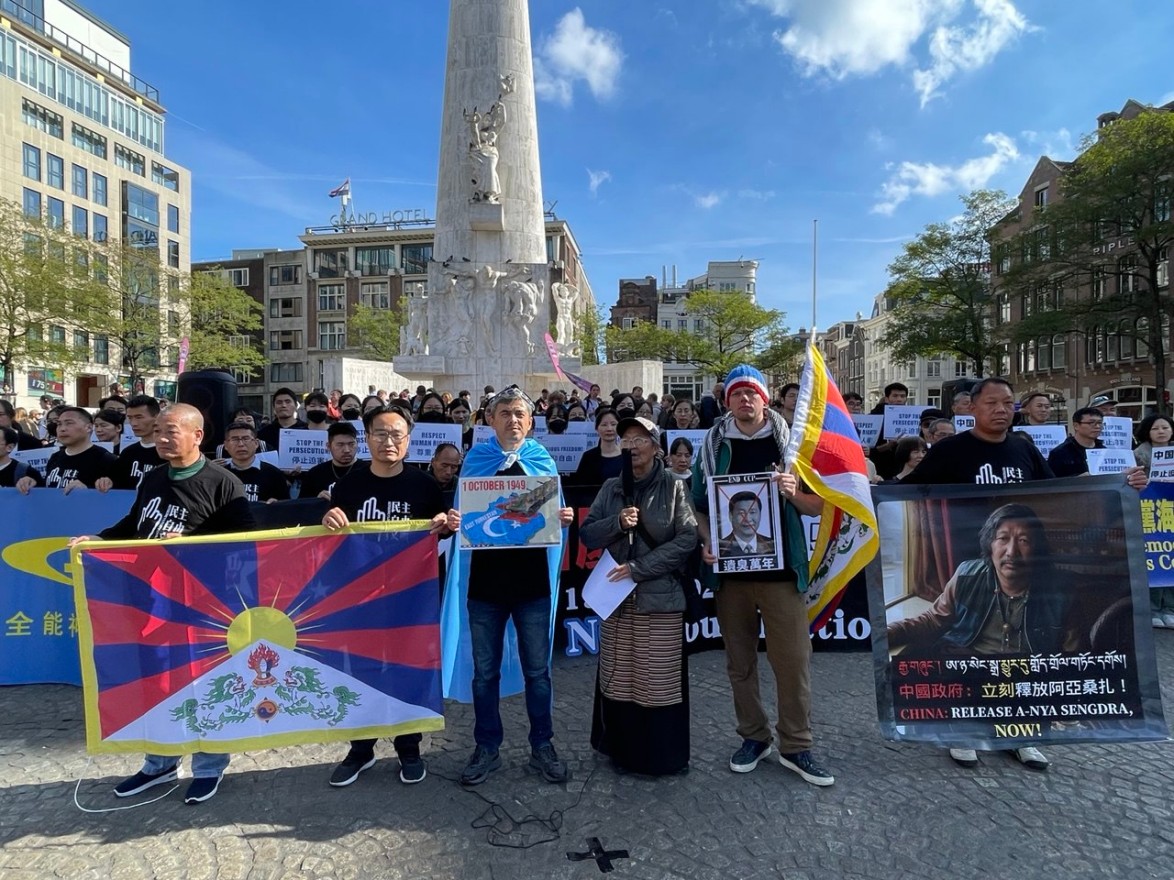
On the afternoon of 3 October, Amsterdam Dam Square became a European scene for an inter-ethnic anti-CCP demonstration. Tibetans, Uighurs, South Mongolians, Hong Kongers, Chinese democracy activists and Dutch human rights groups joined together in the Global Research China Day, which focused protests on the national policy of Xi Jinping and cross-border repression.
The event was promoted by such organizations as Tibet Support Group Netherlands. The organizers indicated that more than 145 Tibetan organizations around the world had undertaken joint activities around China's Eleventh National Day; The Amsterdam rally, however, brought the issue of Tibet to the same scene as the Uighur, Hong Kong, South Mongolia and China Democracy Movement.
原始来源 · tibet.nuGlobal solidarity demonstration against CCP repression — Amsterdamtibet.nu ↗This year, compared to the traditional “Eleven” protests, Dam Square has an additional specific legal objective: the National Unity and Progress Promotion Law, which came into force on 1 July. The organizers believe that the law not only strengthens the education of Mandarin and the unified narrative of the country, but also extends political deterrence beyond China ' s borders through provisions that cover organizations and individuals outside China.
From Tibet to common cross-border security issues
For Tibetans abroad, Beijing ' s ethnic policy is first and foremost a matter of linguistic, religious and educational control; (b) For Uighurs, it is linked to mass surveillance, detention, forced labour and family separation; Hong Kong exiles face extraterritorial provisions of the National Security Act and rewards for overseas activists.
These groups, which in the past often organized their activities separately, are now increasingly present in the same demonstration. The reasons are not complex: while the legal name and administrative structure used in Beijing for different groups are different, the logic of control has common ground — placing political loyalty above individual rights and cultural autonomy, and trying to keep critics abroad at risk from domestic law.
Article 63 of the Law on the Promotion of National Unity and Progress has been of particular interest to overseas organizations. Critics consider that this article provides a legal basis for targeting organizations and individuals who are found to be “disrupting” national unity. For Tibetans and other exiled communities already living in the Netherlands, this means that a Chinese domestic law can also be a tool for speaking about harassment and political deterrence abroad.
Why is the dam square
The Dam Square, located in the core of Amsterdam, is one of the most visible political expression spaces in the Netherlands. Protests are held here, which have different effects from demonstrations outside the Chinese embassy: the former enters the public and tourists' perspective in the Netherlands and turns issues that are easily understood as “distant Chinese issues” into local public discussions.
The organizers therefore not only called for a change of policy in Beijing, but also directly addressed their requests to the Government of the Netherlands and the European Union: publicly condemn China ' s new national unity law, take the initiative to respond to cross-border intimidation in the Netherlands and hold the Chinese Government accountable for the policy of forced assimilation in Tibet.
This claim moves the demonstration from symbolic anti-communist activities to a specific policy level. The question for the Government of the Netherlands is not whether it agrees with the demonstrators ' assessment of China ' s political system, but whether the Dutch law enforcement and security agencies can provide protection if their residents are followed, threatened, cyber-harassed or pressured by their families for criticizing Beijing.
Why did Xi's "unity" create a coalition opposition abroad
The official Chinese Communist Party described “national unity” as the basis for national unity and social stability. But when harmonization is translated into language education standardization, control of religious organizations, political loyalty education and legal deterrence for critics abroad, it also has a counter-effect: groups with very different historical, religious and political claims have begun to form inter-ethnic coalitions in the face of Beijing.
This is the most interesting political picture of the site of the Amsterdam Dam Square. Tibetans do not need to become part of the Hong Kong democracy movement, nor do they need to accept all Tibetan political ideas; They need only confirm a common principle that Beijing has no power to take political bans in China to the streets of the Netherlands.
This alliance of opposition forces abroad is a long-term failure for the CPC. The party system, which seeks to eliminate internal disparities through “unification”, has allowed different groups under pressure to find common language outside the country. Each time a law expansion directed at a particular group of people may provide another group with new references to understand its own situation.
The dam square on October 3 did not change Beijing law, but it openly painted a line in the heart of European cities: the Chinese Government could enact its own domestic laws, but it could not thereby be empowered to regulate the political expression of the Dutch population. It is this line that ultimately needs to be kept in place to counter cross-border repression.
Article discussion
Verified members can discuss this report publicly and manage their own content.
Checking member sign-in status…