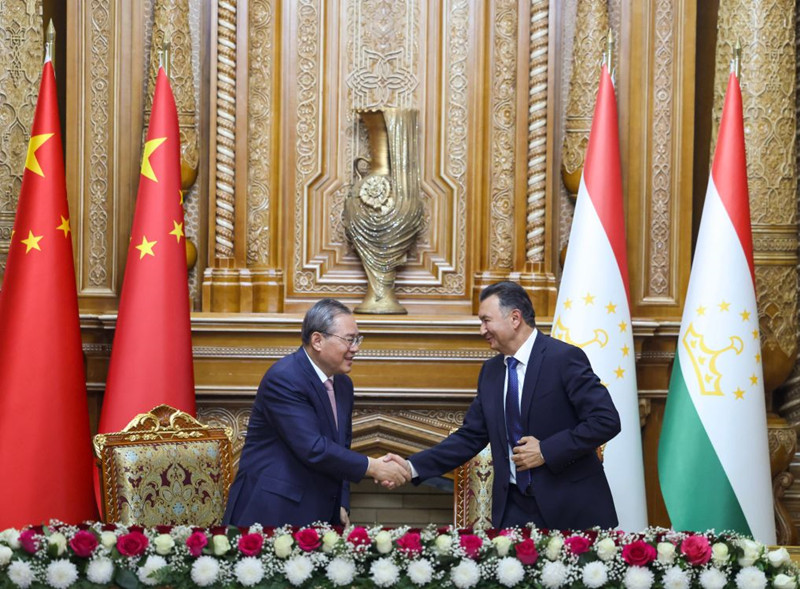
The Dushanbe talks table, in addition to trade, minerals and infrastructure, also has an agenda that is increasingly important in Beijing: who protects China's people and interests in Central Asia and who has the right to define cross-border “security threats”. On 18 October, Chinese Prime Minister Li Qiang met Prime Minister Rasurzoda in the capital of Tajikistan, proposing to deepen law enforcement and security cooperation; The next day he discussed his cooperation with President Rahmon, and he said that he would be able to do so.Reuters.Beijing calls for further strengthening of security and intelligence coordination to counter its so-called terrorism, separatism and extremism.
Tajikistan shares the border with Xinjiang, China, and Afghanistan. In Beijing, there are ongoing projects in Tajikistan, such as roads, mining, etc., and Chinese workers and traders face real security risks. There had been local attacks against Chinese citizens and Beijing had reason to ask the host country to protect its residents. But the claim of a State to protect its citizens is not the same as cooperation to incorporate its own concept of political security into the law enforcement of neighbouring States.
News from the Chinese Government Network, Xinhua News, 19 OctoberIt was shown that on 18 days the parties had signed documents covering areas such as infrastructure, education, anti-corruption and standardization. At the same time, Li stressed that new areas such as trade investment, green minerals, clean energy and artificial intelligence could continue to expand and that law enforcement security cooperation was part of the human environment. Economic and security were closely organized in the same meeting: the sense of presence was deepened by the investment and the security of personnel was the reason for further developing police and information cooperation mechanisms.
For Tajikistan, Chinese capital and engineering cooperation can provide real development opportunities; Central Asian countries also have their own border security and the pressure of the situation in Afghanistan, and they need not be seen as passive players in accepting Beijing policy. The risk is that if both sides classify political expression, ethnic policy disputes and even general exiles in China as general security without being independently identified, cross-border law enforcement may go beyond the legitimate borders of protecting the public from violence. In particular, the long-standing detention and restrictions on religious activities in Xinjiang are among the human rights issues that are widely criticized internationally, and the political implications of such concepts as “anti-secession” cannot be automatically eliminated by terrorist labels.
Central Asia is not the only country with a visitor to Beijing. United States Secretary of State Lubiño arrived in Uzbekistan on 18 OctoberParticipated in C5+1 contacts with the five Central Asian countries and led a business delegation for mineral and commercial cooperation. The Central Asian countries, which have been given new bargaining opportunities between China, Russia and the United States, may also face pressure from different major Powers to make their security and economic positions known. While it is clear that competition is being summed up as “the US-China struggle for Central Asia”, it is easy to ignore that it is the border population, the labour force and the minority groups that are moving in the countries that are truly responsible for the security policy.
Beijing has the unique advantage of being able to move forward with long-term investment, transport engineering, the SCO mechanism and political security issues. It also faces a threshold that must be openly discussed: cross-border cooperation to combat actual violent crime, and the extension of a stable domestic interpretative framework to foreign territory, cannot be confused. It is this line that will determine whether new cooperation will improve the security of the Central Asian population or increase the risk that dissidents will remain tracked outside the borders.
The photo taken and the signing of the Dushanbe contract can prove that the Government is close, but it is not possible to explain in isolation how these agreements will change the situation of ordinary people. For the Government of Tajikistan, the receipt of funds and infrastructure does not mean that the discretionary power of the country ' s police must be delegated to Beijing; For the Chinese Government, the legitimate objective of protecting citizens abroad should not be to be used as a pass for the indefinite extension of the definition of political security.
Article discussion
Verified members can discuss this report publicly and manage their own content.
Checking member sign-in status…