
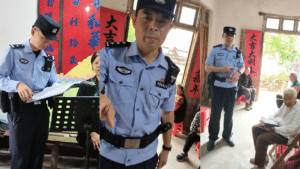
Two days in a row, a family church in Anguilla was entered, searched and interrogated by public security, military and religious affairs personnel.China Aid Association announced on September 22On the 16th of September, Wang Xiao Ji, the head of the oil shop, led about 30 public security and local staff to the meeting place; the next day, religious affairs personnel were again present.
This is not an ordinary “local check”. Photographs and video footage released by the Chinese Aid Association show that law enforcement officers entered a meeting place with crosses, long chairs and religious texts. The report also said that a female evangelist was wounded in the hand while being taken away, and Zhang Yuan Feng was still restricted at home as of September 20; a deputy minister of the Combat Command of Qingdao County was also involved in the interrogation on the same day. Public security, general war and religious affairs personnel appeared at the same time, showing the incident a clear multi-departmental synergy.
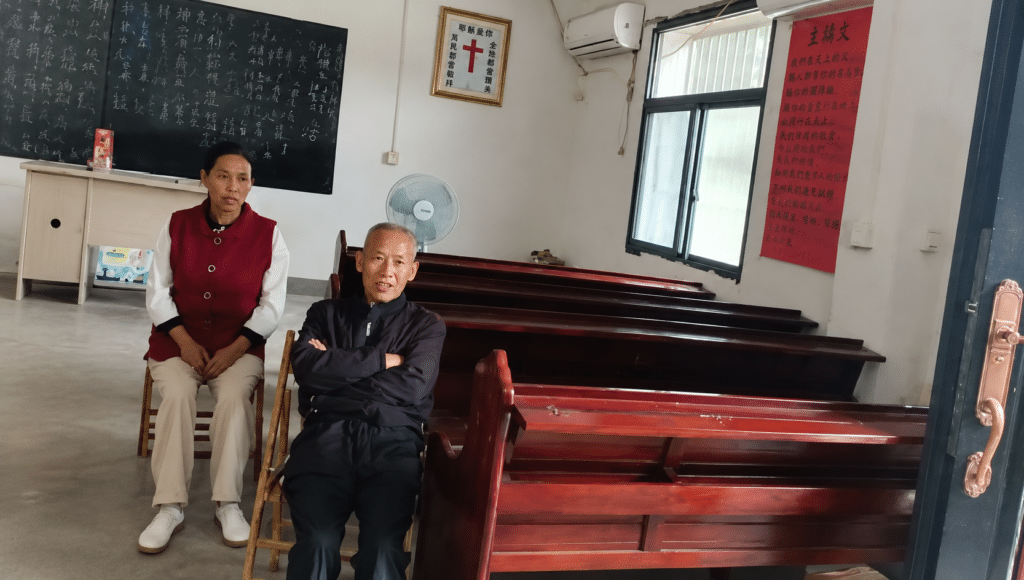
On September 17, Liu Qing Jing, a religious affairs officer in the ancient city, was also directed into the meeting place and asked young believers not to sing songs containing words such as “Jesus,” “God,” “Lord.” Regardless of whether this specific verbal requirement has a final written basis, prohibition of religious songs, deletion of live images, restriction of personnel actions have pushed law enforcement from “management of unregistered places” to direct intervention in religious expression and personal information control.
The Chinese Aid Association said law enforcement officials had repeatedly asked about the relatives of the two evangelists, about Zhang Yuanlai, a pastor and his activities abroad in the U.S. New Jersey Pastoral Council. If this information was accurate, grassroots religious enforcement law had included overseas relatives into the scope of the investigation, indicating that local religious governance was overlapping with so-called “external contacts” scrutiny.
Article 36 of the current Constitution of ChinaTo provide citizens with freedom of religious belief and to prohibit state organs from forcing citizens to believe in or not in religion;Regulations on Religious AffairsThe issue arises here: When administrative administration is constantly expanded to gatherings, songs, mobile video, overseas contacts and personal actions, so-called “religion management according to law” is no longer just registration management, but is in the actual life of recreating what religious activities can be done, what can be said, and with whom to contact.
The most documented thing about the Kinshasa incident is not whether the official authorities have used a summary of "control of illegal religious activities," but every power action that has been named: entering the station, taking away people, removing mobile phone content, restricting believers' actions, forbidding religious songs, engaging war cadres in interrogation, and overseas relatives being the subject of investigation.
At present, local governments and public security agencies have not publicly issued legal documents that can explain these measures in a series. In terms of religious freedom, what really needs to be tested is not the abstract declaration that "freedom of belief is guaranteed", but whether state agencies can carry out administrative administration without suppressing religious expression, abusing personal restrictions, and arbitrarily deleting personal data.
文章讨论
已验证会员可围绕报道公开交流,并自行管理自己的内容。
正在检查会员登录状态…