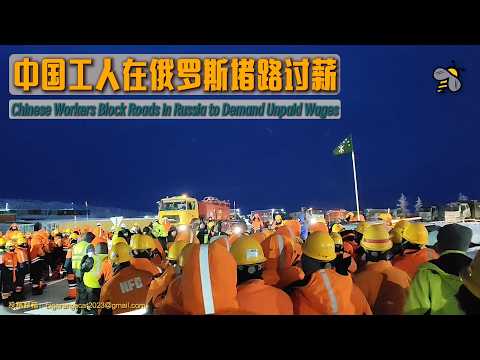
From 26 October to 1 November, Chinese workers in the Bajim copper mine in the Chukot-Khi Autonomous Region of the Russian Far East held a strike for seven consecutive days and repeatedly blocked traffic and demanded payment of salary arrears.
The strike was revealed on November 6th on the independent protest website, Yesterday.I'm sorry. The participating workers directed the liability for unpaid wages to the China-Geek Bridge Engineering Agency Group and the China-Tek 9 Group. On 7 November, the Network recorded the relevant records.
Large Chinese engineering firms continue to demonstrate project construction and contracting capacity abroad, while Chinese workers directly involved in construction have to stop working at mining sites far from their home countries to obtain the most basic remuneration for their work.
This contrast exposes a long-standing problem in the Sino-Chinese overseas engineering system that is masked by the performance of the project: the project can be expanded in size, while the responsibility for paying the wage may become increasingly blurred as multi-level contractual relationships become more and more blurred.
A week of strike, workers channel the pressure of pay to run the project
The Bajim copper mine is located in the Chukchi Autonomous Region of the Russian Far East, in a remote location, and the access of engineers and daily life is highly dependent on the organization of the project.

Yesterday revealed that Chinese workers had been on successive strikes between 26 October and 1 November and had repeatedly expressed their claims for wages by blocking traffic.
In such a remote construction environment, the cost of collective stoppages is not low.
Workers may face not only income disruptions but also problems with accommodation, transportation, contract performance and return arrangements. Mines far from China often mean fewer channels of recourse and greater mobility than the country ' s urban sites.
Workers continue to take collective action for seven consecutive days, reflecting the extent to which the problem of unpaid wages has reached an impact on the proper functioning of the project.
The public information does not disclose the specific amount of unpaid wages, the number of participants in the strike and the final settlement, but the many days of collective strikes themselves indicate that the normal system of payment of labour remuneration fails to effectively address the claims of the workers concerned.
Engineering contract layer subcontracting, and wage liability can easily sink
Large Chinese engineering enterprises are working overseas and are often organized at different levels, including through the master contract for the project, the professional construction subcontract and the labour subcontract.
This model of management, which increases resource mobilization capacity, may also be the single biggest obstacle to workers ' wage-raising.
When settlement disputes arise between the enterprise and the project owner, or when there are problems of money transfer between different levels of contracting, the downstream workers are often the first to be affected.
They do not determine the price of the works, do not participate in the allocation of project funds, or control when the higher-level contractor settles the works, but may be the last link in the overall funding arrangement.
The payment of wages after the worker actually has worked depends on the fulfilment of the contract and legal obligations of the employer and the enterprise concerned.
The project role of the China-Tek Bridge Engineering Agency and the China-Tek 9 Group, named by the workers, was still to be determined by contractual and business information.
However, the claims of unpaid salaries made by workers already involve the responsibility for overseas project management of these large State-owned engineering enterprises.
Even if the actual use of a work contract is signed by a subcontracting enterprise, the master-contracting system cannot therefore ignore the payment of workers ' wages and labour management issues.
If a large engineering enterprise can pool machinery, personnel and construction progress without effectively monitoring whether workers involved in its work are paid, there is a clear gap in its so-called capacity to manage modern projects.
Workers may be more difficult to protect when they leave the country
Chinese workers who travel to Russia for construction work usually rely on recruitment enterprises or labour agencies to arrange work, visas, transport and accommodation.
When labour disputes arise, workers must not only face the business itself, but also address the extraterritorial legal environment and language barriers.
The availability of timely and effective legal aid to overseas miners is closely linked to the contract of employment, the Russian local labour legislation and the system of regulation of foreign labour cooperation in China.
These procedural difficulties do not automatically disappear because workers have already worked.
For ordinary workers, there is only one direct demand: to get the wages that are due under the contract and the law.
However, in cross-border engineering projects, they may not have direct access to the management of the enterprise that decides to pay for the project, making it more difficult to know the exact flow of project funds.

Ultimately, strikes, gathering and blocking traffic are the way in which some workers force project managers to face problems.
When a worker must stop the transport of works to attract the attention of management, normal labour communication and wage security mechanisms within the enterprise have in fact failed.
The honour of overseas works cannot be based on the workers' unpaid wages
State-owned engineering enterprises in China regularly demonstrate their construction capacity and international market position through overseas engineering projects.
Large mines, railways, bridges and energy facilities can be the performance of corporate annual reports and can be the official source of information on China ' s engineering and technological capabilities.
However, these works were not made by slogans.
The construction is actually carried out by ordinary workers who work long hours in remote areas. They bear the burden of harsh circumstances, long-term separation of families, work risks and hardship outside the country.
If the wages of these workers are not paid on time, the company ' s claims of success cannot be evaluated solely by the value of the product, the amount of the contract and the progress of the work.
In August this year, another Russian company, the Baltic Gas Chemical Complex, was involved in the construction of a Chinese enterprise, and there were collective protests by Chinese workers over unpaid wages. The records show that a paid worker and project personnel were temporarily under police control after a clash and that other workers were collectively rounded up in police vehicles and eventually released.
The two incidents, which involved different projects and enterprises, could not be confused into the same case, but both showed that the wage dispute between Chinese workers in Russian construction projects had evolved more than once into collective action.
On the one hand, enterprises use the labour capacity of Chinese workers to expand their overseas engineering operations; On the other hand, workers who face problems in their pay pay are required to pay the price of collective stoppages and public protests. This unequal distribution of costs and benefits is a major source of labour conflict in the overseas construction of the Chinese-funded industry.
Real work performance, first and foremost, in the workers ' wages account
The strike by the Bajim copper miners lasted from 26 October to 1 November. The public records do not currently indicate whether all outstanding salaries have been settled, nor do they disclose the full outcome of the enterprise ' s claims against workers.
However, the strike has exposed a labour problem that has long been concealed by the publicity of the enterprise ' s works.
For workers, overseas work does not imply a special political task. They provide labour and the company pays wages, which is the most basic labour relationship.
For large State-owned engineering enterprises, the state capital background and the size of the project should not be a reason to avoid responsibility for labour security at the grass-roots level.
The more capacity-building is built in a company that can organize large-scale mining projects in the Russian Far East, the more it becomes possible to build capacity and the more it highlights the lack of responsibility for labour management.
The real achievements of Chinese overseas works should not be confined to business announcements, contract amounts and completion campaigns, but should also be reflected in the bank accounts in which every ordinary worker receives his or her wages on time.
If workers must strike for seven consecutive days to earn their own work, it is worth recording, first and foremost, how these workers who support overseas works are forced to defend their rights, which should be guaranteed through collective protests.
Article discussion
Verified members can discuss this report publicly and manage their own content.
Checking member sign-in status…