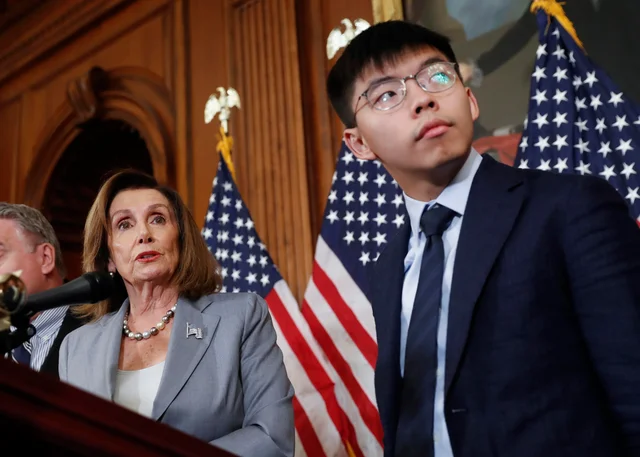
A photograph taken in September 2019 at the United States Congress Hill, the Yellow Front stood by the then Speaker of the United States House of Representatives, Nancy Perosi. At another hearing, he sat in the witness stand of the Chinese Commission of the United States Congress and Administration, publicly calling on the United States Congress to pass the Hong Kong Human Rights and Democracy Bill. The events were in front of the global media.
Seven years later, the same type of international lobbying appeared in the prosecution case in the Hong Kong National Security case. On 1 October, Freedom House's latest issue of “Political Prisoners Watch” included Wong's front in the case of five democratic advocates “who have been prosecuted for seeking help from abroad”, with particular reference to his past contacts with United States politicians such as Pélosi, then Senator Marco Rubio.
原始来源 · freedomhouse.orgFreedom House:五名因向境外寻求帮助而遭追诉的民主倡议者freedomhouse.org ↗On 2 September, Huang Noboa himself admitted to the High Court of Hong Kong a crime of “collusion with foreign or foreign forces against national security”. The case has not yet been sentenced. The prosecution described the conduct as extending before and after the application of the Hong Kong National Security Act, which in fact constituted the indictment period from 1 July to 23 November 2020.
Photos have not changed, legal significance has changed.
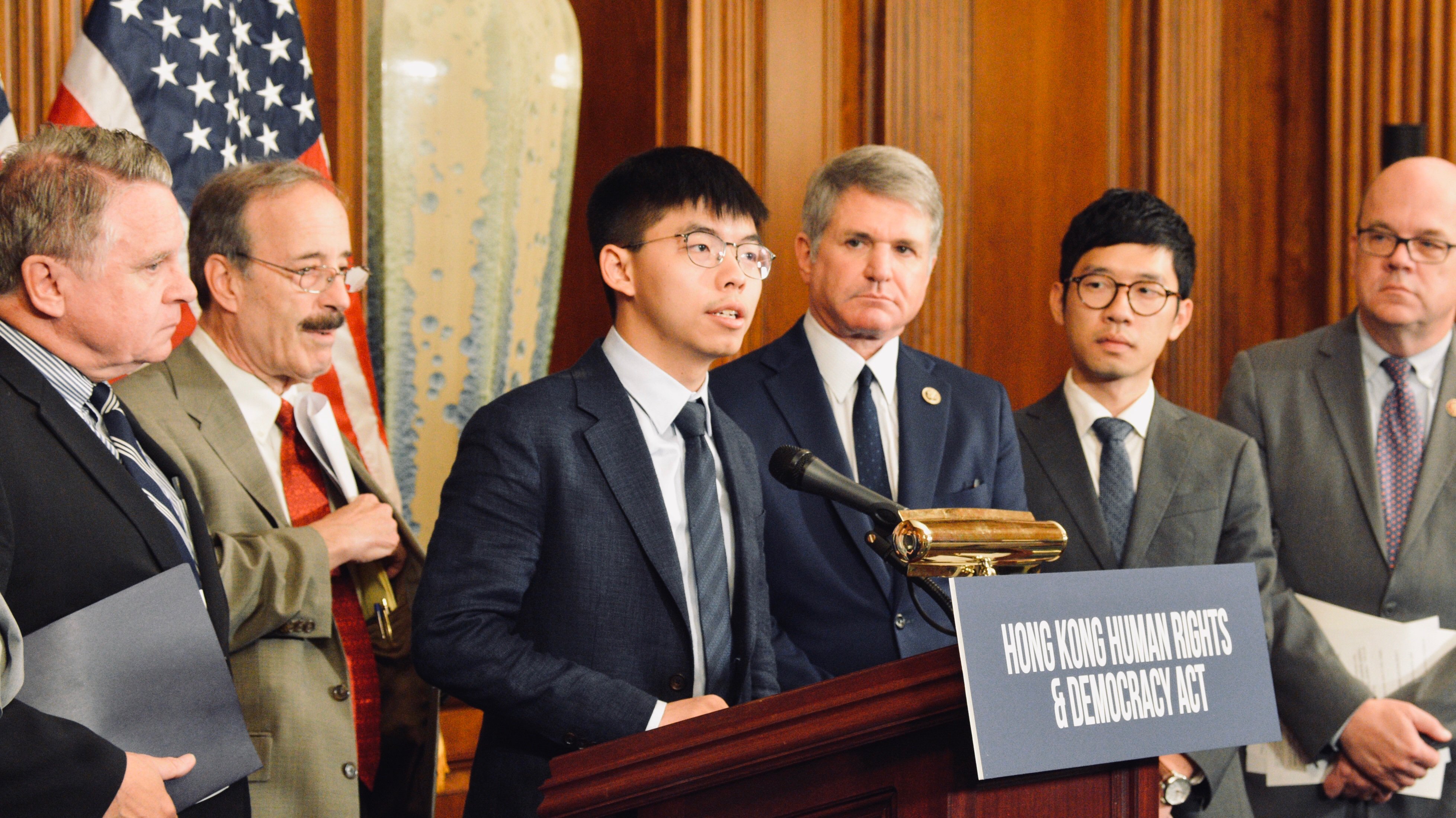
The Washington trip in 2019 was not a covert event. On 17 September, Huang Nobing, Ho Hoo-hyun and others spoke publicly about the protests and the human rights situation in Hong Kong at a hearing in the United States Congress. The following day, Polosi held a press conference with several bipartisan parliamentarians and Hong Kong activists to promote the Hong Kong Human Rights and Democracy Act. The photographs, parliamentary records and interviews of the year are still publicly available.
The prosecution case heard by the High Court of Hong Kong on 2 September placed these activities on a longer “international front” axis. Hong Kong Radio reported that the prosecution claimed that Wong Sing and Rong-hyun had agreed to pursue political goals through international lobbying as early as 2016; Before the implementation of the National Security Law, two persons and others requested foreign agencies and personnel to impose sanctions, including on Hong Kong or China.
原始来源 · govinfo.gov美国国会记录:香港民主与人权听证材料govinfo.gov ↗The key legal line has been set for 1 July
- After the implementation of the Hong Kong National Security Act on that day, the prosecution alleged that Wong Front continued to support international lobbying through foreign media and social platforms, including sharing of a brilliant post, and thus accused him of continuing to participate in the conspiracy to request foreign sanctions or other “hostilities” between July and November 2020.
This distinction is important: the charge is not simply to criminalize the meeting with the United States Congressman in 2019 per se, but rather to have the prosecution use its early public activities to illustrate its so-called long-term cooperation, and to use the expression and cyberacts of the NSA after its entry into force as part of the time period of the charge.
原始来源 · news.rthk.hk香港电台:黄之锋承认串谋勾结外国势力罪news.rthk.hk ↗The sentence originally scheduled to end in 2027 was followed by a new pending trial.
Wong Noboa has been in detention since November
- In 2024, he was sentenced to four years and eight months in prison in the Democratic “47” case for conspiracy to overthrow the State power. The defence stated in court on 2 September that, in the absence of this new case of “collaboration with foreign forces”, his original sentence was expected to end in January 2027.
However, in June 2025, Huang's defence, who was still serving his sentence, was again arrested and charged by the National Security Police. The second national security case was thus covered by the first sentence. After the confession of guilt on 2 September, Judge Tan Yoo-Hoo remanded the sentence to another day.
Under the National Security Act, “coercion with foreign or foreign forces endangers the security of the State” is punishable by different sentences depending on the circumstances; Life imprisonment is a serious condition. In its plea, the defence requested the Court to use the lower threshold of sentencing and referred to Wong Wing's continued detention at age 24 and his imminent age 30.
原始来源 · reuters.comReuters:黄之锋在第二宗国安案件认罪reuters.com ↗Freedom House sees a common model across borders.
The report of 1 October did not discuss Hong Kong alone. It has tried to illustrate a transnational phenomenon, by co-locating Huang Nobing with Vietnamese journalist Fan Zhiyong, Azerbaijani election monitor Anar Mammadli, Iranian human rights lawyer Mohammad Seifzadeh and Egyptian human rights organization leader Gasser Abdel Razek, whose international communication itself has been included in criminal or administrative proceedings by the Government following contacts between activists with foreign parliaments, diplomats or United Nations mechanisms.
This is the analytical framework of Freedom House, not the legal conclusions of the Hong Kong courts. The Government of Hong Kong and the Beijing side have consistently argued that the national security case is aimed at specific acts against national security, rather than at normal international exchanges; China officially reported that Huang Nobing confessed in September as an “anti-China-related Hong Kong activist” and stressed that the charges involved requests for foreign sanctions, blockades or other hostile action.
The controversy thus focuses on a line of public lobbying, calls for sanctions and international initiatives against foreign parliamentarians, under what conditions are political expressions and constitute criminal acts against the security of the State with foreign forces. This line has been specifically interpreted and applied in a series of criminal cases since the implementation of the National Security Act.
Looking back at the 2019 photo, Wong Front stood in the United States Congress as a Hong Kong political activist who openly lobbied foreign legislators. By 2026, the court had recorded that the same political period had been placed in the context of a national security case that might continue to prolong his detention. What really changed between the seven years was not whether that meeting existed, but how the Hong Kong legal system redefined its relationship with subsequent conduct.
Article discussion
Verified members can discuss this report publicly and manage their own content.
Checking member sign-in status…