
A new house buyer in the new Sichuan Meeshan province recently told the story on social platforms: in 2019, a housing unit that had been purchased for $1.6 million was now worth only $300,000, while a bank loan remained unpaid for $1 million. In just seven years, the house had been under-priced by about 80 per cent, and the purchasers were still bearing a debt that far exceeded the current value of the house.
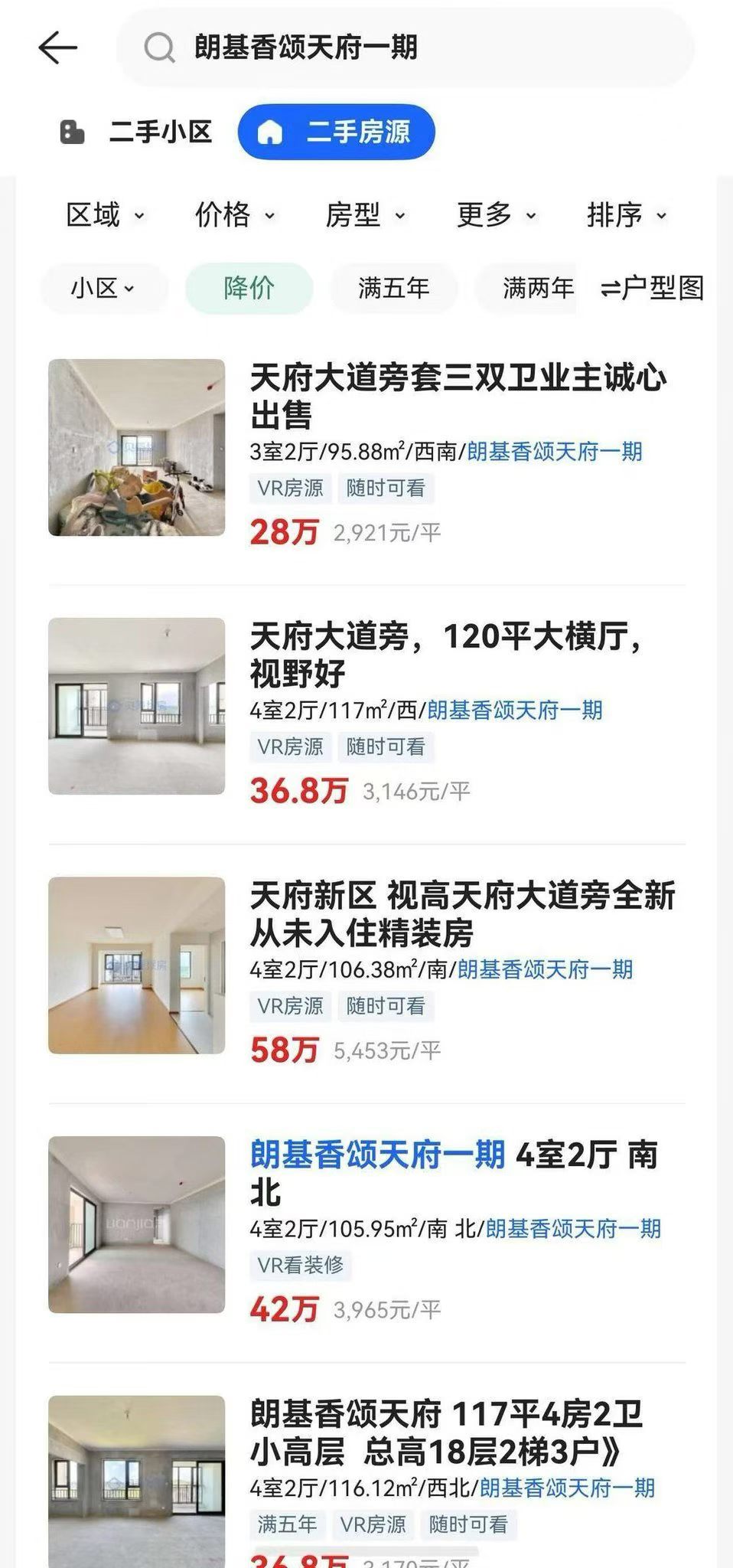
Meanwhile, the first second-hand listing of the new district of Ran Ki-sang Tien Tien Tien, in the New Meeshan Tien Palace, revealed that a total of 95.88 square metres of three-rooms and two houses, with a listing price of only $280,000 and a unit price of approximately $2921; (a) A further 117 square metres of four-room, two-bedroom residences with a listing of $368,000; A 105.95 square metre housing was registered at $420,000. Commodity houses that were previously packaged by developers as opportunities for asset appreciation are now seeking buyers at alarming prices.
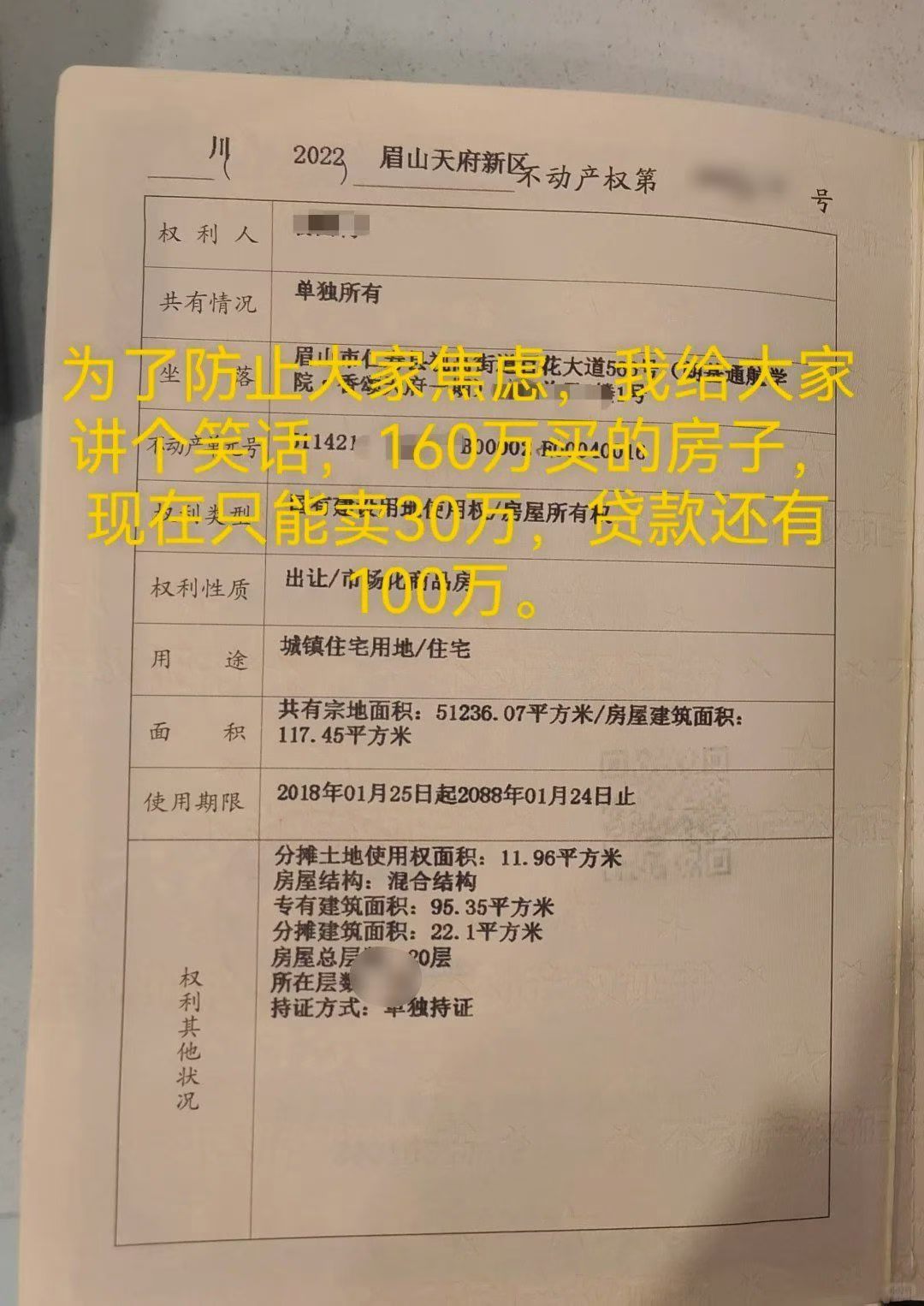
The party also presented a certificate of real estate rights in the new district of the Meeyama Palace, which was registered in
- The certificate shows that the residential building covers 117.45 square metres, that the land is for urban and residential use and that the period of use of State-owned land is 25 January 2018 to 24 January 2088.
A personal experience of a large drop in the price of a source of housing, a real estate title card that records land ownership, reveals the deep contradictions in China ' s real estate system: Local governments have long-term access to large fiscal revenues through land concessions and real estate taxes, while ordinary residents have to save their lives and have to buy their homes on bank loans for decades. After the housing bubble broke down, the land concessions and taxes already collected would not be automatically refunded as a result of the decline in the house price, and the residents ' bank debts would not disappear.
The $1.6 million fell to $300,000, and the loss was not only the market value of a house, but also the accumulation of labour by ordinary families over decades. What is really to blame for this real estate crisis is how China’s land finance, real estate taxation and housing finance system have together shaped high housing prices, leaving the heavy costs of the collapse of housing prices to ordinary families.
1.6 million dollars of houses falling 1.3 million dollars, and the bank's $1 million debt still exists
According to the public account of the person concerned, the price of the house purchased in 2019 was 1.6 million yuan. Today, the house can only sell over $300,000 and the loan balance is still $1 million.
The nominal value of housing has been reduced by 1.3 million yuan, a drop of 81.25 per cent, according to a price of $300,000.
Even more so, the family faces losses of well over $1.3 million.
The initial down payment by the purchaser, the principal and interest on the loan subsequently repaid, and the expenditure on renovations, tax on the tax, property, etc. constitute the actual housing cost. As the real estate market declines, these long-term inputs cannot be fully recovered through the sale of housing.
If the house is eventually sold at a cost of $300,000 and the proceeds are fully used to repay the bank loan of $1 million, a debt gap of about $700,000 remains.
Article 413 of the Civil Code of China clearly states that if the mortgage is depreciated or auctioned or sold, the remaining portion of the price received is settled by the debtor if the price is not sufficient to settle the claim.
This provision means that, in the absence of other debt-disposal arrangements, the debtor may continue to assume the remaining debt even if the mortgaged house is sold.
A set of houses that have lost most of their market value may continue to occupy the labour income of the purchasers for the next decade or so.
This is one of the cruelest realities of the post-breathing of China’s real estate bubble: the rapid collapse of asset prices and the long-term rigidity of the population’s debt.
In the past, the increase in the prices of commercial housing for development convinced residents to buy housing, banks helped home buyers to pay early for their housing through mortgage loans, and local governments received financial income through land concessions. The whole market is operating in expanding real estate transactions.
Today, the prices of houses have fallen and buyers have borne the cost of shrinking; If income is reduced or unemployment is lost, families are also exposed to the risk of overdue loans, judicial enforcement and credit impairment.
The wealth illusions that emerged during the boom in real estate had been dashed, but the relationship between the bank and the debtor remained.
For a family that is dependent on wage income, the risk is sufficient to change the economic situation for the rest of its life.
Two, China's most special place in real estate: the land ownership of the country is owned by the people who buy it at high prices
The real estate certificates presented by the persons concerned reveal a long-standing problem in China ' s housing property system that has been masked by high housing prices.
The certificate registered a total of 117.45 square metres of residential buildings, of which 95.35 square metres are dedicated and 22.1 square metres are allocated. More noteworthy is the tenure and tenure of land.
Article 10 of the Constitution of China stipulates that land in cities is owned by the State. The Land Administration Act also establishes the corresponding land ownership framework.
Chinese residents buy commercial housing, they can legally acquire ownership of the house and the right to use State-owned land for construction, which is linked to the house, but they cannot obtain private ownership of the land by paying for the house.
Land use for urban residential construction is usually granted for a period of 70 years. Article 359 of the Civil Code provides for automatic renewal of the expiry of the right to land for the construction of a home, but such renewal does not change the nature of the State ownership of the land.
This institutional arrangement gives the Government broad administrative authority at key points of urban land supply, planning use, development intensity, land concessions, etc.
Developers must acquire, in accordance with the law, the right to use the land for construction in order to develop the corresponding real estate. The cost structure of land acquisition into real estate projects ultimately affects the price of the sale of the goods.
The cost of acquiring land tenure by developers is included in the housing prices paid by ordinary households.
This means that residents, while not being able to acquire private ownership of urban land, need to pay the corresponding economic costs for the marketing of land tenure.
During the boom, the continued rise in land prices will drive developers to increase costs and channel them to buyers through the real estate market.
Local governments, in turn, translate land resources into fiscal revenues through land concessions. The higher the housing prices and the more active the land market, the easier this fiscal revenue mechanism will expand during the boom.
The systemic contradiction in China ' s real estate market is here: ordinary people need to compete in the market to pay for their housing prices, while the important power to decide on land supply is concentrated in the government system.
Housing needs are borne by the population, land resources are allocated by the Government, land revenues are channelled into the financial system and financial debt falls on home-buying families.
III. Research estimates: land costs and related taxes exceed 55 per cent of the price of a set of housing
The high prices of real estate in China are closely related to the cost structure that is built up by land concessions and real estate-related taxes and fees.
The Chinese Land Finance Report 2024, published by the Economist, Mr. Ren Zeping, has undertaken a systematic study of China's land finance.
原始来源 · finance.sina.com.cn任泽平:中国土地财政报告2024finance.sina.com.cn ↗The report provides an estimate of the composition of the commodity residential price in 2023, using a sample of eight cities, namely Beijing, Shanghai, Guangzhou, Shenzhen and Hangzhou, Chengdu, and the results of which are as follows:
Land costs account for about 38 per cent of the house price, and real estate-related taxes for about 17.2 per cent, both of which together amount to 55.2 per cent.
This means that the price of each $1 million housing stock in this sample is equivalent to approximately $380,000 of land costs and $172,000 of real estate-related taxes.
The study also calculates the macro-relationship between national revenue and sales of commodity houses: in 2023, State land use rights gave out revenues equal to 49.7 per cent of the sales of such houses in the year; After five property-specific taxes, the combined amount corresponds to 65.6 per cent of the sale of the commercial house in the year.
The ratio of macro-fiscal revenues to sales is of a different statistical calibre than the cost composition of a single housing unit, but both studies reflect the very close economic links between China ' s land finance and the real estate market.
Real estate development involves a wide range of sources of fiscal revenue, including land tenure revenue, tax on deeds, land value added tax, property tax, urban land use tax, cropland occupancy tax and other applicable taxes.
Among them, State land tenure revenue is an important source of long-term support for the budget of the local government fund.
Land supply is managed by the Government, developers acquire land use rights through the market, land costs enter the price of housing, and buyers pay the purchase costs through down payment and mortgage loans.
This process links public land resources, real estate markets and the wealth of the residents ' families.
The Government receives income from land concessions and real estate-related taxes, while residents pay for the price of their commodity housing at the wages of decades, which is the most noteworthy distribution structure of wealth in China ' s land fiscal system.
When land prices are rising, high land costs can be absorbed by the end market through house prices.
When the house price has fallen, historical land, which has entered the financial system, gives in income and associated taxes and does not automatically return the house of the buyer because it has depreciated.
This is the economic relationship between the financial prosperity of the land and the housing risks of the population, which is highly asymmetrical.
Four, down from $8.7 trillion to $4.15 trillion: how China's land-based financial dependence is formed
China ' s local government has long relied on land for its revenue, which is closely linked to the fiscal functioning mechanisms following the 1994 splitting reform.
The tax reform has re-divided central and local revenue, while local governments still bear a large share of the responsibility for expenditures on infrastructure, public services and urban construction.
Under the combined effect of fiscal pressure and local economic growth assessment mechanisms, land concessions have gradually become an important source of financing and fiscal revenue for local governments.
This pattern has been reinforced during the period of high-speed expansion of real estate.
The Government grants land rights, developers access land and develop housing with bank financing, residents buy it through housing mortgages, and land concessions are used for related fiscal expenditures and local construction.
Local financing platforms can also be used to raise funds through land development, asset mortgages and project financing, as real estate development expands.
This makes land an important asset that connects local finance, real estate construction and financial credit.
The data published by the Ministry of Finance of China reflect the scale of the model that was once achieved.
In 2021, the national budget allocated land use rights to income of $870.51 billion, or $870.51 billion.
In 2025, this income fell to 4151.8 billion yuan, or 41.518 trillion yuan.
原始来源 · mof.gov.cn财政部:2025年度财政收支情况mof.gov.cn ↗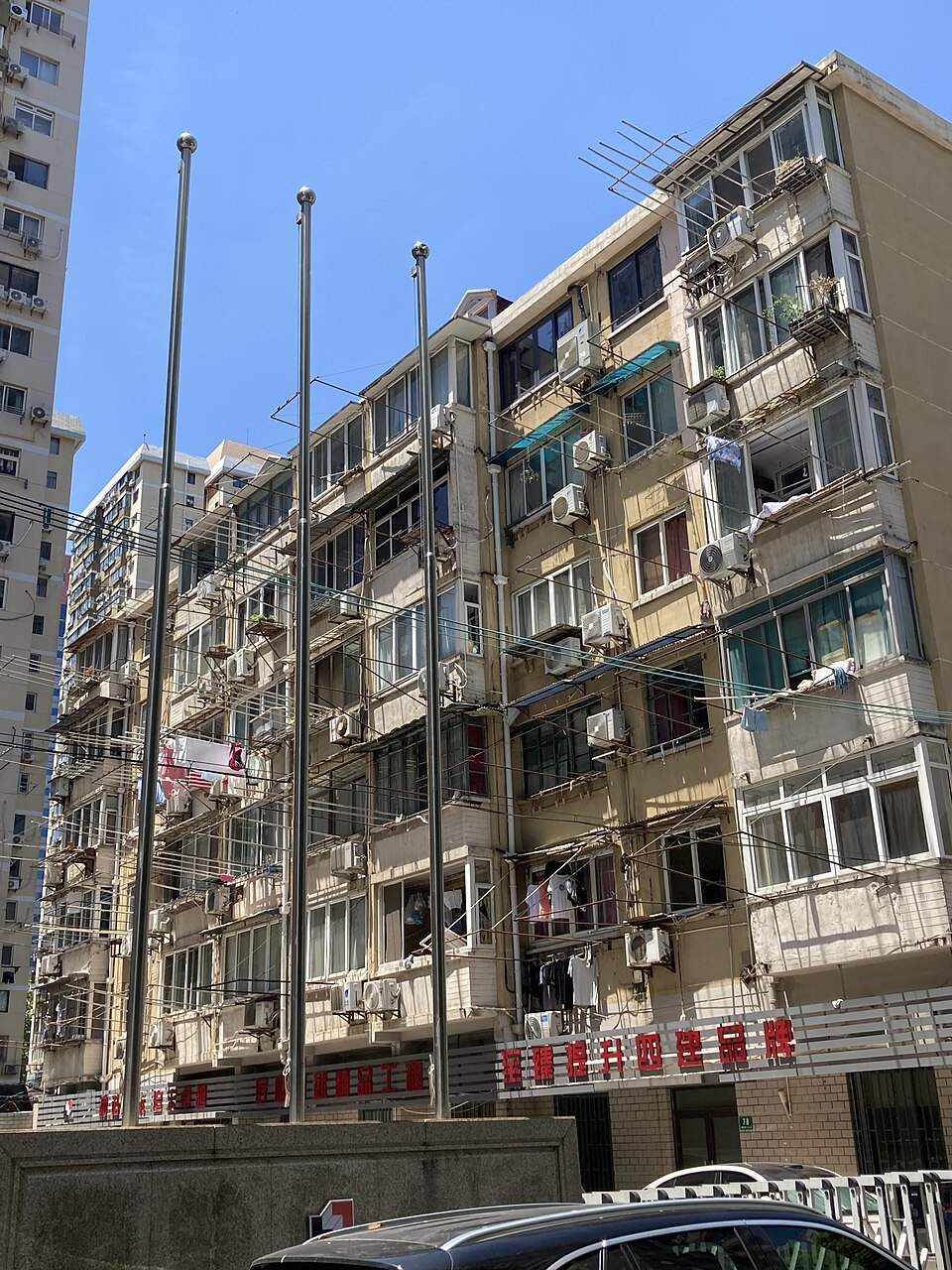
Over the four years, land-based income from land-based activities has been reduced by approximately $4.55 trillion, or 52.3 per cent.
The land market continued to be under pressure as it entered 2026.
Data released by the Ministry of Finance on 23 October show that the national State land use rights generated $168.87 billion in revenue in the first three quarters of 2026, a decrease of 27.9 per cent over the previous year.
原始来源 · gks.mof.gov.cn财政部:2026年前三季度财政收支情况gks.mof.gov.cn ↗Meanwhile, five real estate-specific taxes continued to generate significant revenue in the first three quarters of the year:
The tax is $28.8 billion, the land value added tax is $28.1 billion, the property tax is $36.97 billion, the urban land use tax is $18.7 billion and the cropland occupation tax is $105.9 billion.
These five taxes total $123.2.8 billion, plus State land use rights revenue of $166.87 billion over the same period, and both components of the revenues total $284.1.5 billion.
Even in 2026, the continued decline in the real estate market, the combined size of land concessions and five property-specific taxes reached 2.84 trillion yuan in the first three quarters alone.
This set of figures shows the size of China’s land finance and the long-standing financial dependence that the real estate boom has left.
When the income structure of a local government is tied to the depth of real estate transactions, land development and related taxes, local governments can easily create economic incentives to expand land development, maintain a vibrant land market and promote real estate investment.
This also creates a potential conflict of interest between the responsibility of local governments for land supply management and the need for fiscal revenues.
The land finance has been instrumental in urban infrastructure and real estate development for some time, but this dependence can also have a ripple effect in the period of the market downturn: reduced land concessions, local debt-servicing constraints, shrinking real estate investments and shrinking housing assets for the population.
Ultimately, the debt and investment risks accumulated by the whole model of real estate expansion began to be concentrated through different channels.
V. Fragmentation of real estate, how local governments, developers, banks and residents share the loss
The most worthy of in-depth accountability for China ' s real estate crisis is the distribution of benefits between the phases of real estate boom and recession.
(b) During the period of rapid real estate rise, local governments obtain fiscal revenues through land tenure concessions and tax revenues through real estate-related activities; Developers recover investments and profits through building and selling housing; The bank generates claims and interest income through development loans and personal housing mortgages.
Ordinary households invest wages, savings and even the life savings of parents in the real estate market.
Many families not only consume their old savings but also take long-term loans for 20 to 30 years to buy a dwelling.
In anticipation of continued housing appreciation, the system was promoted as an important means of achieving the growth of household wealth.
However, when the price of the house stopped rising and fell sharply, the original interest relationship changed.
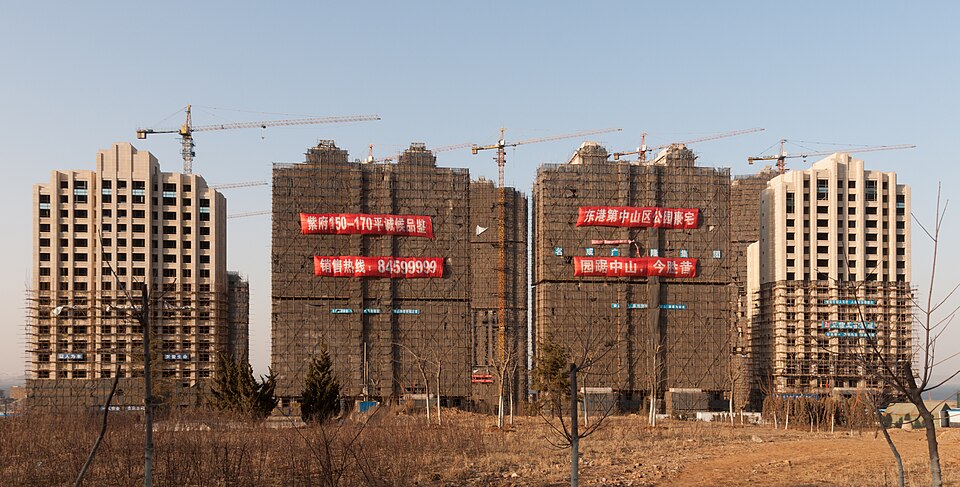
(b) The possibility of a financial chain break-up, debt restructuring or even bankruptcy of the developers; Local governments face declining land revenues and local debt pressures; Banks need to address the negative assets associated with real estate.
For ordinary buyers, the most direct loss is the decline in the value of the housing assets, while the principal of the loan contracted remains to be repaid.
The experience of Sichuan Maeyama, whose home buyers have been able to buy $1.6 million, which is now worth only $300,000 and still owes the bank $1 million, is a stark example of this risk transfer.
The purchasers used real income to purchase the housing sold at market prices for the current year, and after several years, the market value of the housing has become difficult to cover.
This means that high asset valuations that developed during the boom in real estate may quickly lose support in the face of market reversals, while fixed-up resident debt from loan contracts cannot be reduced simultaneously.
The increase in house prices has supported the financial and property sales and financial expansion of land; The declining house prices may allow ordinary households to continue to pay high debt after losing their asset value.
The more far-reaching impact is the link between the shrinking of housing wealth and the decline in consumption capacity.
Other living expenses are reduced when families find that their own housing has been significantly depreciated and must continue to pay principal and interest on bank loans.
Education, health care, old age, daily consumption and even the formation of the next generation of families may be affected.
Real estate thus shifted from the expected assets that drive the wealth of the population to a debt burden that would reduce the capacity of households to consume in the long term.
The growth pattern of China ' s economy, which has long been dependent on real estate investment and residential housing expenditure, is also subject to greater adjustment pressures as the wealth and consumption capacity of the population decline.
原始来源 · stats.gov.cn国家统计局:2025年全国房地产市场基本情况stats.gov.cn ↗6 Government takes control of land supply and earns income from land transactions: institutional responsibility cannot rest solely on the buyer
One of the most responsible subjects for the long-standing problems of the real estate market in China is the Government sector, which has the power to develop land planning, land supply and real estate policy.
Under the current Chinese system, local governments and their natural resources, finance and housing-based urban and rural construction sectors have responsibilities for land supply, financial management, real estate development regulation and market management, respectively.
However, land concessions are closely linked to local financial interests in relation to the relevant real estate taxes.
This institutional structure allows the Government to have both administrative authority in the real estate market and a significant financial interest.
Particularly during the period of high real estate development, some local governments rely on land for the expansion of urban construction, and continue to borrow through land development and local financing platforms, creating a cycle between real estate markets, fiscal revenues and investment expansion.
Risks begin to emerge when the growth in real estate demand does not sustain such expansion.
The land finance study of the Ren Zeppe team similarly noted that dependence on land income has contributed to land supply in parts of the country that exceed actual population and housing needs and have led to accumulation of stocks.
There is a systemic link between the high stock of real estate in China and the sharp decline in residential prices in some areas, which deserves in-depth study.
The change in the price of housing in the new district of the Mesama Tiencing House should be observed in the context of local finance and land supply.
The Meeshan City Government, the New District Control Council of the Meeshan Tien-Teng and the local natural resources, finance and housing administration have public responsibility for explaining local property development and land use policies.
The size of local land supply for the past years, the sale price of land, government-acquired land concessions, the use of the relevant financial resources, the involvement of local financing platforms in real estate development, and the real estate market risk management measures should be important elements of public oversight.
Since land supply and real estate policies are never the sole decision of the home-buying family.
Local governments are deeply involved in real estate market development through policy and administrative powers, while residents are able to cover the cost of home acquisition through private loans. There is no equivalence between power and risk.
When the housing bubble breaks down, the responsibility of the designer and the market regulator cannot simply be translated into a sentence “the buyer is at risk of investing in”.
If local governments can earn long-term income from land concessions and real estate taxes, they must face a deeper public responsibility question: what are the roles of land policy, fiscal incentives and financial regulation, and how much are the costs of these institutional arrangements incurred by ordinary households, while the housing bubble is being created and broken?
This is why real estate issues must be brought into the discussion of public financial supervision, local government debt surveillance and reform of the housing finance system.
7 The fundamental contradiction of land finance: housing is a basic requirement for the population, but it is transformed into a local financial instrument
Housing is primarily about the basic life of the human person.
The ordinary family buys a house in order to have a stable living environment, raise children and guarantee a later life.
However, under the long-term model of land finance, housing has a different function: to support local revenue, investment in real estate development and financial debt expansion.
When local governments need to raise funds through land concessions, developers need to recover land and construction costs through high sales, and banks need to expand real estate operations through loans, the housing needs of ordinary residents are caught up in a huge financial chain.
The chain depends on the continued and increasing cost of home purchase.
A set of houses can generate land concessions and associated taxes for government finances; For developers, it is a project for which the sale is refunded; For banks, it is a long-term mortgage claim; For ordinary families, it may be the most important asset of all life.
The economic benefits and risk of the same housing are assumed in a very different way by different subjects.
When the real estate market rose, residents believed they had gained added value.
When the real estate market collapsed, residents found that the purchase money paid for was not refunded as a result of falling prices and that outstanding bank debts remained.
Under the conditions of land ownership, market access to land and a high level of commodification of residential housing, real estate prices reflect not only market supply and demand, but also are greatly affected by land supply, local financial needs and financial policies.
The central issue for the land finance system is therefore how to constrain local government's dependence on land income, how to increase transparency in land concessions and fiscal spending, and how to prevent the excessive concentration of property risks in the general household, as a result of public power.
More importantly, the housing security system and the personal debt-management mechanisms in China require a real response to families that have been in serious negative asset distress.
Reducing the long-term housing burden, improving the access to debt restructuring for families with difficulty in lending, constraining the expansion of local government financing and increasing the financial transparency of land should be the essence of reform.
The relationship between land finance and family debt cannot be fundamentally altered by stimulating home purchases and encouraging residents to re-indebt.
Eight, from $1.6 million to $300,000: When land is financially out, ordinary families become the last to bear the burden
The experience of the home purchaser of Sichuan Shoes revealed the most retrospectable reality in China's real estate system.
In 2019, 1.6 million yuan was purchased for housing.
Today, only 300,000 dollars can be sold.
Bank loans still have a million yuan left.
Short lines of text may record a loss of income from years of work for a family and a long debt burden in the future.
In contrast, China ' s land finances have been on a huge scale over the past years.
In 2021, the national budget for land concessions amounted to RMB 8.7 trillion. Even in 2025, when the real estate market continued to be depressed, land concessions still generated more than $4 trillion.
These figures record the real estate expansion that the land finance once supported and also reflect the long-term dependence of local finance on the land market.
At the end of the day, however, the decline in real estate prices is reshaping their financial position.
Housing, once used to be a guarantee of wealth growth, can now become a heavy debt; Long-term savings have been invested in real estate, while the market value has been reduced significantly; A home that no longer covers loans may still continue to occupy household income for decades to come.
All this suggests that the real estate crisis in China has gone beyond the normal market price adjustment and has revealed direct structural contradictions between land finance, the commodification of housing and the financial debt system.
Urban land is State-owned, local governments receive income from land-use concessions and related taxes, while residents have to buy housing for decades of working income and bear the financial consequences of a significant fall in housing prices.
What is really in need of reform is a system that highly binds land resources, fiscal revenues and household debt.
Where the depth of public power determines the long-term impact of land supply, real estate finance policies on market expansion, Governments should assume public responsibility for their power and policy influence.
For families that have been in a deep asset trap, institutional reform requires more equitable debt-disposal and risk-sharing arrangements, without all the heavy consequences of real estate expansion being pushed to ordinary home buyers.
China has passed a time of land financial prosperity. Local finance has generated huge revenues from real estate expansion, and real estate enterprises and financial systems have continued to expand in this process.
Today, the loss of family wealth after the bubble burst has become a reality.
The 1.6 million-dollar purchase of a house that can now sell more than 300,000 yuan is both a family wealth trap and a heavy bill left over from the long-term operation of China's land finances.
The revenues once generated by the land finance are recorded in the government books, while the debt left by the break-up of the real estate bubble is being written into the lives of countless ordinary families for decades to come.
Article discussion
Verified members can discuss this report publicly and manage their own content.
Checking member sign-in status…