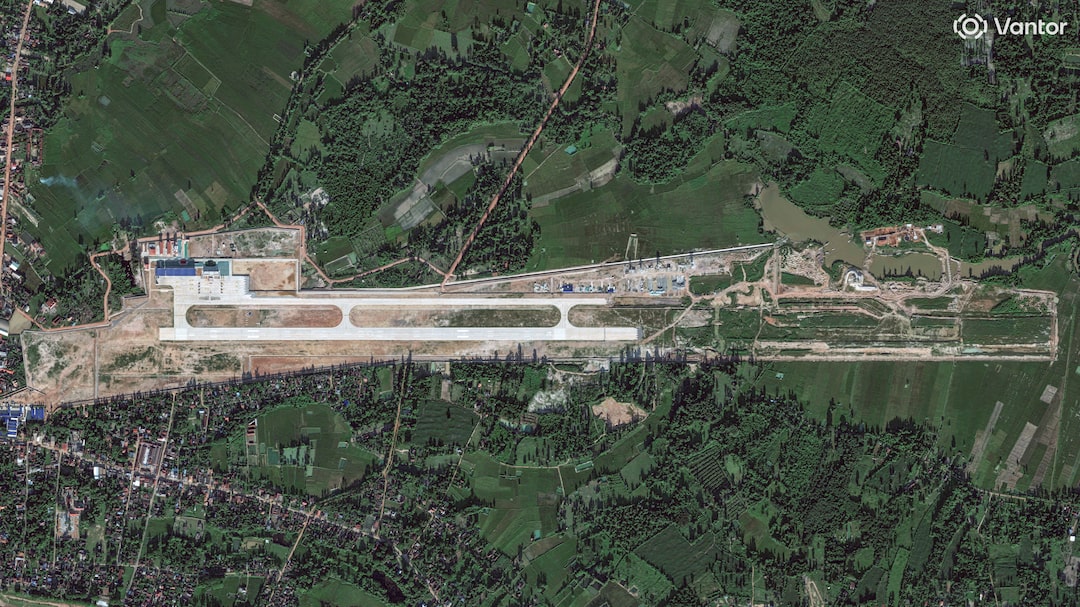
A group of commercial satellite maps, taken on 30 September, added the most specific piece of evidence to Beijing’s latest military deployment in South-East Asia: in the newly constructed joint training facility for the Chinese and the old, in Ban Keun, north of Vientiane, Laos, has already seen the appearance of eight K-8 light attack/trainer machines and over twenty guaranteed vehicles and the airport runway is still being expanded.
The Chinese Ministry of Defence announced only one day ago the establishment of the “Cyber-Yugon Joint Security Training Centre” and the “Cyber-Yon Friendship Air Academy”. Beijing defines the project as pilot training and bilateral military cooperation, not targeting third parties; However, Reuters checked the satellite images and found that the speed of construction and the size of the equipment were beyond the stage of a paper-based project.
From “training centres” to sustainable air force nodes
Satellite maps show new runways, taxiways, aprons and ancillary buildings being shaped. More notably, K-8 and guaranteed access to the airfields that are not yet fully completed. This means that the facility is not waiting for future commissioning, but is being built and used in a synchronized manner.
K-8 is made by the Hongdu Aviation Industry of China and can be used for advanced training and light attacks. The aircraft was also equipped by Laos itself, and therefore the aircraft could not be proved to be in the SLA by its own aircraft. But the strategic significance of military installations is never dependent solely on the ownership of aircraft, but rather on who is involved in the construction, who has long-term access rights and who can rapidly expand deployments with existing infrastructure.

Beijing actually gets a “accessible”
The network of overseas military facilities, which China is now publicly recognizing, is still much smaller than that of the United States. Djibouti is the first official security base for the Liberation Army abroad; Cambodia ' s Yunbong Naval Base provides for the continuous access of Chinese warships. Ban Keun would advance this presence, for the first time, further inland to the south-central peninsula if a stable training, maintenance, logistics and personnel rotation mechanism were to be put in place.
for security researchers in Australia and Singapore and elsewhere, according to Ban, Keun does not have the capability for large long-range operational bases at this time, but the presence of runways continues to extend space and will in the future accommodate larger transport aircraft, reconnaissance aircraft or electronic intelligence platforms. The most valuable point for Beijing is not how many aircraft are deployed in Laos today, but rather the acquisition of a politically reliable and paved entry point for infrastructure.
Laos shares a border with China, and the Chinese-Chinese railway has been closely connected to the infrastructure of the two countries. China was also one of the largest bilateral creditors in the country and had invested in its electricity and transport systems over the long term. This economic dependence does not automatically prove that Vientiane would hand over military sovereignty to Beijing, but it gives the Communist Party much greater political leverage than its usual partners in negotiating long-term military access.
This step will change the security calculations in Vietnam first
Ban Keun has no seaport, cannot replace the South China Sea coastal base, nor can he project large-scale air and sea forces directly, as is the case with United States facilities in the Philippines or Japan. That is why it is still too early to call it a mature “China overseas base”.
But Vietnam will not just look at today's scale. Hanoi has long regarded Laos and Cambodia as a security buffer zone on the western side of the country, while there is a sovereignty conflict with Beijing in the South China Sea. A continuous and expanded air force facility for the Chinese military is near Vientiane, which means that Viet Nam must begin to include the western side in its military planning for China.
This change reveals the typical pattern of the Xi Jinping military deployment abroad: first, by training, securing, port cooperation or joint facilities, and then by avoiding a one-time declaration of a permanent base; The actual capacity to use is gradually being expanded, pending the normalization of personnel, equipment and infrastructure. Beijing does not need to raise the “Air Liberation Army overseas” brand on the first day, but simply to ensure that there are doors available for future use.
Ban Keun is now the most interesting, not the name, but what happens next: the size of the runway to be extended, the number of aircraft stationed at the site, the long-term rotation of Chinese military personnel, and the presence of communications, intelligence and ammunition security facilities. The satellite map has proved that the project can no longer be understood solely by the “Aviation Academy”.
Article discussion
Verified members can discuss this report publicly and manage their own content.
Checking member sign-in status…