
On 23 October, account X, “Cow” (@Xiaoniu6161)The video was sent to a woman who was facing the long march, with the irony that "Li Xiaoxi: Ryoko, I want to go forward." The images show the subtitles "Driven the Japanese out of Huashaka" and "Home over Man's Body". Video quickly put a question before the public: are actors or public figures sharing verifiable historical facts when they are involved in the dissemination of the history of the revolution, or are they giving personal influence to give emotional endorsement to national propaganda? As of the time of the submission, no initial records of Li Xiaoxiang ' s account, complete unpublished version or commercial cooperation contract had been found, and the sarcasm of the reproducer could not be her original words; The identity and original language of the video character also require further confirmation of the original release. “True loyalty” cannot be written as an identified personal motive, but there is every reason for the public to test the historical language of the video.
This controversy did not occur in vain. On 9 October, 60 television series The Great Long March was launched in the air.State Radio and Television General Authority BulletinThe show was clearly planned by the Ministry of Communication, Arts and Arts, the Television and Theatre Division of the General Directorate of Radio and Television, with the participation of the Beijing City Council's information department. On 22 October, at the 90th anniversary of the victory of the Long March in Beijing, Xi spoke of the long march as a triumphal epic of “25000 miles” and called for its spirit to be transformed into a force for political mobilization now. Television dramas, commemorative congresses and short video public opinion are in the same intense political history, but this does not mean that it has been proved that the video was produced by television dramas or by agencies that promoted them.
It must start from the real point of view of history: the long march is first and foremost a breakout after military defeat. The fifth anti-Sud Central District failed in 1934, when the Red Army withdrew from Jiangxi under pressure of military and ground-based survival and experienced a high degree of danger of marching, fighting, return and regroupment. CompanyAn official speech by Xi Jinping on October 22ndThe failure of the fifth anti-theatrical “crush” and the crisis of the survival of the party and the Red Army were also acknowledged. Thus, the “retrenchment” was not based on false slander, but rather on the basic context of the military operation. The Red Army has since preserved part of its living strength and has set up new political and military centres in the north, and cannot in turn erase the failure of departure. Recasting the cause of failure as a fateful victory, and packaging the breakout process as a great thing with a clear direction from the outset, is a political narrative choice that needs to be pursued.
Who left the 25000 miles? Converted to modern city, about 12,500 kilometres. If 371 days are taken, on average, about 33.7 kilometres per day, the fighting, injury and rest will be inserted. This distance is extremely difficult, but it cannot be proved simply by “over the length of China's east-west) because the cumulative march can be reversed, bypassed and bypassed. The question is how it can be estimated from the march of certain units to a unified historical slogan for all audiences: which force, which day to which day, which bypasses are included, and whether the complete map and the original logbook can be publicly repeated.
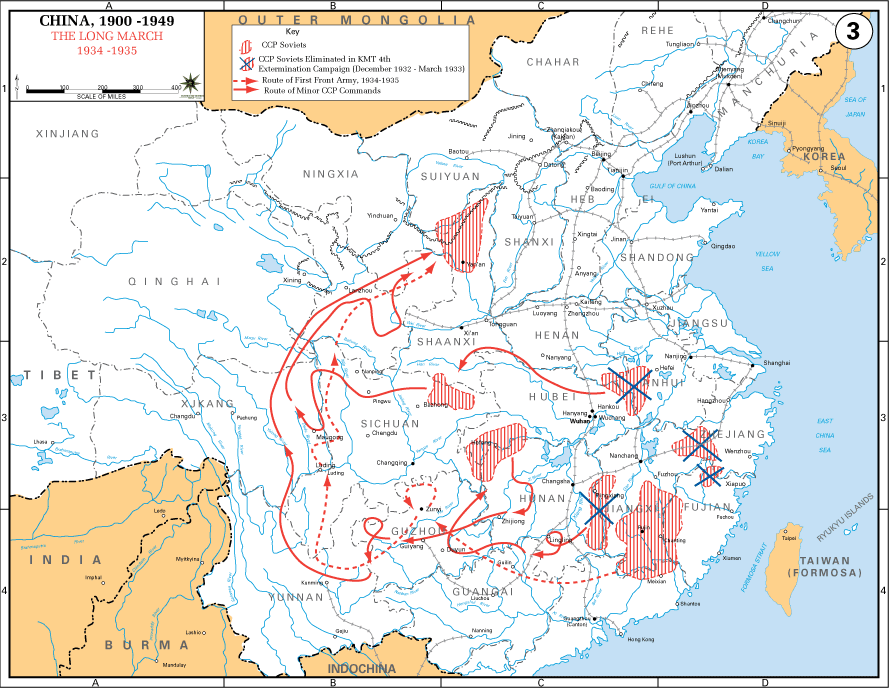
The most interesting counter-arguments are from the CCP's own public party history.CCP News Network and Yang Guangzhou Network 2016The cumulative figure for the 371-day military watch of the Red One Corps was 18,095 miles, and the later map mapping calculated about 18,499 miles; It's not 25,000 miles. The official defence of 25,000 miles was based on the explanation that the combat forces were more advanced than the immediate authorities and that the maximum of the marching forces could have reached that value. In other words, even if this interpretation is accepted, the “estimated number of troops who have gone the farthest” cannot be replaced by “a common road for each of the Red Army as a whole”. The Chinese party history never proved that everyone had travelled the same 25,000 miles. The omission of the promoter from the subject matter of statistics is precisely where the public has the right to question it.
Independent measurements add to the level of debate. British researchers Ed Jocelyn and Andrew McEwen re-established their long march in 2002 and 2003 and have been able to find a way to get to the end of the conflict.Published in the Beijing Youth Journal, 2003They concluded that the journey was estimated to be 5,860 km at most and to be well below 12,500 km. The modern route of the two persons does not necessarily reproduce the full military round-trip and feeder operation of the year, so the re-entry is not a ruler that automatically rules all troop mileage. It reveals that when different information and measurements give different results, there is no reason why State propaganda should allow only one symbolic number to be recited repeatedly, without explaining its measurement calculus.
The video subtitle "Driven the Japanese out of Huaxia" also needs to be put back in time. The Central Red Army core long drafts occurred between 1934 and 1935, and the various Road Red Army divisions continued until 1936; After seven events in 1937, China entered the All-China War against Japan. The long march, which has historical links to the subsequent political strategy of the Communist Party against Japan, cannot be directly filmed as a military operation by the deporting Japanese army. If this subtitle is a summary of the direct outcome of the Red Army Chiefs, it confuses two different phases of the war. If it is a literary tribute to a long history, it is also a matter of marking the target, not making the audience mistakenly believe that it is a matter of history. The greater the influence of stars, the greater the responsibility for this distinction.
The more important news is not just what stars say, but who has the institutional power to tell how history can be told. Implemented in 2024PRC Patriot Education Law(a) Article 3 lists patriotism, the Partido de la Público and the Socialisto as indivisible; Article IV establishes the leadership of the party; (a) Article 15 requires the inclusion of patriotism in school curricula; Article 21 also refers in particular to the leading role of eminent persons in the arts and culture, sports and the like. In this way, party history is not only a freely debated subject of research, but also a political task shared by education, literature and the media. The researchers Martin Lavicka and Marina Svensson are here.Academic Papers 2026It is argued that the Act strengthens the institutional link between party loyalty, national identity and historical narratives. The design of such a system is highly questionable: who can publicly refute officially recognized heroic stories when the law binds the right historical attitude to political loyalty?
And the answer cannot be from the TV producers alone.I'm looking at the presentation of the Great Long March.It was stated that the higher authorities were deployed in a unified manner, and that the producers were guided by a common approach to the script, approval, revision and dissemination.Freedom House 2026 Network Freedom ReportThe Chinese Internet freedom was assessed at 9/100, with only 2/35 points in content limits, indicating that the authorities had the capacity to review and manipulate the expression of the network on a large scale. Public debate can easily lose reciprocity while involving advocacy agencies in the shaping of stories and putting at risk the expression of dissent and the dissemination of negative evidence. The review referred to this mechanism, which replaced independent verification with a single political narrative, as “false State rule”; More specific and verifiable institutional issues are how administrative advocacy, platform reviews and legal sanctions are superimposed, making it difficult for the public to publicly test strong narratives.
Li Xiaoxiang cannot be directly pushed into her for unverified motives of personal gain because she is a public figure; Nor can the lack of evidence in the initial release of the video be allowed to relinquish the duty to pursue advocacy. If the video is indeed released by her, she needs to answer whether she read the works and history, whether she checks the subtitle “Drive the Japanese” and whether there is an advocacy or business reward; The production and advocacy agencies should also identify collaborative relationships and inform the public about the information used to support historical conclusions. Actors can express political views, and viewers have the right to test those views in the face of history.
The history of the Red Army ' s military withdrawal as a triumphant starting point for political beliefs is an important link in the CCP narrative; The resulting political legitimacy and personal philosophies should not be grounds for objections by researchers. The long draft should not be judged by listening to the adjectives of the commemorative congress, but rather by looking at the year's diary, the military watch, the military order, the record of casualties and the records of the warring parties, and by comparing the route and measuring errors. Respect for ordinary soldiers who have lost their lives on the road also includes the recognition of hunger, defeat, miscalculation and cost, and not just the creation of eternal correct legends for those who later come to power. The real horror is not a history of controversy, but a sense of authority that society should treat a controversial interpretation as an irrefutable test of loyalty.
Article discussion
Verified members can discuss this report publicly and manage their own content.
Checking member sign-in status…