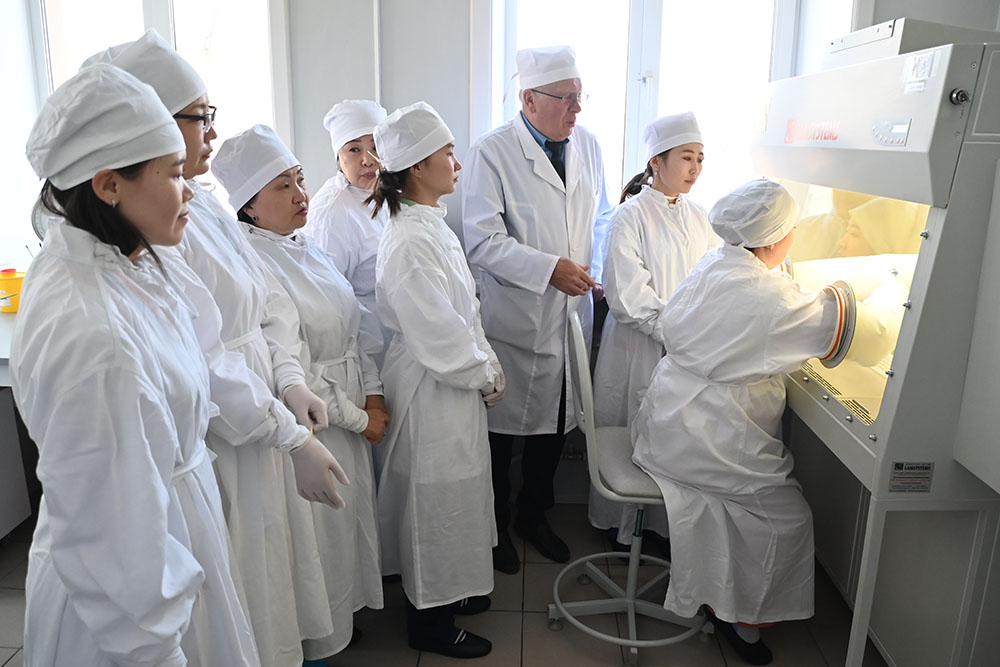
An anti-rat disease researcher in Irkutsk, Siberia, Russia, died after severe pneumonia, followed by medical observations of nearly 200 contacts, and over 60 institute staff were reportedly isolated at one time and several hospitals. Local media claim that the deceased may have broken the in vitro in the laboratory with a rat-epidemiology agent before he was born; The Russian Federation health authorities deny that the current results of the tests indicate that there has been an infection with the plague or a laboratory pathogen accident.
The deceased Darya Hipilova, aged 28, worked at the Irkutskshiberian and Far East Institute for Anti-Piracy Studies. Reuters reported on 5 October that she had died after a serious pneumonia outbreak. The Russian Federation ' s Office for Consumer Protection and Public Interest (Rospotrebnadzor) stated that the preliminary investigation had not found any link between her disease and the pathogens exposed at work, nor had it been established that the Institute had had an accident with pathogenic microorganisms. The head of the agency, Anna Popova, has travelled to Irkutsk.
原始来源 · reuters.com路透:伊尔库茨克反鼠疫研究所工作人员死亡后多人被隔离reuters.com ↗Another version was disclosed in the Russian local media. It was reported that Hipirova could break an in vitro with a plague agent during work on 25 September and subsequently develop an illness. This statement was not confirmed by the Russian Federation health authorities, but it was taken into public view at the same time as the extensive vaccination measures that were subsequently taken on the ground.
International media quoted local sources as saying that over 60 Institute staff were once isolated in the research institutions, that the Irkutsk City Hospital Nos. 1, 3, 10, Ivano-Matleninski Children ' s Hospital and a maternity hospital were accused of having taken isolation measures, and that the hospital in Shelevh, where Hipilova died, was also affected. Nearly 200 people who might have been in contact with her were included in medical observation.
There are no reports of a sterilisation chain in the exposed. Some of the subjects were reported to have detected either the general respiratory virus or the new coronary virus. The Russian health supervision authorities have stressed that the epidemiological situation is stable.
The plague is caused by the plague of Yelsen, in which pulmonary plague can be transmitted between humans by leaching through the respiratory tract. The Irkutsk Siberian and Far East Institute for Anti-Pest Disease Studies (IRI) is responsible for research and control of dangerous infectious diseases such as plague. The sudden death of a young researcher working directly with the AVF from severe pneumonia, combined with subsequent contact tracking and institutional isolation, has quickly raised concerns about the alleged exposure to laboratory occupations.
Public statements by local Russian officials have also changed. According to Euronews, Alexei Tshidnov, the head of the neighbouring Republic of Britt, once mentioned the plague in a public message, and then replaced the words “possible”; Governor Igor Kobzeev of Irkutsk has used “specially dangerous infections” to describe the situation. The federal health regulatory bodies subsequently made it clear that no plague had been detected.
原始来源 · euronews.comEuronews:俄罗斯当局回应西伯利亚鼠疫疑云euronews.com ↗The United States media Axios reported that the United States Government was following the suspected plague in Irkutsk. By 5 October, the Russian side had maintained that the death of Hipilova had not been confirmed as related to the plague, and denied that there was evidence of a pathogen accident at the Anti-Piracy Institute.
However, the immunization action that Irkutsk has taken goes far beyond the death of a common pneumonia: the staff of the Institute for the Prevention of Pests and Pests are being isolated, control measures are being taken by various medical institutions and nearly 200 contacts are being observed. Meanwhile, reports of Hipirova having broken the pyropathogen in the laboratory are still spreading. The Russian official denial and massive vaccination operations that have been launched on the ground constitute the most striking contrast of the incident at present.
Article discussion
Verified members can discuss this report publicly and manage their own content.
Checking member sign-in status…