
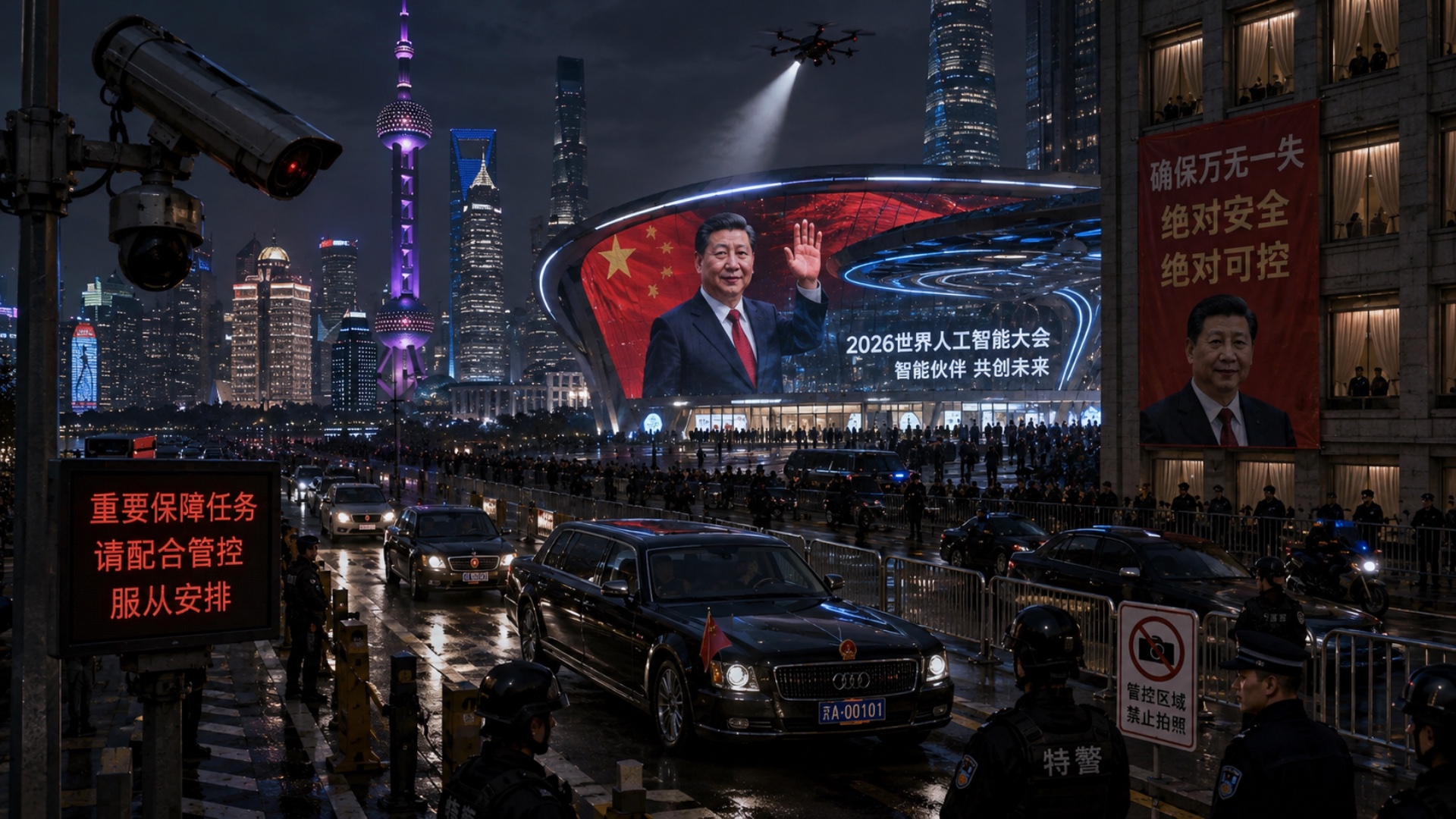
In mid-July 2026, the 2026 World Conference on Artificial Intelligence and the High-Level Conference on Global Governance of Artificial Intelligence (WAIC) opened in Shanghai. On this international stage officially crowned as "Smart Partners, Create the Future", industry giants, scholars and technology politicians from around the world gathered together to discuss global governance of artificial intelligence, computational breakthroughs and open source ecology. The top leader also delivered a keynote speech on the scene, announcing to the world that China will play a "fair and reasonable" leadership role in global AI governance.
However, behind this event that represents the highest edge of human science and technology, several “internal notices” circulated on social media have torn the refined veil of this technological powerhouse and revealed its very pre-modern authoritarian background in its bones.
On the one hand, there is a digital feast in the venue about the “big model in the context window to 1 million tokens” and the smart body parallel processing; on the other hand, the Shanghai suburban driving school practitioners are forced to touch the black car at 5 a.m., and the country’s luxury hotel guests are deprived of the absurd reality of pulling the curtains power. This “Cyberpunk” kind of wonder, not only constitutes the deepest irony of black humor about “high technology”, but also reveals the ultimate paradox of an authoritarian regime: a government that even citizens of their own country are free to travel, and even a glance at the scenery outside the window is full of fear, why do we talk about the “future future” of mankind?
The absurdity of power microscopy: even suburban driving schools have to make the way for the "guide"
On the eve of the opening of the conference, a photo of a coach from a Shanghai driving school informed the participants in the WeChat group on the Internet.
“These two days have not been delivered, President Xi came to Shanghai, and now the coach car is not allowed to go anywhere other than the prescribed Co-Third route, the two-day practice time has also changed, and Tuesday is back to normal.”
This was followed by an official “happy note” from The Ritz-Carlton Hotel in Shanghai, which clearly stated:
“In order to coordinate with the security work of the 2026 World Conference on Artificial Intelligence, we need to implement information controls for specific regions according to relevant departments’ requirements. Therefore, please be sure to keep the room curtains closed during the following periods, while the Flair terrace will be temporarily closed. The specific periods are as follows: Thursday, July 16, 2026 16:00
- 21:00, Friday, July 17, 2026 09:00
- 12:00 (middle).”
These two apparently incompatible announcements put together the real landscape of modern China’s highest-powered pilgrimage.
Ordinary people living under extreme constraints
For those ordinary practitioners who struggle in hot summer days in order to earn their livelihoods and get their driving licenses, the arrival of the head of state does not give them any pride, but instead deprives them of their most basic interest rate laws. In order to avoid the traffic control that the head of state may pass through the time or may cause, the driving practice time is hardened and adjusted to "5 to 9 in the morning" and "5 to 7 in the evening". This means that practitioners and trainers must rise up when the sky is out and join the political show in extreme fatigue. The suburban driving school, this marginal social zone several decades away from Shanghai's political core and the artificial intelligence venue, is unlikely to be exempt from the absolute crush of power. This whole range of social mobilization and social
The “Crazy Bird” behind the hotel curtains
If the restriction of driving school was for the “absolute smoothness of traffic,” then the requirement of the Ritz-Carlton Hotel “not to open the curtains” exposed a pathological safety anxiety. The skyscraper in the mouth of the land was the window to show Shanghai’s capitalist prosperity and socialist construction achievements. However, when the highest leaders entered the area (to attend the welcome party on the evening of July 16 and the opening ceremony on the morning of July 17), these windows must immediately become “blind.”
The deep logic of forcing high-priced five-star hotels to close the curtains for international and domestic guests is to prevent any potential threat from the sky – whether it’s snipers, photographs, or banner protests. This even extends to the inside of the private accommodation space “information control” and eye blockade, each high-level ordinary person, even the elite class, are naturally assumed to be “potential assassins” or “destroyers”.
Cyber Totalitarianism: The Deadly Paradox of Firewall State Governance of AI
In the Declaration of the Chairman of the 2026 World Conference on Artificial Intelligence and the High Level Conference on Global Governance of Artificial Intelligence, China's Government Speech Speaker said: "Open Source Opening is an important path to the development of artificial intelligence for all", and declared that "we should actively build an open and inclusive international open source community."
This diplomatic statement is almost impenetrable in literal terms, but if placed in China’s brutal internet reality, it can lead to a strong cognitive disorder.
The “open source” call based on “unopened”
China is one of the countries with the most severe control over the Internet in the world, not one. The notorious “national public network surveillance system” (the Great Firewall) has captured a billion Chinese people to death in the desert of the global Internet. In the world’s least open and information circulation is the most severely censored country, its leaders are sitting in a layer-protected venue, calling for global artificial intelligence “to adhere to openness and win-win drive innovation development”, which must be said to be a magic realism.
True AI innovations rely on absolute freedom of information flow, unlimited data collisions and tolerance of offensive and misleading speech environments. However, in China, the first step to develop the big AI model is not to optimize the algorithm, but to conduct a cumbersome “ideological security review” to ensure that AI’s responses are in line with the Party press release, ensuring that AI does not trigger any sensitive nerves about political prohibitions. When Ali’s interpretation, Hundred Degrees of Civilization, Tencent’s blend shows its 1 million token upper-text capability in the venue, their underlying logic is still bound in the iron cage of censorship. An environment where Google, Wikipedia, GitHub (regular walls or speed limits) can’t freely
Thieves screaming for national security
In his opening speech, Xi Jinping said: "We should jointly oppose the practice of generalizing the concept of national security in the field of artificial intelligence and putting our own national security above the security of other countries."
It sounds like it’s criticizing U.S. export controls on China’s high-end chips (such as NVIDIA GPUs), but ironically, the Chinese government itself is the world’s most enthusiastic about “generalizing the concept of national security.”
Driving training car affects national security, so to change until 5 a.m.;
* Hotel tenants pull the curtains to affect national security, so to control information;
Discuss the economic downturn and the youth unemployment rate affecting national security, so the full web seal;
Even the normal market research of foreign-funded enterprises can be viewed as espionage.
China extends the concept of national security unlimitedly, even above basic people's livelihoods, economic development and citizens' personal freedoms.When a regime itself extends security anxieties to the point where even the people are afraid of driving, but accuses others on the international stage of "generalizing national security", this double standard fully demonstrates the hypocrisy of totalitarian politics.
The Mirror of History: From Feudal “Avoidance” to Modern “General War Security”
China’s propaganda machines often mock Western politicians’ elections as “political shows” and boast of the “efficiency and organizational power” of the Chinese system, but the two announcements in Shanghai show that it is exactly where the system is most frightening: in order to satisfy the will of individual rulers or absolute security, the entire social machine can be untoldly mobilized in a “general war” mode.
The “evasion” and “evasion” of the new era
In China's feudal imperial era, the Emperor's expedition has a strict "evasion" system. Local officials will clear the streets in advance, the people must not close doors and go out, kneel to the Holy Road, anyone who has a spy is a serious crime. In 2026, Shanghai, as China's most modern, most famous and internationally connected Doom, is still unable to get rid of the genetic code of this feudal politics when receiving "Chairman Xi".
The school’s “don’t let go anywhere else” is the modern version of the “Clean Street”; the hotel’s “don’t let the curtains open” is the modern version of the “don’t look at the face”. Although the ruler’s title has changed from “Emperor” to “President of the State”, the “Power is not confined, cannot be offended” absolutely authoritative nature has not changed. Modern technology (such as high-definition surveillance, face recognition, big data fence) not only has not weakened this privilege, but instead gives the ruler a more efficient and thorough social cleansing ability than the ancient emperor.
Double surrender by elite and civilians
In this security storm, both the underlying social driver of the school and the social elite, foreign merchants, who were able to live in the Ritz-Carlton hotel, suffered equal "denial strikes" in front of absolute power.
For the bottom, power to adjust your time with rough executive orders, to seize your vehicles, you must be silent, because you have no channel to speak out.
For the elite, even if you pay expensive room fees, five-star hotels have to comply with “relevant department requirements,” depriving you of landscape rights and even incorporating your privacy space into surveillance.
This indiscriminate repression sends a clear signal that in China, no private property, personal rights, or business agreement can be sacred and inviolable.In the face of the ultimate beast of “political security”, “leader security”, all the achievements of modern civilization must be instantly destroyed.
Observations and Conclusions: The Weak Giant and the Home Prisoned Leader
A truly strong, self-confident, and people-loved leader doesn’t need to be afraid of the coach car and hotel curtains in the suburbs.
Thro the history of the world civilization, the more dictatorship, the more high-pressure rule, the higher leadership, the more deeply paranoid. In the late years of Stalin refused to take a plane, several identical cars while traveling out at the same time to deceive assassins; Saddam has countless substitutes, never spend the night in the same place. Today, in China, which has been called the "rise of the power", the security rules used by the highest leadership every trip, are updating historical records.
This “totally closed” scrutiny is precisely the deepest metaphor for China’s political situation today:
Though the ruler possesses the power of pervasive surveillance and the most powerful digital tool in human history, he actually transforms himself into a prisoner living in an absolute vacuum and a sterile room. He does not dare to face the real people, and he does not hear even a slight disagreement from the people, wherever he goes, all the curtains are pulled, all the streets are empty, and all the passers are arranged "mass actors".
The World Conference on Artificial Intelligence in 2026 ended with the official self-proclaimed applause. The announcement of Xinhua will still be filled with great narratives such as "work together to create a better future for human society".But history and the public will remember those curtains that were forced on, remember the train cars that were forced to launch at five o'clock in the morning and can only waver on the designated route.
An authoritarian country that builds an island of information on the robberies and firewalls, whose fundamental purpose is to engage in artificial intelligence, has never been to unleash the productive forces of mankind, let alone for the global well-being; but to better upgrade its "big brother" style of panoramic architecture, is to more accurately control every citizen's words and actions, putting one billion people forever in the darkness of "do not let the curtains open."
This feudal zombie system, wrapped in the highest civilized technology of mankind, no matter how bright and bright it is on the stage in Shanghai, cannot hide its inner destiny, which is accelerating towards corruption and collapse.
Article discussion
Verified members can discuss this report publicly and manage their own content.
Checking member sign-in status…