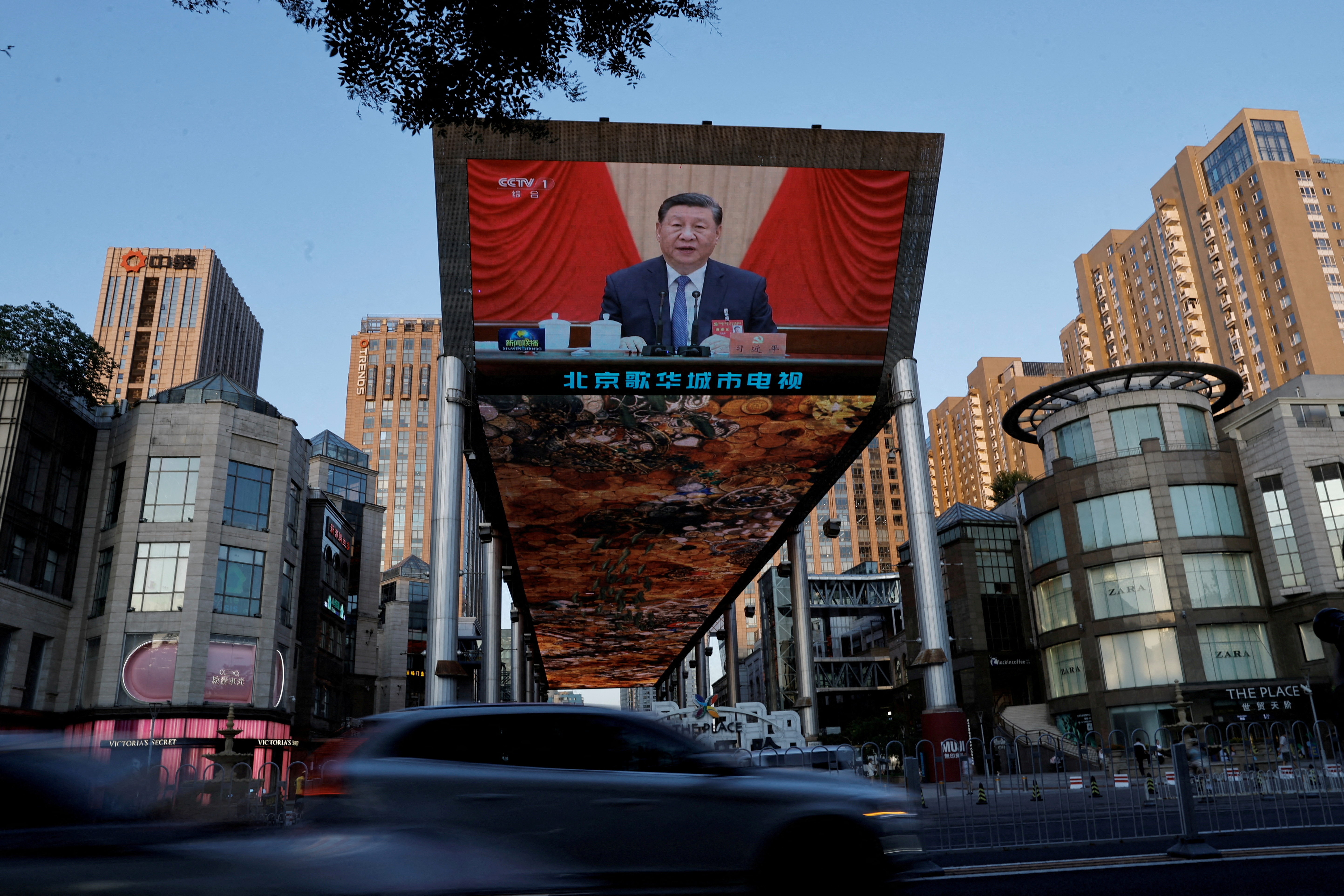
The twenty-fifth China General Assembly (CCM) Fifth Plenary Meeting will be held in Beijing from 26 to 29 October. On 21 September, the Central Political Bureau of the Communist Party announced that the meeting would look at “the need to keep moving towards a comprehensive and strict approach to the issues of the party”. As Xi entered the fourteenth year of the regime, the Communist Party once again put “self-revolution” on the agenda of the central plenary. But the “revolution” of the Chinese Communist Party, which defines its own rules, sets its own oversight bodies and disposes of its own cadres, cannot circumvent a more fundamental question than the number of anti-corruption figures: who will supervise a party that has long held a monopoly on the highest political power of the State and that has not been given executive power through competitive national elections?
This is not an abstract political label. The Chinese Communist Party did not win national power in multiparty competition, nor did Chinese voters have the institutional channels to remove the Communist Party from power and to change it to another party through national elections. In its 2026 report, Freedom House, an international democracy and human rights organization, continued to classify China as “unfreedom” and described the ruling of the Communist Party as a repressive system of power, noting that the Communist Party controlled the State bureaucracy, the media, cyber-spoken discourse, religion, universities, business and civil society. For Focus China, these institutional facts are the basis for judging the arbitrary nature of the Communist Party of China, not the political slogan of the de facto state.
原始来源 · freedomhouse.orgFreedom House:2026年中国自由度报告freedomhouse.org ↗The official narrative of the Chinese Communist Party is completely different. The Political Bureau meeting stressed the need to promote a comprehensive and strict party-based approach in the spirit of “self-revolution”, with a view to maintaining organizational purity through party-based oversight, discipline-building and anti-corruption. The problem is precisely here: the subjects of the so-called “self-revolution”, the rule-makers and the implementers are the CCP itself.
原始来源 · ccdi.gov.cn中央纪委国家监委网站:9月21日中共中央政治局会议通稿ccdi.gov.cn ↗The Central Disciplinary Commission, which is co-located with the National Monitoring Board, links the disciplinary powers of the Communist Party of China to the same institutional system as those of the State inspection. The inspection teams have access to local and local units, and the monitoring and monitoring teams are in contact with party and State bodies, organize the upgrading and downswing of cadres, and the disciplinary system investigates violations and violations, while the “political discipline” “political oversight” and the preservation of party central authority are explicitly included in the monitoring requirements. The five plenary sessions of the Central Disciplinary Commission in 2026 have been publicly deployed to cover such important areas as finance, State enterprises, energy, tobacco, medicine, higher education, sports and engineering.
Combating corruption is not a problem in itself. Corruption, bribery and abuse of power by officials should certainly be prosecuted. The real problem is that the Communist Party has placed the right to fight corruption, control of cadres and political integrity within the leadership of the same party. A cadre may be subject not only to investigation on economic issues, but also to political discipline and organizational loyalty. Thus, the “All-round Tighter Party” is both an anti-corruption mechanism and a mechanism to maintain the political control of the large-scale bureaucracy by the Central Party of the Communist Party.
This is the most important part of the Chinese Communist Party ' s arbitrary politics: power is not just Xi Jinping, but a whole network of party-state organizations. The CCP has the power to organize, to supervise and supervise the conduct of its activities, to exercise oversight powers by the National Monitoring Board, to have the political and legal system under the leadership of the party, and to control public space through the system of publicity and cyber-regulation. Power can be divided between different agencies, but it does not separate itself from the leadership structure of the Communist Party of China. The so-called “supervisory” is found in large numbers within the ruling system, not from an opposition party that can compete for power, a media that can independently pursue the highest power, or a judicial system that can operate independently of the political leadership of the ruling party.
Freedom House ' s 2026 report noted that Chinese State leaders were not freely elected, that the Communist Party had a dominant influence on the judicial system and that China ' s political rights and civil liberties were rated as a whole by 9 points (100 points). These external assessments do not determine the position of Focus China, but confirm one another with a fundamental institutional reality: the CCP does not need to seek a mandate from voters to remain in power in competitive national elections, nor does it have a political opposition that can legitimately replace the CCP as a ruling party through national elections.
In such a system, the “self-revolution” has in fact exposed the paradox of one party ruling itself. The CPC claims to have to rely on the supervision of the CPC, on the CPC to bring it to order, and on the CPC to judge whether or not the restructuring has been successful. The disciplinary commissions can investigate cadres, the inspectorates can access institutions, and the National Monitoring Board can investigate public officials, but the supreme political authority to supervise these oversight bodies still does not leave the party's leadership. The chain of supervision can grow longer and the disciplinary bodies can grow larger, but they can always go back to the same centre of power.
Xi has strengthened “central unity of party leadership” and political discipline, particularly since the beginning of the regime. The significance of disciplinary inspection cannot therefore be measured only by “the number of corrupt officials caught”. When political loyalty becomes a disciplinary requirement and when cadres are placed on the watch board to uphold central authority, anti-corruption and political control may occur simultaneously in the same system. For the CPC, this could be called the preservation of organizational unity; From a position of opposition to one party ' s arbitrariness, it means that the ruling party has an increasingly strong internal power of discipline, without correspondingly establishing a political channel for independent social oversight of the ruling party.
(a) The real monitoring of power must answer a question that the Chinese Communist Party “self-revolution” has always avoided: if the person under investigation is a general cadre, the disciplinary board may investigate; If the problem arises from the Commission, the political and even the supreme political power itself, who can investigate independently without the authority of the CPC? Who can publicly obtain evidence? Who can demand that those in power step down? Who can peacefully replace the ruling party through the ballot?
The P-5 could continue to adopt a new party discipline, with more patrols and more cadres, but none of them automatically translated party discipline into democratic accountability. The real borders of the so-called “self-revolution” of the Chinese Communist Party are the ones where supervision remains ultimately under the control of the Communist Party. For Focus China, critical ruling by the Communist Party cannot remain on the word “autonomous” but must continue to reveal how this power works: who sets rules, who controls investigations, who controls the fate of the cadre, who limits the press and political competition, and who is excluded from the power of oversight. Only by putting these chains of power in one by one would the political logic of the CPC “to monitor itself” be truly exposed to the public.
原始来源 · reuters.com路透:中共五中全会定于10月26日至29日举行reuters.com ↗
Article discussion
Verified members can discuss this report publicly and manage their own content.
Checking member sign-in status…