
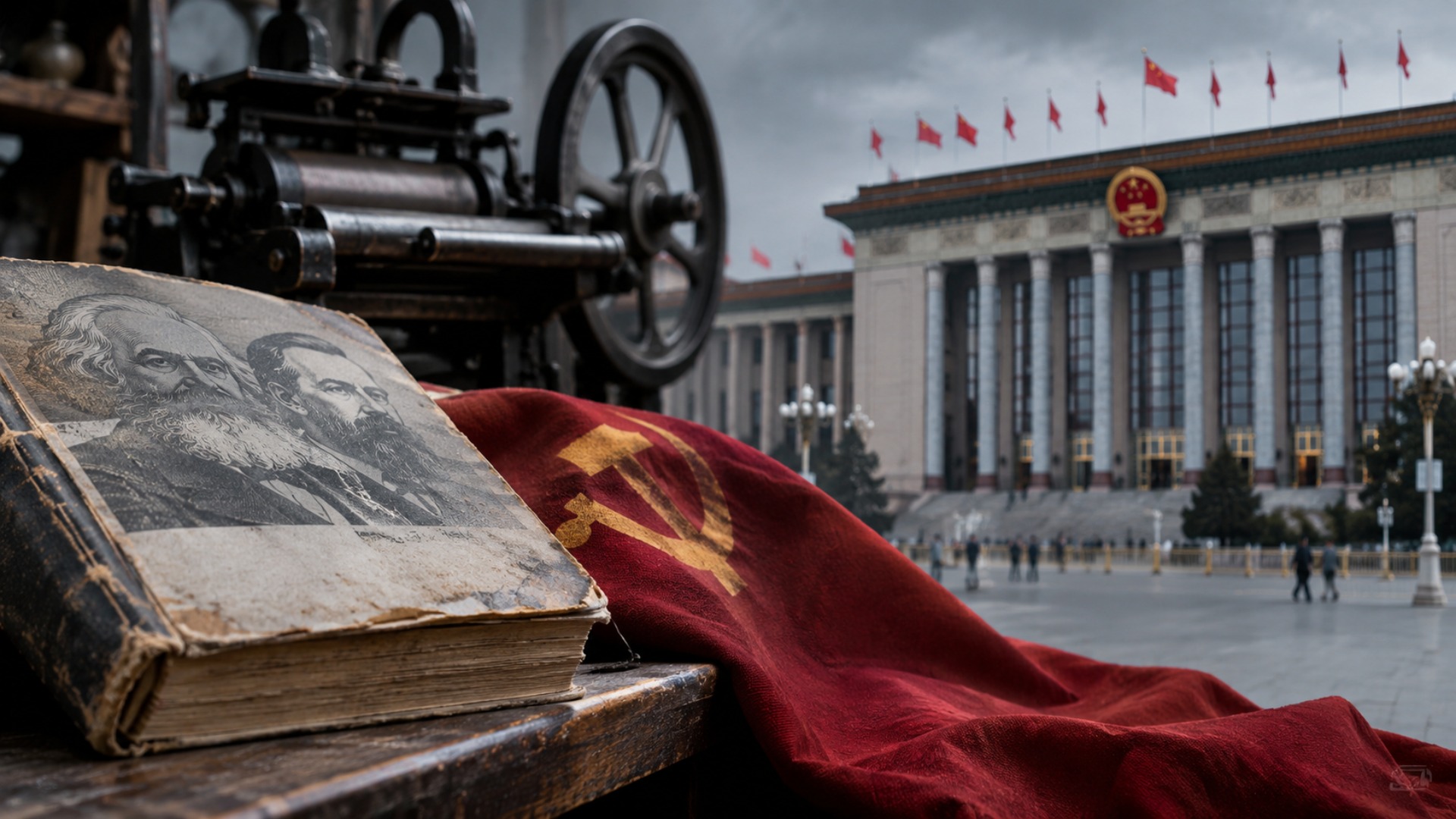
A video critical of the ideological double standards of the Communist Party of China was recently distributed on social platform X. The video, which takes as an entry point foreign sources the political symbols of the Communist Party, such as the Communist Party Declaration, the International Song, the sickle hammer, and which lists the foreign assets dispute of the Communist Party leaders, the emigration of the family of officials, and its long-standing opposition to the Western political system, concludes with a phrase that reads: “No Western. The blogger adds:
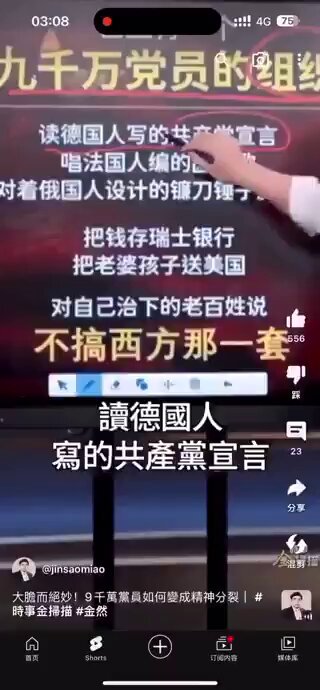
The dissemination of this video has touched upon a long-standing contradiction in China’s political system: the Communist Party of China, which has established the communist revolution tradition as an important source of political legitimacy, has adopted Marxism from Europe as its ideology of governance, but has consistently rejected the re-establishment of the authority of the State through institutional arrangements such as free and competitive elections, party rotations and power checks and balances.
The selective acceptance of foreign systems and ideas, from the source of ideas to the political system, from the interests of the leading cadres abroad to the political rights of ordinary citizens, reflects the different criteria adopted by the Communist Party for foreign political civilization: theories that can help to consolidate the rule of government can be the guiding idea of the State and the system that may change the existing power structure is excluded from political reform.
From the theory of the European revolution to the political orthodox of the ruling party in China
In 1848, German thinker Karl Marx and Friedrich Engles publishedCommunist ManifestoIt provides an important theoretical basis for the international communist movement. Since then, Marxism has entered China through the Russian Revolution and the Communist International (CPI) and has gradually become a core resource for the idea of the establishment and development of the Communist Party of China.
Four years after the establishment of the Communist Party of China in 1921, the October revolution in Russia has passed. The International Communist Party has had an important impact on the early organizational development, political routes and revolutionary activities of the Communist Party. The Communist Party has since gradually developed its own system of political and military organization, but its original philosophy and organizational model has a distinct international communist movement background.
"The International Song"The history is also clear. The lyrics were written by the French poet Euren Baudie in 1871 and by the French composer Pierre Diggett in
- The song, which was born in the context of the European Workers ' Movement, later became a symbol of the international communist movement and was used by the Communist Party of China for a long time in its major political activities.
The combination of sickle and hammers originated during the Russian revolution and later became a symbol of Soviet communist politics. The CCP flag uses this combination of symbols, which perpetuates the visual traditions of the international communist movement.
Max was politically censored in Europe and exiled many times, but his revolutionary theory eventually gained political influence in the twentieth century far beyond his lifetime. From the seizure of power by the Soviet Union in Bolsheviks to the establishment of a one-party rule by the Chinese Communist Party and the initiation of extreme social transformation by the Khmer Rouge in Cambodia, Marxism and its subsequent revolutionary doctrine were used by different communist regimes as the ideological basis for the seizure and consolidation of power.
These regimes have been carrying out political repression, confiscating property, restricting individual freedoms and causing a massive humanitarian catastrophe under the banner of class struggles and revolutionary transformation. The Stalin purge, the Maoists' political persecution and the Khmer Rouge massacre left a concrete and heavy historical record.
While Marx claims to be a man's liberator, several Marxist communist regimes have established a highly centralized system of political power. In these historical practices, class enemy division becomes a tool of political persecution, revolutionary ideals are used to justify the coercive power of the State, and individual rights are repeatedly placed below political objectives.
However, in the official Chinese political narratives, Marxism is considered to be the scientific theory that guides national development, and liberal democracy, constitutionalism and multiparty competition systems from other countries are often relegated to a political model that is not appropriate for China ' s national context.
The core of the question is not whether an idea was born abroad, but who has the power to decide what kind of ideas China can accept and what political system it adopts.
"No Westerner": who defines the boundaries chosen by the political system
The “no Western set” is not a political expression created by the vacuum of web-based video, but a typical expression in the long-term political path of the Communist Party.
Deng Xiaoping stressed during the period of reform and opening up that China cannot replicate the political system in the West. Enter Xi Jinping This position was further incorporated into the official discourse of the Chinese socialism system and the system of governance of the State during the period of the administration.
The government has been monitoring the situation. Xi Jinping The Chinese side has been set up to adhere to the path of socialist political development and has stressed that the Western model of political system cannot be replicated. Since then, the Central Committee of the Chinese Communist Party has reiterated in several important documents and conferences that China cannot implement a system of Western multipartyism and separation of powers.
In October 2021, the government announced that the government would be responsible for the war. Xi Jinping At the Central People ' s Congress, it was again emphasized that China could draw on the positive results of human political civilization, but not replicate the Western model of political system.
In official terms, the CPC does not deny that foreign political civilization exists as a source of inspiration, but has always insisted on the leadership of the CPC to determine the scope and direction of the reform of the system.
This political arrangement has had a fundamental consequence: ordinary Chinese citizens cannot pass free and competitive national elections to determine whether the Communist Party of China continues to rule, nor can they legitimately compete for central power through political organizations independent of the ruling party.
Although the Chinese Constitution provides that all State power belongs to the people, the real political functioning is established within the institutional framework of the Communist Party of China. The election of representatives in the National People ' s Congress system is not equivalent to a system that allows different political parties to freely compete for the highest executive powers of the State.
Thus, the so-called rejection of the “Western package” is not just about attitudes towards a foreign system, but about institutional restrictions on political competition, power oversight and sources of legitimacy in power.
Marxism can be a national guiding idea for China across borders, but Chinese citizens cannot choose a different political system. This mismatch is precisely why video irony can trigger political discussion.
Overseas assets of high-level family members: another set of political and economic realities
The video, which says “money is deposited in Swiss banks” “to send wives and children to the United States”, will further draw criticism to the overseas interests of the Communist Party.
Although the language of the highly general irony is used, the phenomenon of the possession of offshore companies and offshore assets by relatives of high-ranking Chinese leaders has long been documented in international investigations of news.
In January 2014, the International Union of Investigative Journalists (ICIJ) published an investigation into Chinese assets abroad. The survey documents indicate that at least five current or former members of the CPC Central Political Bureau have held companies in offshore financial centres in the British Virgin Islands, Cook Islands and elsewhere.
of which Xi Jinping The brother-in-law, Dan Jiaxuan, the son of former Prime Minister Wen Jiabao, and his son-in-law, Liu Chun-hai. ICIJ disclosed that Deng Jiu-Chu had established a real estate company in the British Virgin Islands with a business partner and that Wen Jiabao's family had also appeared in the relevant offshore company registration documents.
In 2016, the Panama Document further exposed the use of offshore company assets by politicians and their relatives worldwide. Relevant documents related Xi Jinping The family of the Chinese political elite, brother-in-law Deng Jiaqin, and former president of the National Council for Political Affairs, Li Xiaodan, are among others.
These offshore records do not in themselves amount to illegal or corrupt findings, but they reveal the real link between the Chinese Communist Party (CPC) power and the international financial system.
This contrasts with the ideological position long emphasized by the Communist Party.
In the domestic political sphere, the CCP excluded the system of multiparty competition and separation of powers in the West from the framework of political reform of the country; In the areas of private wealth management, business investment, child education and family life, some elites and their relatives take full advantage of overseas markets, legal systems and financial services.
Investments abroad and foreign education are options that individuals could have made under the law. It is truly worth monitoring whether ordinary citizens have the same full guarantees of rights when political power holders and their families are able to enjoy the freedom to allocate wealth and live in transnational countries, and whether the property of those in power is subject to independent and transparent public scrutiny.
In particular, against the backdrop of the CCP anti-corruption campaign, which has lasted for many years, the regime of public disclosure of official property has not yet established a complete mechanism that covers the highest levels of power and is accessible to the public independently and monitored. The relationship between power and wealth remains marked by information asymmetries.
China can accept foreign technology but not political competition
Since the reform and opening up of the economy, China has been largely dependent on international trade, foreign capital, the introduction of technology and the global market system.
Chinese enterprises can finance international capital markets, the Chinese Government can learn from foreign economic management experiences, scientific institutions can introduce overseas technology and students can go to universities in Europe and the United States to receive education. These cross-border exchanges have contributed to the economic and social development of China.
However, in the political system, the Communist Party has always maintained another set of standards.
China could introduce foreign state-of-the-art equipment, but it had not established a system that allowed different political parties to compete freely for central power; Capital markets could be developed without a comprehensive political oversight mechanism independent of the power system of the ruling party; The development space for independent political organizations can be strictly limited, while the foreign corporate governance system can be drawn upon.
The official Chinese interpretation of this is that China must maintain a political development path that is consistent with its own national circumstances and preserves the stability and institutional continuity of the country.
However, the political system is fit for a country and cannot be the sole final and unchallenged decision of the current regime. The institutional choice involves the fundamental political rights of citizens and the acceptability of peaceful, open and institutionalized competition for State power.
When the ruling party also has the power to interpret the political system, to modify the direction and rules of access to power competition, so-called institutional options can easily be translated into political arrangements that preserve the established status of governance.
This is also a fundamental obstacle to China’s long-standing political reform: while the economic sphere can be constantly introduced into competition, the highest-ranking power competition in the political sphere has always been systematically excluded.
From political slogans to power structures: who decides the future of the Chinese
This X video is so powerful that it is a simple contrast that transforms complex ideological arguments into real problems that ordinary people can understand.
Marxism comes from Europe, the International Song is born in France, and the sickle hammer is a symbol of the tradition of the international communist movement. The acceptance of these foreign ideas and symbols by the CCP suggests that foreign sources have never been the real criterion for determining whether a political thought can enter China.
The real criterion is whether such ideas and systems are compatible with the existing power structures of the CPC.
The Communist Party of China does not reject foreign political civilization altogether, but is selective in its absorption of different political ideas. (a) Elements that can provide the theoretical basis for party leadership and be incorporated into official ideology; Institutional arrangements that could create independent political forces and challenge one party to long-term governance were restricted or excluded.
The ultimate effect of this choice is not an abstract East-West ideological contest, but the political status of every Chinese citizen.
An ordinary citizen can choose to buy foreign goods, learn foreign technology, study abroad, but cannot choose another party to form the central government through free and competitive elections, and lack the institutional space to promote peaceful rotation of the ruling party through independent political organizations.
When political power does not have to face a truly open competition for government, censorship of the press, judicial independence, transparency of official property and civil freedom of association are also more vulnerable to the same system of power.
China ' s recent modern history had long demonstrated that the entry of foreign ideas and systems into China did not necessarily mean that national independence and national sovereignty were undermined. The key is whether Chinese society can decide on its own, according to its own needs, what to accept, what to reform and how to restrain those in power.
In this sense, the last sentence of the video, “No Westerns”, reveals a deeper political reality: The Communist Party has allowed itself to choose from all countries of the world the intellectual, technological and institutional resources that are conducive to governance, without giving Chinese citizens the same right to choose the political system.
China ' s political future should not be determined by a permanent monopoly of any political party. National sovereignty belongs to the people, which also means that they should have the right to choose, monitor and change the people in power through open and fair political processes.
When a revolutionary theory of foreign origin can provide the basis for China’s long-term administration, and when the Chinese people are not free to decide whether to continue to accept it, the question is long past whether China will learn the West, but whether the power of the State belongs to the people or to the political parties that claim to represent them.
Reader comments
Loading comments…