
The editorial department says: A graduate of law school and qualified Chinese Shenzhen female lawyer, for the defense of the rights of family and reporting lawyers, has been sent to the mental health center by the police and the community three times in a row. However, the police archives and court judgments show a different dimension. When legal practitioners face identity loss and forced medical difficulties, Focus China takes you through individual cases and examines the deep game of Chinese grass-roots governance and individual rights protection.
Introduction: The “signature” before the post office and the desperate legal person
In the Lunar Year of 2024, the thirty, should have been the moment of the reunion of the Chinese social family, but the 31-year-old Shenzhen practising lawyer has lived in a state of extreme dependence.
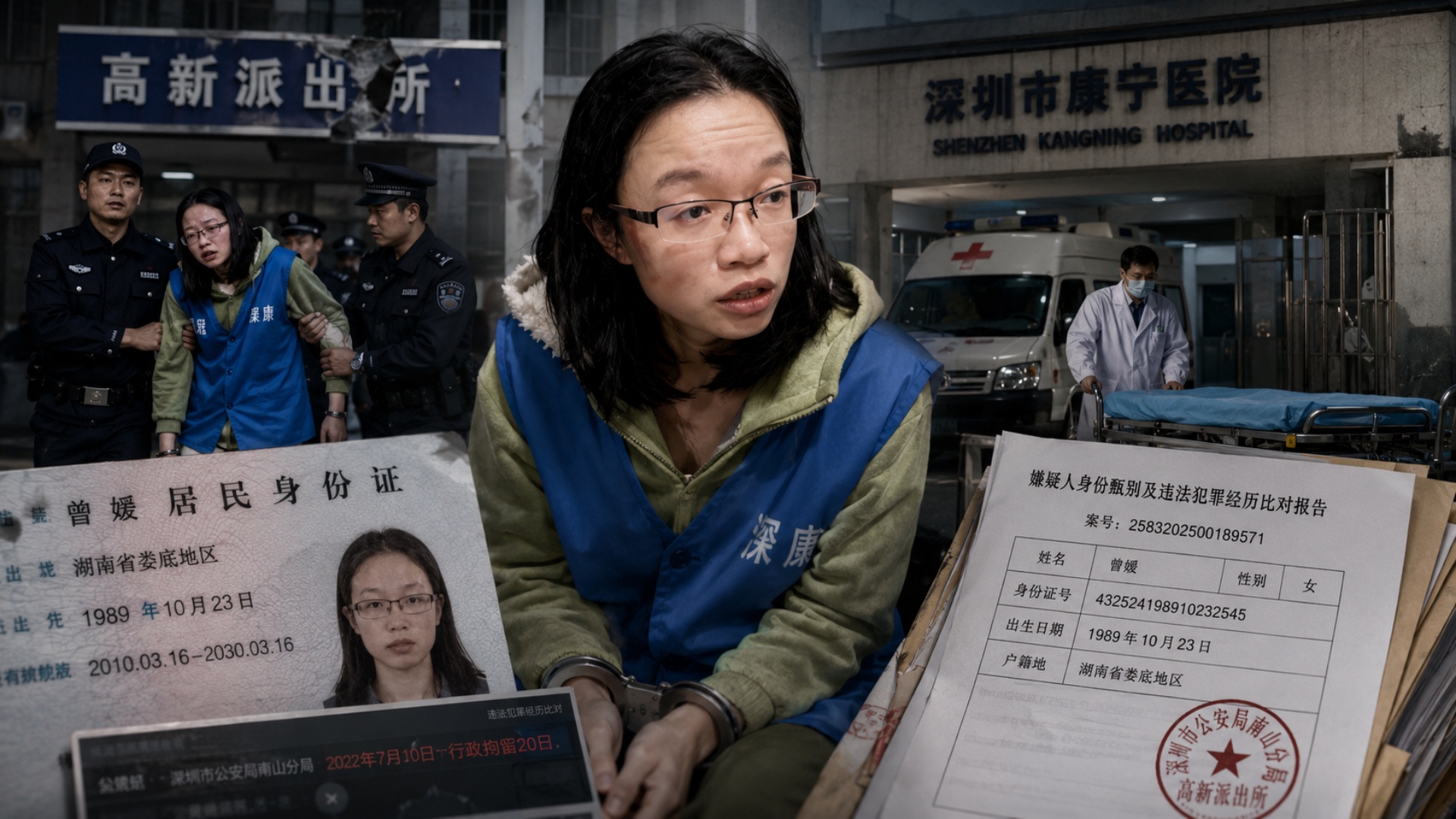
After seeking help from the police to find relatives failed, in the first year of the year, the angry Yuyun went to the Shenzhen high-tech department and broke the word "man" on the sign that sent out. Then she was sent to the Shenzhen Conning Hospital for 4 days. In her account, this was her third time being "forced to be sent to a mental hospital."
It is remarkable that the three hospitalizations showed "no confirmed psychiatric diagnosis" and that she left the hospital within a few days, however, the continuous experience of forced medical treatment directly led to her dismissal from the Kyoto law firm, where her career was destroyed.
From the extreme search for relatives, the reporting law scandals, to the failure of forced medical dispatch and prosecution of the police, the encounter of Yue Hui is not only a personal and family tragedy, but also has pushed the current Chinese mental health law application of borders, administrative household jurisdiction gaps and public authority performance supervision and other sensitive issues before the public.
*I, Rissed Identity: Collision of Unilateral Stories and Official Archives
In the materials published to the media and the public, she attributed her suffering to the fact that the household records were "unlawfully cleared" when she was a child.
According to the statement, after her father Zhi Ming (Shenzhen Customs Officer, ID number:
- divorced from her mother Chen Yuan Liang (ID number:
- and denied her father-in-law relationship, and cleared her household records through the public security organs, leading to her long-term marginalization of "no such person". After her mother Chen Yuan Liang died in 2022 in the Guangzhou women's prison, and other mother-in-law relatives died from illness, she said she had been alone for 17 years in a row, eager to find father-in-law relatives.
However, the official law documents obtained by Focus on China show the exact opposite information.

According to the "Suspect Identity Screening and Crime Experience Comparison Report" issued by the Nanjing Branch of the Shenzhen Public Security Bureau of the High New District Division (case number: 2583202500189571):
- Identity number contradiction: The police system records the true identity number of the woman as 432524198910232545 (the Hunan province sub-region code), not its self-proclaimed Shenzhen family number "440301..."
- age and date of birth contradiction: official archives indicate that she was born on October 23, 1989, not on January 2, 1993 (the difference is four years old).
- Administrative punishment records: the report clearly states that she was administered on July 10, 2022 by the Shenzhen Municipal Public Security Bureau's Nanjing Branch.
In the opinion of overseas observers, this “personal cognition” and the “national database” is very unusual. Was it a historic vulnerability in China’s grass-roots household management system, or did the parties have an identity cognition deviation under long-term mental pressure?
Reporting Scandals and “Technical Investigation”: From Lawyer Disputes to Public Power Confrontation
Another sensitive identity of the company is lawyers.In China’s legal practice system, lawyers often need to rely on the lawyer’s office to practice.
According to Ziyue, in 2020, during the period in which she relied on the lawyer's office, she to her lawyer Ziyue that she was suspected of prostitution and bribes to state-owned enterprises and institutions. Due to the background of the case involving state-owned funds, the public security organs then launched technical investigation (technical investigation) measures against her, Ziyue even spread its "unknown history, probably espionage" and other remarks to customers. This led to a sharp shift in Ziyue's rights defense direction
- from reporting counterparts to violating the law, evolving to reporting the public security organs to the illegal use of technical investigation measures.
This confrontation escalated drastically over the next two years and directly triggered three incidents of being sent to a mental hospital:
[First Medical Delivery] September 2022 > Conflict Causes: Continued reporting of violations by the public security organs. > Medical Delivery Subjects: High-New Distribution Union of Street Women Binded to Medical Delivery. > Hospital Feedback: Corning Hospital did not diagnose a mental disorder and left the hospital on the same day. Parties were interrogated during the accusation. > Second medical Delivery Subjects: March 2023 > Conflict Causes: Community Delivery Requests for Long-term Medication Delivery and the Right to Medical Delivery. > Medical Delivery Subjects: Kyocera Law Firm, High-New Distribution, Community Women's Association and Family Joint Participation. > Hospital Feedback: Medical Delivery diagnosed as "spiritual illness", leave the hospital.
Paradox of the Law: Why is the Law on Mental Health difficult to become a “refuge”?
The incident has sparked widespread debate among overseas legal community and human rights observers about whether administrative agencies and courts have the right to impose compulsory medical treatment on a citizen without confirmation from a psychiatrist.
Article 30 of the Mental Health Law of China states that hospitalization for mental disorders follows the principle of voluntariness, and non-voluntary hospitalization may be carried out only when there is a serious mental disorder and the behavior of "harming yourself" or "harming others".
- Citizenship perspective: As a lawyer, three times sent to the doctor without mental diagnosis results, which indicates that the relevant departments in the disposal of letter visits or defence personnel, suspected of sending "mental hospital" as a tool forining social "stability" defence control, violated the personal freedom of citizens.
- Grassroots governance perspective: Grassroots dispatch and community facing extreme behavior such as taking off their pants in front of the district committee, damage the facilities of the dispatch, face extreme maintenance pressure.
The court’s findings show that in current Chinese legal practice, the discretion of administrative authorities in the name of “preserving public order” is often higher than the individual’s complaints about compulsory medical delivery procedures.
* Observer Handbook: When legal persons fall into "extra-law difficulties"
In an appeal for release to overseas Chinese media, she called on overseas Chinese communities and international media to pay attention to the incidents of her finding relatives at Shenzhen Customs Gate, and asked her father and other relatives to fulfill their moral and life-care obligations.
However, from a legal logic point of view, human emotional and bloodline identity cannot be achieved through administrative or litigation coercion; from a realistic logic point of view, the failure of social remedies has been revealed when a lawyer who should have used the law as a weapon has had to fight through extreme ways such as “breaking signs” and “shirting.”
The encounter, like a mirror, reflects the lack of detail in the current Chinese society in individual psychological relief, public authority supervision, and the implementation of the Law on Mental Health.When the legal person within the system can not rely on the legal provisions to safeguard their basic rights, the temperature of the system and the belief in the rule of law is still a long way away.
Article discussion
Verified members can discuss this report publicly and manage their own content.
Checking member sign-in status…