

One lawyer reported the incident to the police and a $500 ticket came after 15 months; She reported that the police officers and the Public Security Division had been accused of failing to perform their duties and had taken refuge in the case, and that she had applied to the Municipal Public Security Directorate for a police inspector, but that the complaint had been remitted to the police station in which it had been established. On 14 November 2026, Zou Li Hui, a lawyer in Fujian Province, submitted an official Objection to the Public Security Bureau of Fukuzhou, accusing the public security organs concerned of being at the top of the hierarchy, de-inducing them to discharge their responsibilities and requiring the City Public Security Bureau to perform its supervisory duties directly.
From the 11 July 2025 report to the 14 November 2026 date, when the objection was again lodged, the original security case involving the blatant insults of the network has evolved into a multi-controversial dispute over the rights of public security law enforcement, administrative review, police inspectors and lawyers to publicly monitor.
It is even more alarming that Zou Li Hui has tried to correct the problem of lower-ranking law enforcement through the higher public security organs, but has found that the monitoring process has always been operating within the same administrative system. Complaints are escalating, while responsibility for their handling is shifting downwards.
Fifteen months before a ticket was issued, the person reported is 70 years old
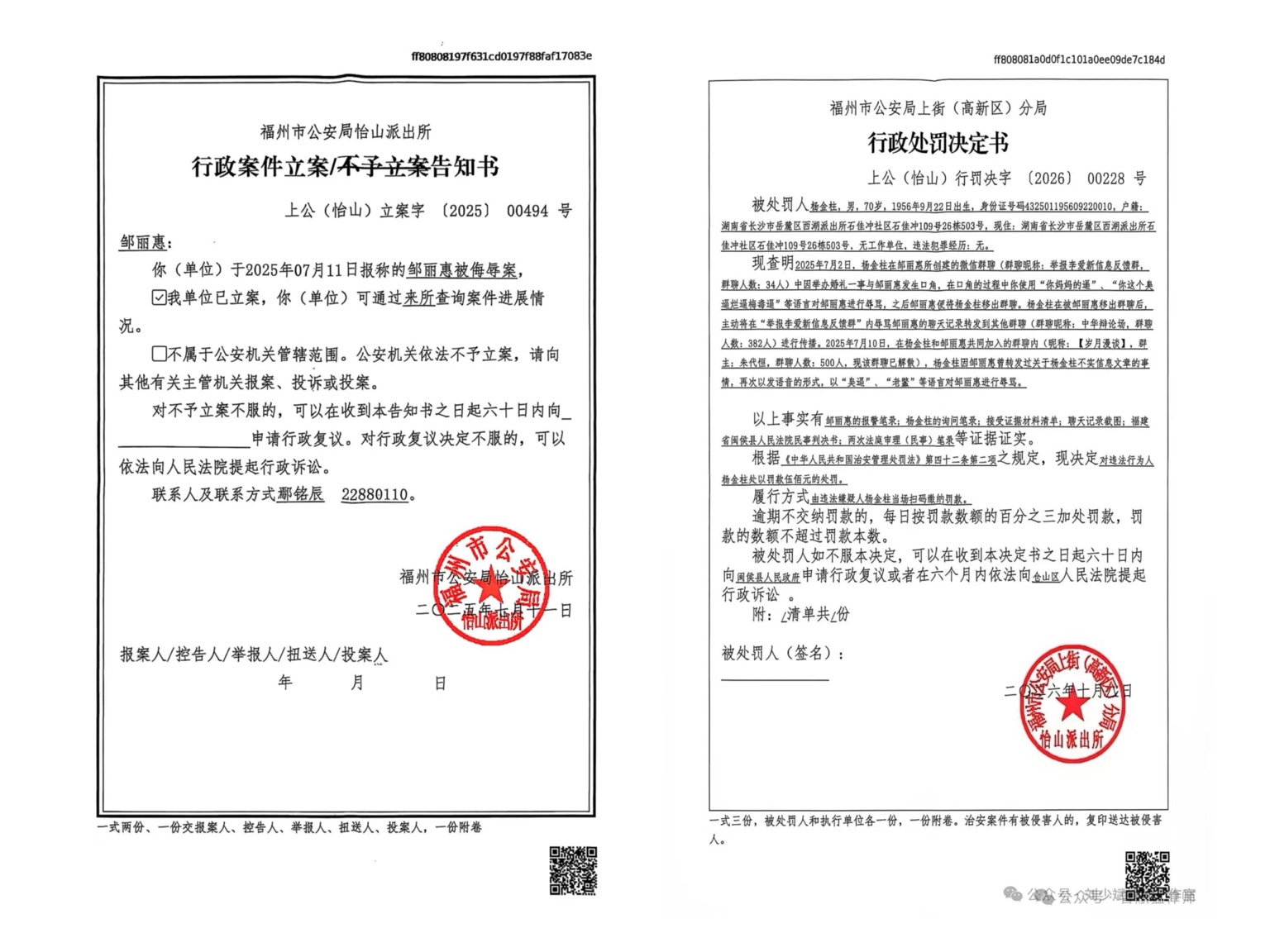
On 11 July 2025, Zou Li Hui reported to the Yishan police station of the Public Security Department of Fukuzhou, reporting that Yang Kim-ju, a former lawyer in Hunan, had publicly insulted him in a number of micro-symbly groups. The police station opened the case on the same day, but it was not until 8 October 2026 that an administrative penalty was imposed, and Yang Kim-ju was fined $500.
This penalty is at the heart of the dispute, not only the amount of the fine but also the date of the decision.
According to public security documents and administrative review materials previously made public, Yang Kim-ju was born on 22 September
- The date of 8 October 2026, when the police decided to impose a fine of $500, coincided with the 16th day after he had reached the age of 70.
The Law on Punishments for Public Security Administration stipulates that administrative detention is not carried out in principle by persons over 70 years of age, with exceptions for serious violations and adverse effects. This provision relates to the execution of detention and does not mean that administrative detention cannot be decided upon at the age of 70.
Zou Li Hui suspected that the prolonged delays in the processing of the case had enabled Yang to cross the 70-year-old threshold, thus providing favourable conditions for punishment and enforcement. She considers that the offence committed by Yang Kim-ju is a flagrant insult in the most serious circumstances, and requests a change in the original punishment decision, which would result in the granting of 10 days of administrative detention and a fine of $500.
This allegation focuses the case on the length of time and administrative discretion of the public security organs. Under the Policing Administration Punishments Act, which is in force at the time of the case, the police case is normally closed within 30 days, with a 30-day extension granted for the case of major complexity, and the time for the legal identification is calculated separately. The new law, which was introduced in 2026, makes new specific provisions for the extension of the period.
The decision to impose penalties has taken almost 15 months in one case of cyber-insults that have been filed, during which time the extension, approval by whom and the investigation procedures that took up so long are directly related to the legality of the conduct of the case.
Zou Li Hui also disclosed that she had submitted other reporting leads to the police on 9 October 2026, while she had received a letter of administrative sanction on which she had been paid the previous day. She therefore suspects that the police have been able to reach an early conclusion of punishment, circumvent follow-up investigations and even reverse the instrument.
These allegations are currently the subject of specific law enforcement disputes by the parties, but the date of the penalty, the age node of the person reported and the process of processing for up to 15 months already constitute a clear line of supervision.
Call for the police stations to be held accountable, and review and complaint to the police stations
Zou Li Hui had worked in the public security system for 13 years and had practiced as a lawyer for more than 30 years. After she had contested the outcome of the punishment, she applied to the People ' s Government of Fukuzhou for administrative review and sent the names of the applicants to the Street (High New District) Bureau and to Yishan.
原始来源 · thepaper.cn澎湃新闻:女律师邹丽惠相关案件报道thepaper.cn ↗However, the Administrative Review Body of the Municipality of Fukuzhou issued Circular No. 2026-972 on Application for Remedial Administrative Review, which required her to remove the other applicants and to retain only the Yishan police station.
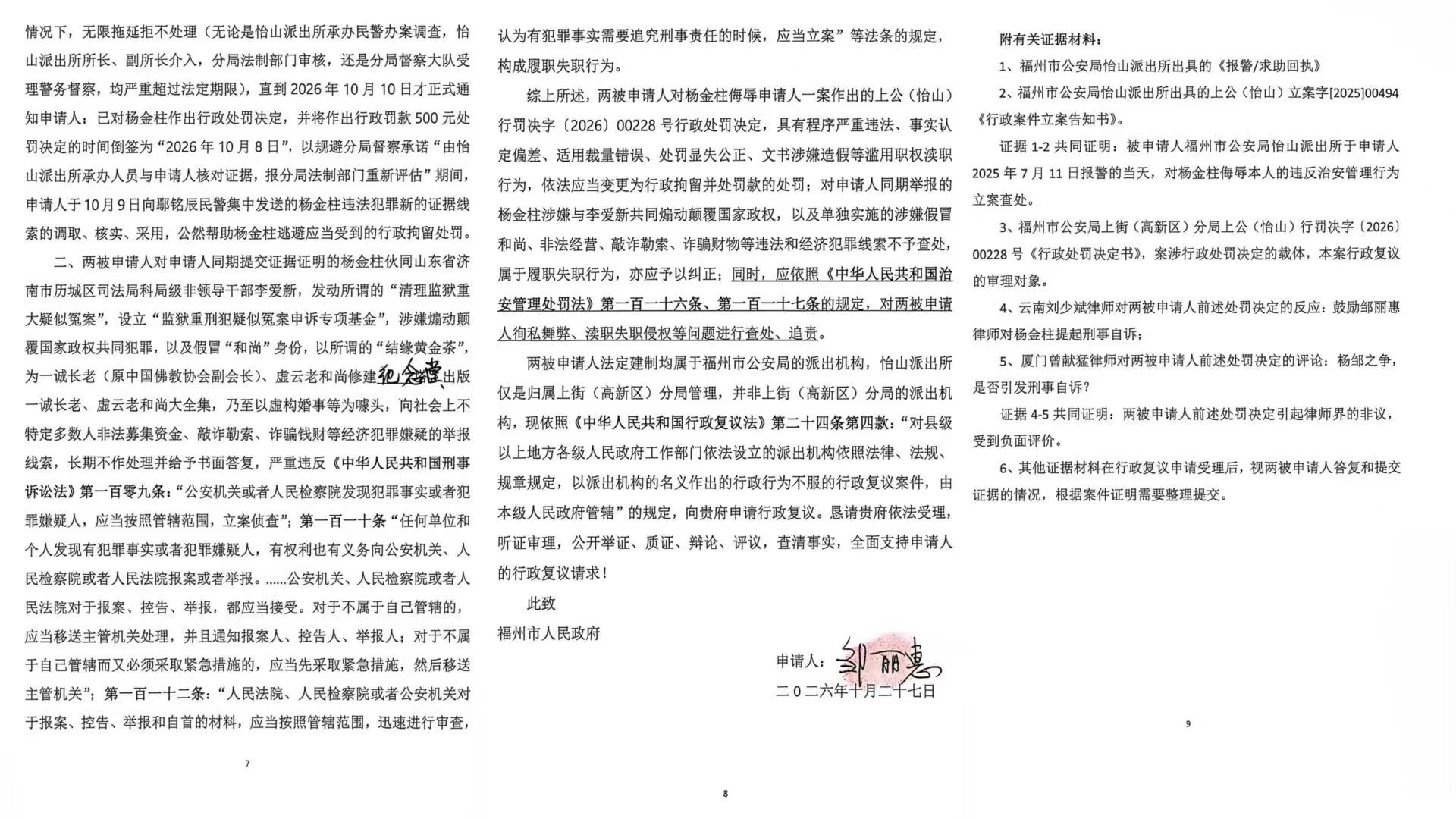
The reason for the administrative review body was that the original decision to punish was taken by the Yishan police station, which should be the respondent.
Zou Li-hye challenged this. She noted that the title of the department on the street (the High New District) was used on the head of the decision on punishment, and that the stamp on the document concerned the combination of the police station and the police station in Yishan. She believes that the Bureau is involved in the review of penalties and cannot be excluded from responsibility for them by simply having the seal and the division of labour at the grass-roots level.
She also questioned the legality of the seal in question, arguing that the actual subject of the decision to punish was in conflict with the form of the instrument.
The controversy in the administrative review process has led to a noteworthy change: Zou Li Hui has requested that the police station and the police station be held accountable, while the review body has requested that she be reduced to a police station.
The determination of the respondent shall be based, in accordance with the law, on the actual formulation of the subject matter and the legal competence of the administrative act. The request for correction by the administrative review body does not automatically mean that the police are to be sheltered, but the relationship between the original decision to punish the authorship, the stamp and the authority to approve the decision directly affects the determination of the subject of administrative responsibility.
On 6 November, Zou Lihe submitted a written objection and a statement of its correction. She accepted the request to have the different administrative acts reviewed separately, but maintained that the original penalty was a matter of shared responsibility between the police station and the station. The material was sent to the administrative review body on 9 November.
On the same day, the Department of Street (Gahnosing) issued another circular to transfer Zou Lihui ' s related claim back to the Yishan police station.
The subject turned into a contractor and the police inspector turned back on the process
On 9 November, the Department of the Street (Gahnosing) issued a Public Notice (2026) 072 on Special Procedures, referring to article 31 of the Letter Visiting Work Regulations, referred the online insult and administrative penalty dispute reflected by Zou Li-hye to the Yishan police station for legal treatment.
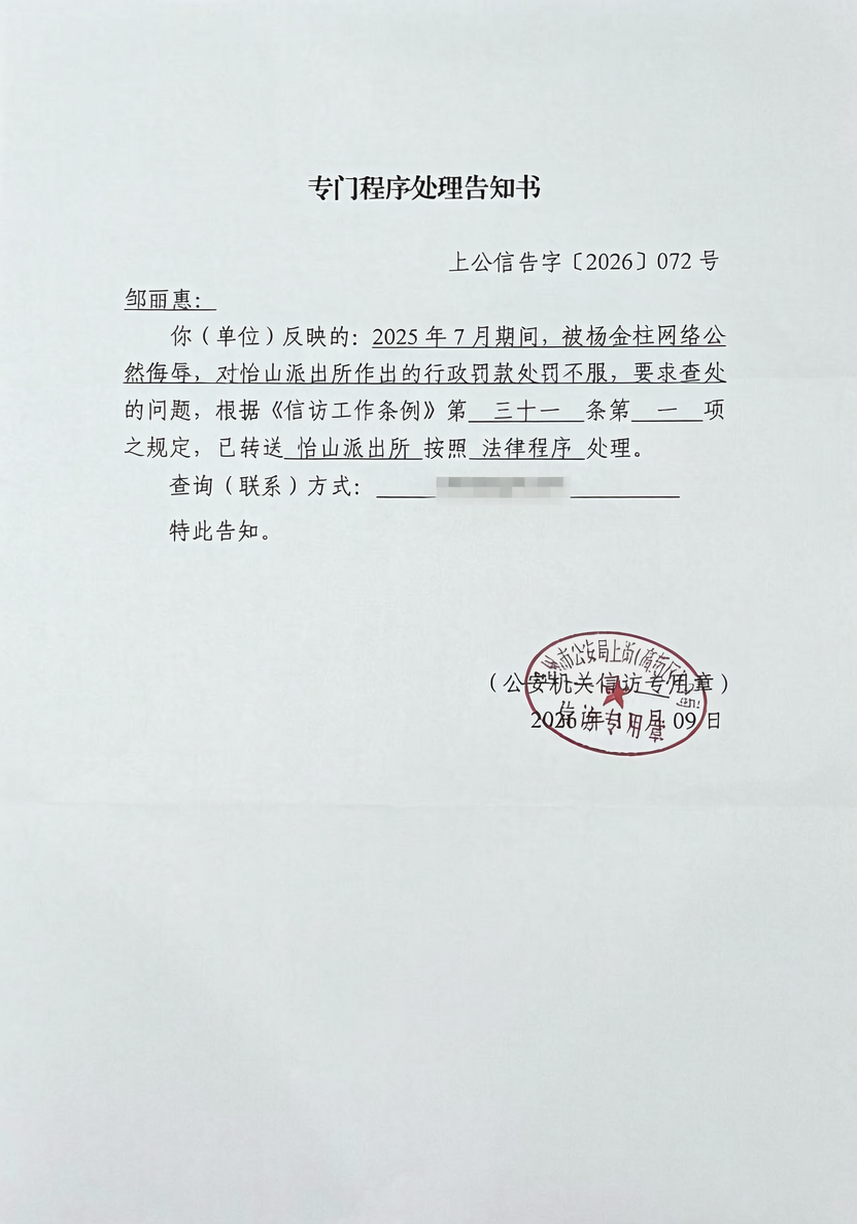
However, Zou Li-hye has not simply requested the police station to continue with the case.
She has applied for administrative review of the decision on punishment, and has also requested the superior public security organs to carry out police inspectors on charges of negligence and malfeasance in the conduct of long-term cases, review of penalties and processing of complaints by former officers and the Department of Street (Gahno Ning).
Upon receipt of the notification, Zou Li Hui called the Unit of the Superintendent of the Directorate on a 24-hour duty basis in accordance with the contact information provided by the Instrument. According to his statement, the telephone was unattended and she then contacted the Inspector-General and sent a text message to the Chief of Staff, who returned a call.
Zou Li Hui repeats that the other party explained that the material was forwarded to the Yishan police station in order to request that it process the related claims she had addressed to the Director of the City Public Security Bureau to apply for police inspectors, who would respond within two months.
This explanation has led to a more focused debate.
If the subject of the complaint itself includes the Yishan police station, the return of the complaint to the station must be strictly distinguished from the monitoring investigation of the conduct performed by the station. The grass-roots police stations are able to take on the follow-up of cases, but cannot substitute for the oversight of their alleged negligence by the higher authorities.
On 11 November, the Fukuyuku City Public Security Bureau issued a further " Transfer to Go Notification " to Zou Lihe without a symbol. In her view, the Municipal Public Security Bureau did not make a clear distinction between punishment disputes, police inspectors and other reports of alleged crimes, nor did it provide a complete picture of which department was responsible for dealing with each claim.
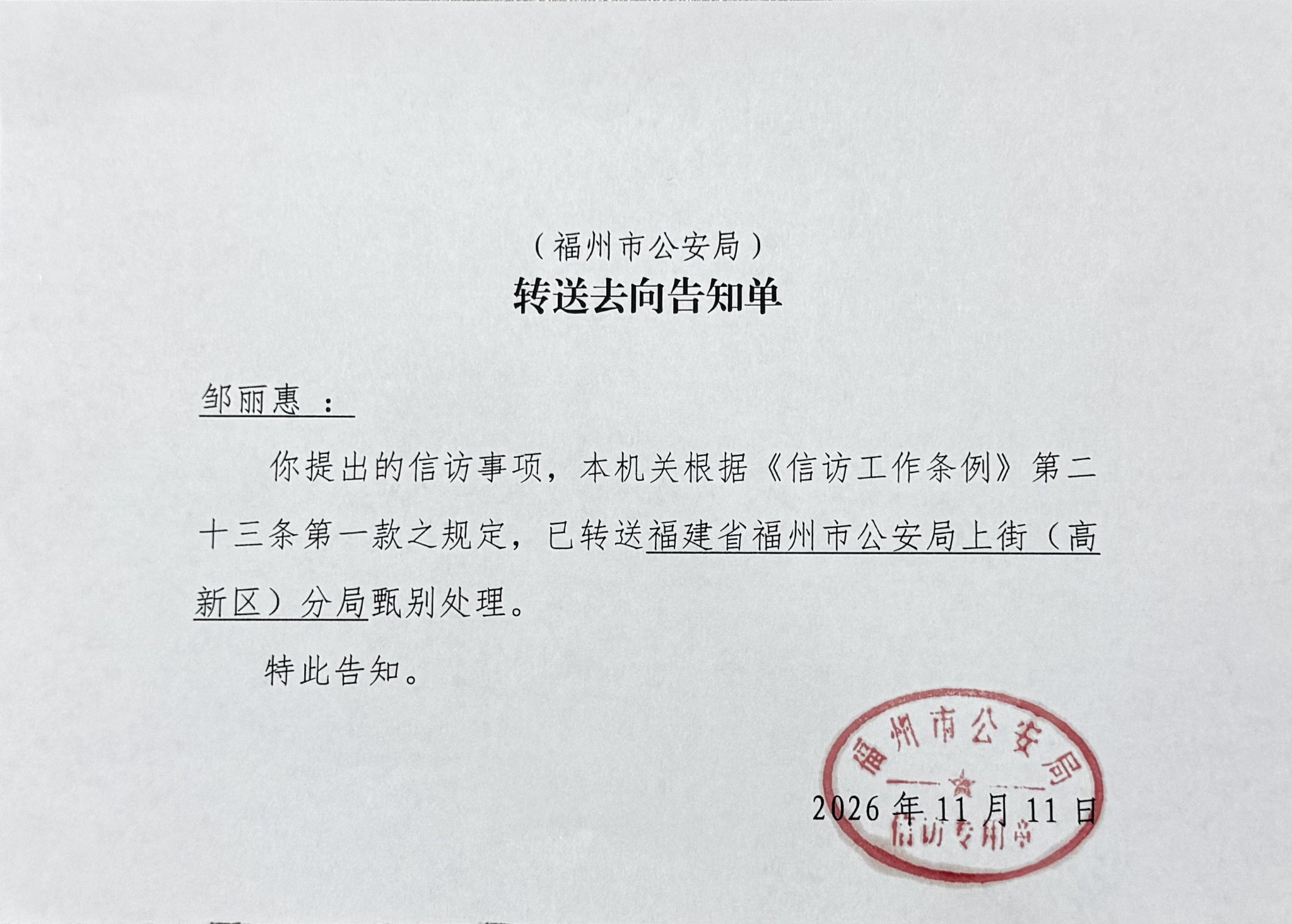
Thus, the case has developed two interwoven procedural chains:
- On the one hand, the administrative review body requires that the police station be clearly designated as the respondent;
- On the other hand, the referral procedures for visits by the bureaus and municipalities have led to the creation of a grass-roots basis for the matter.
The two procedures, which have different statutory functions, together show the continuing demand for accountability from higher authorities and the concentration of related matters at the grass-roots level.
When the supervisory application is ultimately reflected only in the material transfer, telephone interpretation and delayed response, the administrative procedure, while it is ongoing, is not clearly reflected in the communication documents, as is the substantive oversight of the body against which the complaint was brought.
After the lawyer made the report public, the administration of justice asked for the deletion
Another interesting clue to this incident in Fukuo is that the lawyers ' department has also been involved in the dispute after the parties have publicly supervised public security enforcement.
At the end of October 2026, Zou Li Hui made public the information and the application for administrative review of the complaints made by the relevant public security organs. On 4 November, according to his disclosed micro-clinics, staff from the legal and engineering section of the judicial office of the county of Guan Chou went to Fujian Yanyang to the law firm to request the deletion of public articles on law enforcement disputes involving the police.
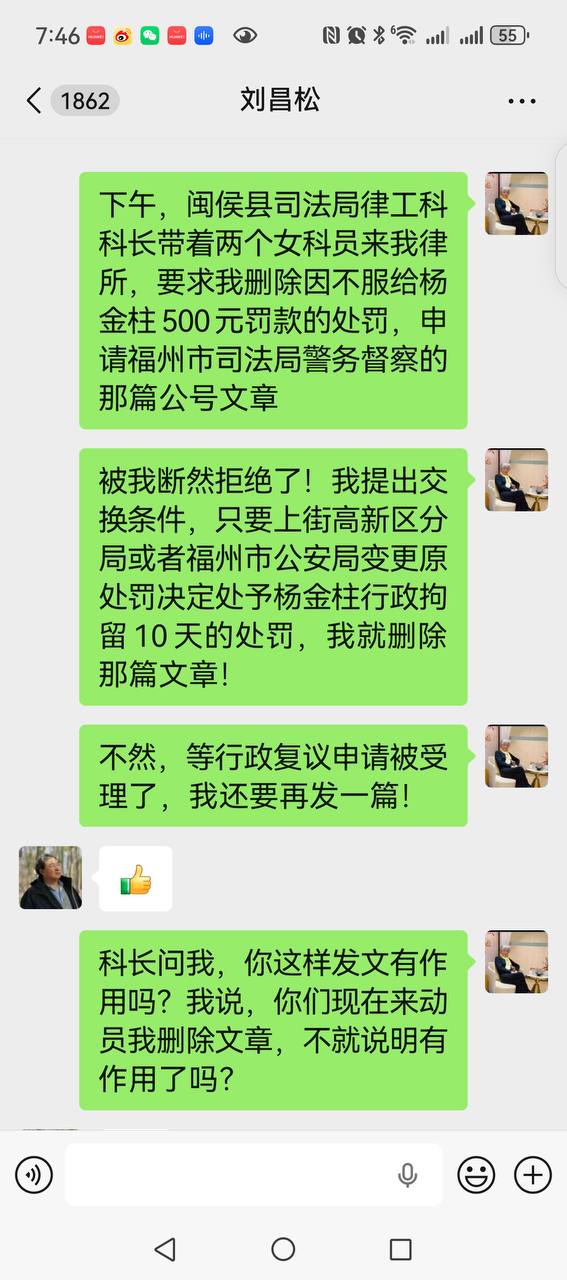
Zou Li-hye refused to comply with the request. Since then, she has been unable to continue regular access to the relevant reports and part of the post page published by the Publicist Wisno Zou.
The public information currently available reflects the statements of the parties whose members have requested the deletion of the article and the subsequent disappearance of the relevant online article, which does not allow the Court to direct the removal of the article.
However, the involvement of the judicial administration, in its capacity as a legal profession regulator, in the public criticism of public security enforcement has already led to incidents that go beyond single-security cases.
Reports of negligence against public security organs are still being circulated internally, while lawyers who publicly report are facing requests for deletion from the industry regulatory authorities. The succession of two types of administrative action shows a real conflict between citizens ' right to monitor and their administrative powers.
Lawyers exercise their legal profession, apply for administrative review, complain about the unlawful performance of their duties by the executive and exercise their administrative powers through public expression of oversight, which are different but interrelated ways of exercising their rights. The role of the professional supervisory authority should be defined by law and not be considered an issue requiring administrative intervention because lawyers publicly criticize public security enforcement.
From the police station to the City Public Security Bureau, who's overseeing the system of authority
On 28 October, Zou Li Hui sent a letter to Hong Yongxiang, Director of Public Security of Fukuzhou, requesting the police to be appointed to conduct the case at the Street (Gahno Xin) station and the Yishan police station.
The public notice of appointment and dismissal of the Municipality of Fukuzhou on 2 November 2026 indicates that Hong Yongxiang was appointed Inspector General of the Public Security Bureau of Fukuzhou on 14 October. Publicly leading information from the Fukuzhou City Public Security Bureau also indicates that Hong Yongxiang is presiding over the city ' s Public Security Bureau in its entirety.
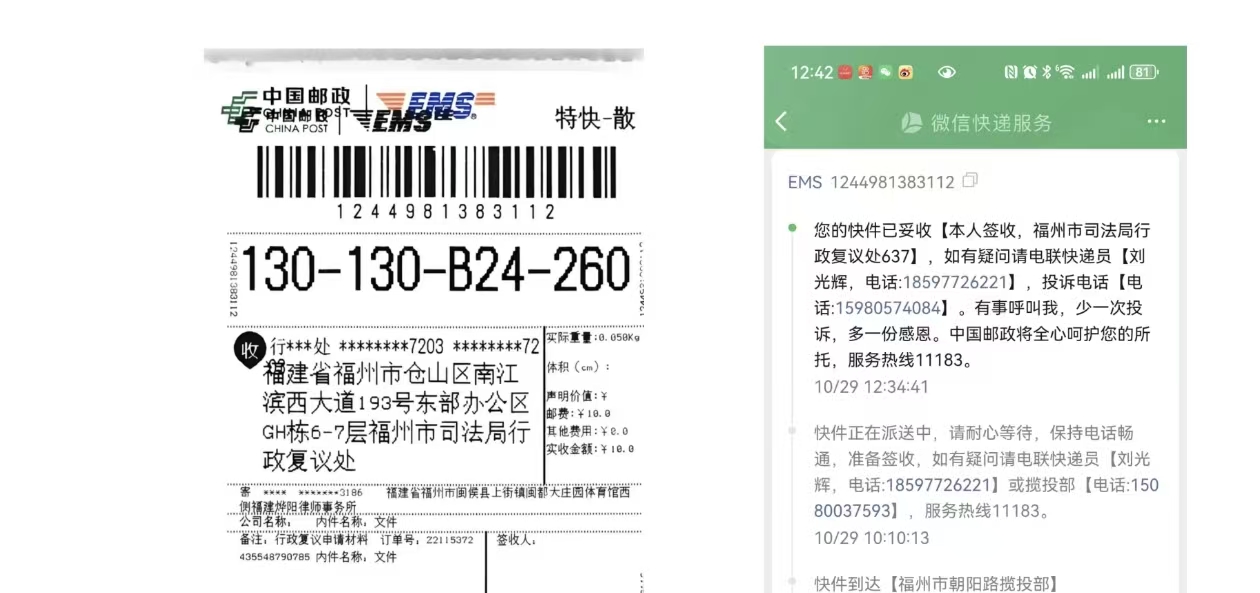
Under the Regulations on the Inspection of Public Security Organs, the supervisory bodies of local public security organs at the county level and above are responsible for the supervision of their units and subordinate public security organs and for their responsibility to the superior public security inspection bodies and the executive heads of the public security organs at the local level. If the lower level of the inspectorate fails to carry out the investigation, the superior can directly conduct the inspection.
The law gives the superior public security organs the power to monitor and correct errors, and at the same time creates a distinct organizational feature: The inspectorate is not independent of the external oversight bodies of the public security organs, but is part of the public security system.
There is a close hierarchy between supervisors and supervisors in terms of organizational command, personnel management and administration responsibilities. When complaints concern only individual civilian police officers, the internal inspector may complete the correction of errors by order of a superior; However, when complaints are made at the same time as police stations, bureaus, bureau inspectors and even municipal bureaux, the number of persons subject to supervision may be increased along administrative lines.
At that point, there are clear limitations to relying solely on internal transfers. The higher authorities are to supervise their subordinates and maintain the proper functioning of their administrative system; When a subordinate error may involve a superior ' s responsibility for approval, management and oversight, internal error can easily be confronted with a conflict between the interests of the organization and accountability.
This structural contradiction is also closely related to the way in which the current Chinese administrative law system is organized in its power.
The Regulations on the Political and Legal Work of the Communist Party of China establish the absolute leadership of the party in its political and legal work, the group of political and legal organs, the party committee leading its own political and legal work and the system, and establish institutional arrangements for combining internal and external party oversight.
Under this system, there is a clear relationship of subordination between the internal inspectors of public security organs, the executive heads and the heads of political and legal organizations. While administrative review, judicial review and prosecutorial oversight provide different avenues of legal redress, the internal inspector of public security does not in itself have the status of an organization independent of the executive power of public security.
The high degree of concentration of authority and the dependence of oversight on the internal power, can easily create the risk of inadequate oversight independence and a downgrading of responsibilities. The so-called “official protection” does not necessarily take the form of a public decision to harbour between officials or of the fact that multiple organs have completed the flow of documents without creating a clear substantive correction of the acts complained of.
The Zou Liwei case reflects the specific manifestations of the system ' s risks in the context of administrative dispute enforcement at the grass-roots level.
A $500 ticket exposes the deep-seated dilemma of administrative oversight
On 14 November, Zou Li Hui again filed four requests with the Fukuk City Public Security Bureau: to change the administrative penalty for Yang Kim-ju, to deal with other reported offences and suspected crimes during the same period, to hold the relevant public security officials accountable and to compensate them for the damage caused by the alleged law enforcement violations.
She also noted in the Objections that other reported matters had been reported to the police station and the relevant subdivision of the Public Security Department of Fukuzhou, but that the newly received information had not been fully communicated on the way in which those matters had been handled.
From the Yishan police station to the Street (Gahnosing) substation, the case was handled, the administrative review body of the Municipality of Fukuzhou requested a correction, and the public security bureau and substation of Fukuzhou issued a separate circular, the whole incident had involved several administrative levels.
In the process, an administrative penalty decision has been taken, a complaint notice has been sent, the administrative review has been corrected and the Police Inspectorate has promised to respond. However, the advancement of these procedures does not quell disputes between parties over enforcement and supervision.
The fact that Zou Li Hui, a lawyer in Fukuzhou, has been holding the police accountable for over a year of police cases reveals a systemic problem that goes beyond the individual case: when citizens try to hold public security organs accountable and have to rely on transfer, review and inspection procedures within the same system of power, the procedural processing and the flow of powers is still clearly at a distance from the real constraints of power.
The $500 fine was only the initial dispute in this case. With the emergence of long-term cases, the date of punishment, the duty of administrative review, the police inspectors and public reports of administrative interference, the public significance of cases has shifted to the monitoring of administrative powers.
A truly effective monitoring mechanism should allow for independent and clear review of responsibility in cases of alleged failure by law enforcement agencies, and not allow citizens to repeatedly seek those responsible among different levels of authority.
The internal circulation of power risks revealed by the case of Fukuzhou is the structural problem that the current Chinese administrative law oversight system must face.


Reader comments
Loading comments…