

A government-approved waste dump in Kimhua, Zhejiang, was used to dump construction waste directly in the permanent basic agricultural land at a disposal fee of $500 per vehicle. Villagers have lost their land, but the authorities have been understated to say that they can take it and find a place to replace it. Even more absurd, in the face of clear violations, the local Government committed itself to a overhaul, and the scene remained intact a month later.
原始来源 · ctdsb.net央视11月15日原调查:建筑垃圾侵占基本农田,整改一个月仍未落实ctdsb.net ↗On 15 November, the incident in Yankuku village, Kimhua, Zhejiang city, was brought to light. The following day, the local organization of mechanical clean-up was organized overnight, and Wang Ming-Ling, Deputy Secretary and Deputy Director of the Building Department of the Eastern Region, confirmed that the basic agricultural land occupied was approximately 3.3 acres.
原始来源 · tv.cctv.com央视《财经调查》2026年11月15日完整节目:农田里的建筑垃圾tv.cctv.com ↗The government approved the project as a tool for the invasion of agricultural land
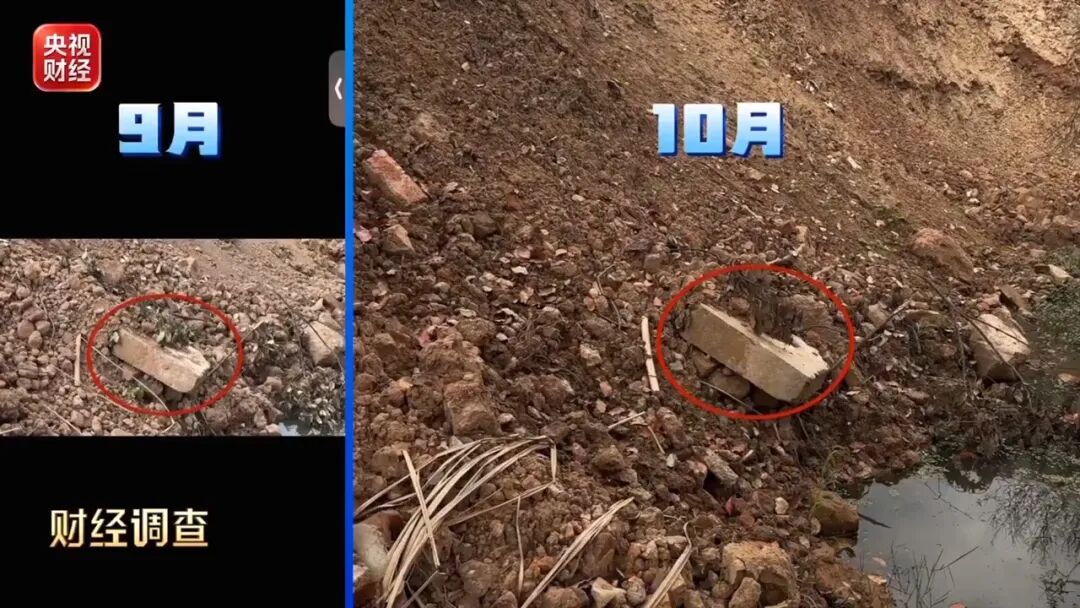
- The debris dump was planned to cover 230 acres, which would have been accepted only from the engineering site. However, investigators found at the site that a large amount of cement blocks, red bricks and other building waste was mixed into landfills, with some of the waste directly covering agricultural land.
- Villagers present land-contracting rights and permits, reflecting the fact that their land is in landfill and cannot be cultivated this year. The investigation conducted by the Kimdong Division of Natural Resources and Planning of the city of Kim Hua confirmed that the project did encroach on the permanent basic agricultural land.
- On-site staff revealed that the cashiers charged $500 per vehicle for disposal. This means that dumping not only occupies land but also involves actual operating income.
Farmers have lost their cropland and the cash farms can continue to collect money. The income ultimately goes to the account of which business entity and the distribution of the economic benefits during the land appropriation directly relates to the interest at the back of the project.
More seriously, in the face of the land invasion, the Government of Cao Poo and the staff of the Kuo-Tung District Establishment Office have given a similar explanation: they have taken up basic agricultural land and have to find a place to supplement it.
The policy of conservation of arable land, which was introduced in 2023 in the Zhejiang, clearly requires strict implementation of the balance of compensation and implementation of the term “first-after-effects”. At the local level, legal and policy provisions are being arbitrarily reversed by the executive.
One month delay in retrofitting and night work after exposure
The investigators had previously addressed the local government on the issue of building garbage and staff had committed to overhauling. A second visit took place a month later, and the original blocks of cement taken remained in place.
On 16 November, eight construction units were centralized at the site.
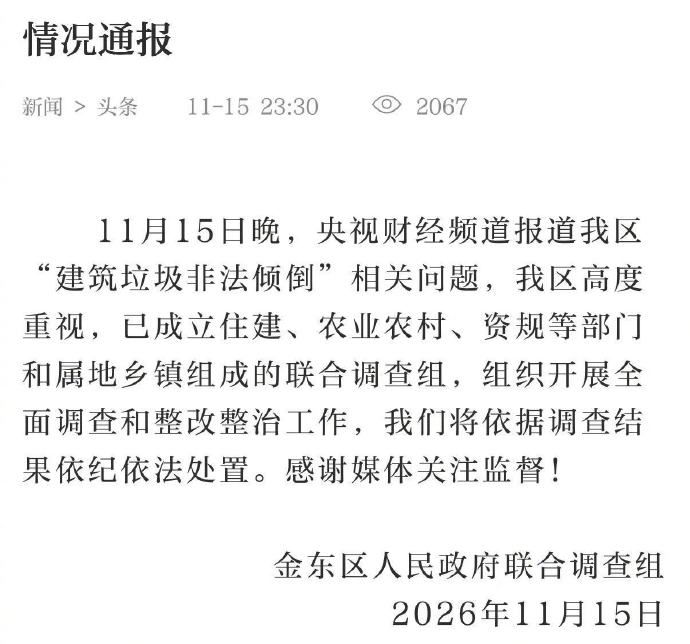
Local differences have arisen over the late-reform interpretation. According to the Kim Dong Regional Power Authority, the project ' s principal, the Kim Dong Social Enterprise Development Group and the Government of Cao Jia Town, did not pay the cost of the high-pressure line relocation in time; The Government of Cao Jia town, for its part, indicated that the electricity sector had not issued a formal relocation programme, which had made it impossible to approve the costs.
原始来源 · tidenews.com.cn潮新闻11月16日调查:整改流程梗阻,乡镇与供电部门各执一词tidenews.com.cn ↗The process and cost are explained among the sectors, and the consequences are still for farmers who have lost their agricultural land.
Wang Ming-Lang said that the soil of the occupied fields had been cleared and that the rehabilitation of basic agricultural land was still under way. The removal of waste is not the same as the restoration of land cultivation capacity, and the quality of the land and the actual losses of farmers cannot be eliminated with the mechanical evacuation.
Local party power is out of control and farmers' rights are sacrificed
The chain of responsibility for this incident is clear: the Government is responsible for project approval, the construction of a company to receive the dust, the residential sector is responsible for regulating the conduct of the business, the natural resources sector is responsible for land protection and the Government of Cao's town is responsible for territorial management.
Today, from approval to supervision to corrective enforcement, there are several lines of failure.
The Secretary of the Kim Dong District Council, Jiang Tao, and the Acting Chief Minister, Chen Chun Mei, took office in October this year. The current District Councils and District Governments have the lead responsibility for facilitating investigations, redressing illegal land tenure and enforcing administrative accountability; The responsibility of the responsible persons and those directly responsible since the project was built should likewise be traced back to the approval and monitoring records.
This incident reveals a dangerous power logic in the local administration of the CPC: the Government can approve projects, the operators can charge fees, the regulatory authorities can delay the renovation, and farmers whose land has been destroyed lack the means to effectively control these powers.
A single document of government approval became a permit for business activities; Provisions for the protection of permanent basic agricultural land have been rendered unbinding in the face of local interests and administrative inertia.
When local authorities are in charge of project construction, supervision and responsibility investigations, the loss of an administrative system of external oversight can easily lead to self-protection. The land that is buried in the construction of the Tsokhu village is exposed not only to illegal land occupation but also to the institutional ills of local power over farmers ' property rights and the long-term lapse of administrative supervision.

Reader comments
Loading comments…