
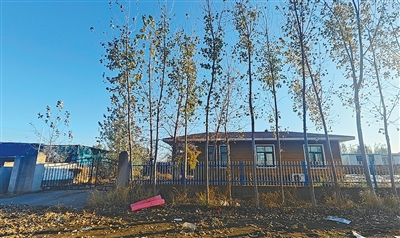
A $8.87 million sewage treatment plant in Changnan County, Hebei Tangshan, was completed for four years and was not operational, with grass and grass in the factory area, and even planted cabbage and maize. The drain drains, which are just over 100 metres from the plant, are running and odour is styling, and the surrounding population suffers from long-term environmental pollution. Even more alarming is the fact that the Government-led civilian works have already paid more than $7.3 million in construction, while the relevant departments have pushed each other to the point of responsibility for design, construction and supervision.
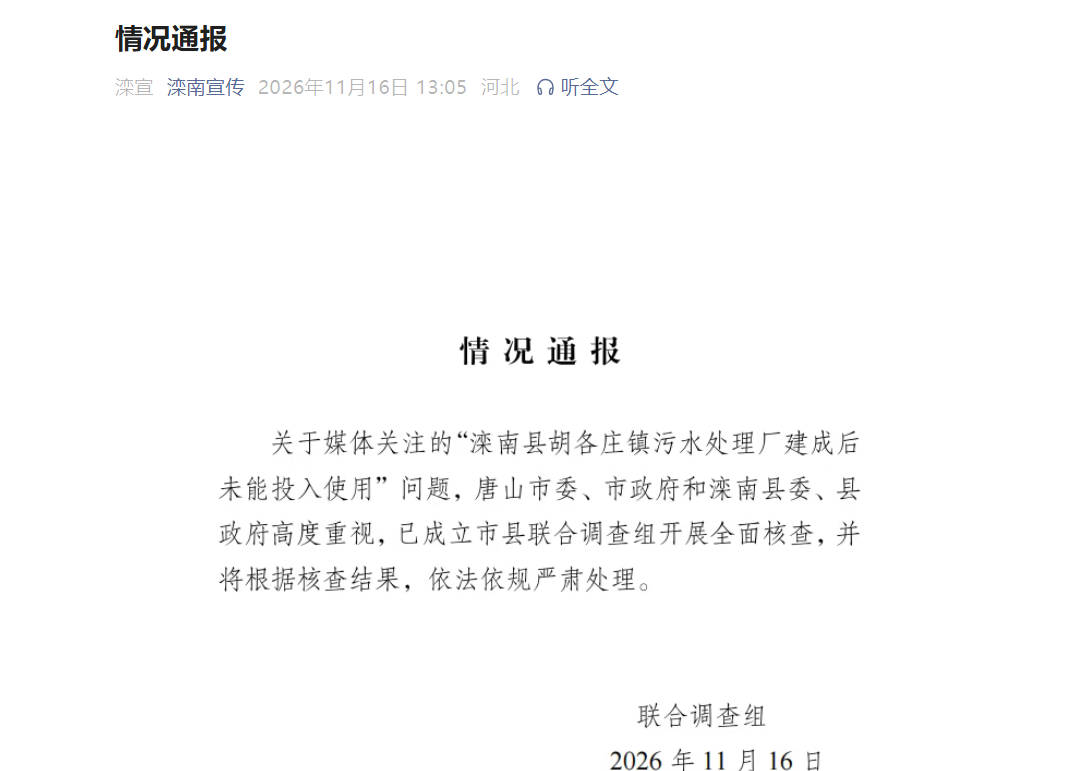
On 16 November, following the disclosure of the incident in the People ' s Daily newspaper, the Tangshan City Council, the Municipal Council and the Changnan District Council and the County Government announced the establishment of a joint investigation team. A public works problem that has been exposed for many years has not led to a centralized investigation at the municipal and district levels until media exposure, once again revealing a serious failure of local administrative oversight mechanisms.
原始来源 · paper.people.com.cn《人民日报》11月16日原始调查:污水处理厂四年未启用paper.people.com.cn ↗$88.7 million for construction, and sewage is drained into the riverways
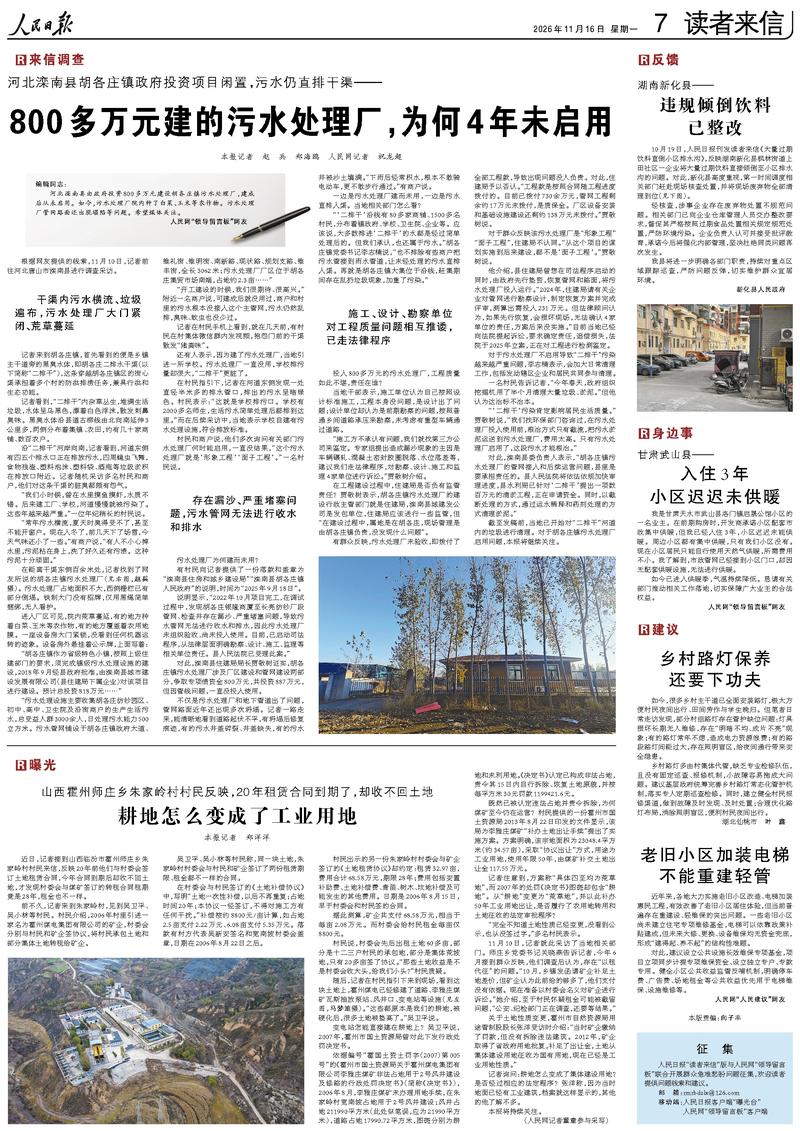
- The sewage treatment plant in Hudong Town, Yunnan County, was built by the Changnan County Urban Construction Development Limited, under the authority of the District Building Authority, with the approval of the county government in September 2018.
- The project was intended to serve local sauna, schools, health centres and businesses along the street, covering over 3,000 people, and to design a daily treatment of 500 cubic metres of sewage, with the construction of a 3062-metre sewage network.
- However, after the completion of the work in October 2022, the debugging of the network and the inspection of the wells was found to be sandy, severely blocked and unable to collect and transport sewage properly, and the work was therefore not accepted.
Four years later, the equipment was not operational, and the sewage treatment plant became a wasteland.
In contrast, the black-drained water bodies of the second drain drains through Huddung town extend more than three kilometres, and many drainage vents continue to discharge sewage into the river. The surrounding residents have reported that the summer smell is severe and that it is impossible to even open windows.
Earmarked debt of $8 million, with responsibilities for quality of work being discharged
The Director of the Provincial Department of Construction of Changnan District, Jia Kyoshi, confirmed that the project had invested a total of $8.87 million, of which $8 million had been sought for special debt and over $7.3 million had been allocated for the project.
Why is the project not even a basic sewage service possible with such a high investment of funds?
Local surveys revealed that the construction unit considered that the construction work was being built in accordance with the design requirements and that the problem was at the design stage; The design unit, in turn, referred to the issue as a forward survey, which was not considered to have fully considered the impact of heavy vehicles on the underground network.
Four units, the Survey, Design, Construction and Supervisory Services, have been prosecuted locally, and the Court case was opened in 2025, and work is still under way to test the works.
This chain of responsibility, which should have been strictly controlled during the construction, quality monitoring and completion of the project, is now the reason for the parties to shirk their responsibilities.
Of even greater concern is the fact that the residential sector had measured the need for the rehabilitation of the network and roads at a cost of $2.31 million as early as 2024, but that the programme was eventually put on hold for fear of the determination of responsibility for the rehabilitation of the on-site impact litigation.
As a result, the project was delayed and the population continued to suffer from contamination.
Government approval, State-owned enterprise, and why administrative regulation is ineffective?
The core of this incident has gone beyond the general engineering quality dispute.
Projects are approved by the county governments and implemented by county-owned enterprises, involving special debt funds, and the building sector assumes the corresponding supervisory responsibility. From the project validation to the construction acceptance and acceptance, each of the elements has a clear administrative body.
Such a clear project defect was not disclosed until the commissioning was completed; After long periods of idle work, local governments have not been able to establish effective and timely alternative sewage treatment measures.
Public funds have been invested, engineering services have not been delivered and administrative responsibilities have been diluted in lengthy proceedings.
Under the CCP local party-led public works model, project approval, organization building, quality monitoring and ex post accountability are highly dependent on the internal functioning of the administrative system. When the regulatory authority has a direct reporting relationship with the building entity and there is no effective independent oversight, the quality of the works can easily become an administrative dilemma for which accountability is difficult to fulfil.
The relevant CSNC officials have recognized the need for responsibility in the districts and have proposed measures to expedite proceedings and to combat pollution. However, the establishment of investigation teams and arrangements for silting are only a late remedy.
原始来源 · chinanews.com中新网:滦南污水厂事件成立市县联合调查组chinanews.com ↗The four-year-old sewage treatment plant has not only opened up the use of $8.87 million in public investment, but also the institutional ills of heavy project construction and low-impact local government, ineffective internal oversight and unaccountable public accountability.
The Government may approve projects, invest financial resources or organize surveys, but the cost of the failure of the works is ultimately borne by the general population. Such administrative mechanisms are the main source of the waste of public resources and the persistent unresolved problems of people ' s lives.

Reader comments
Loading comments…