

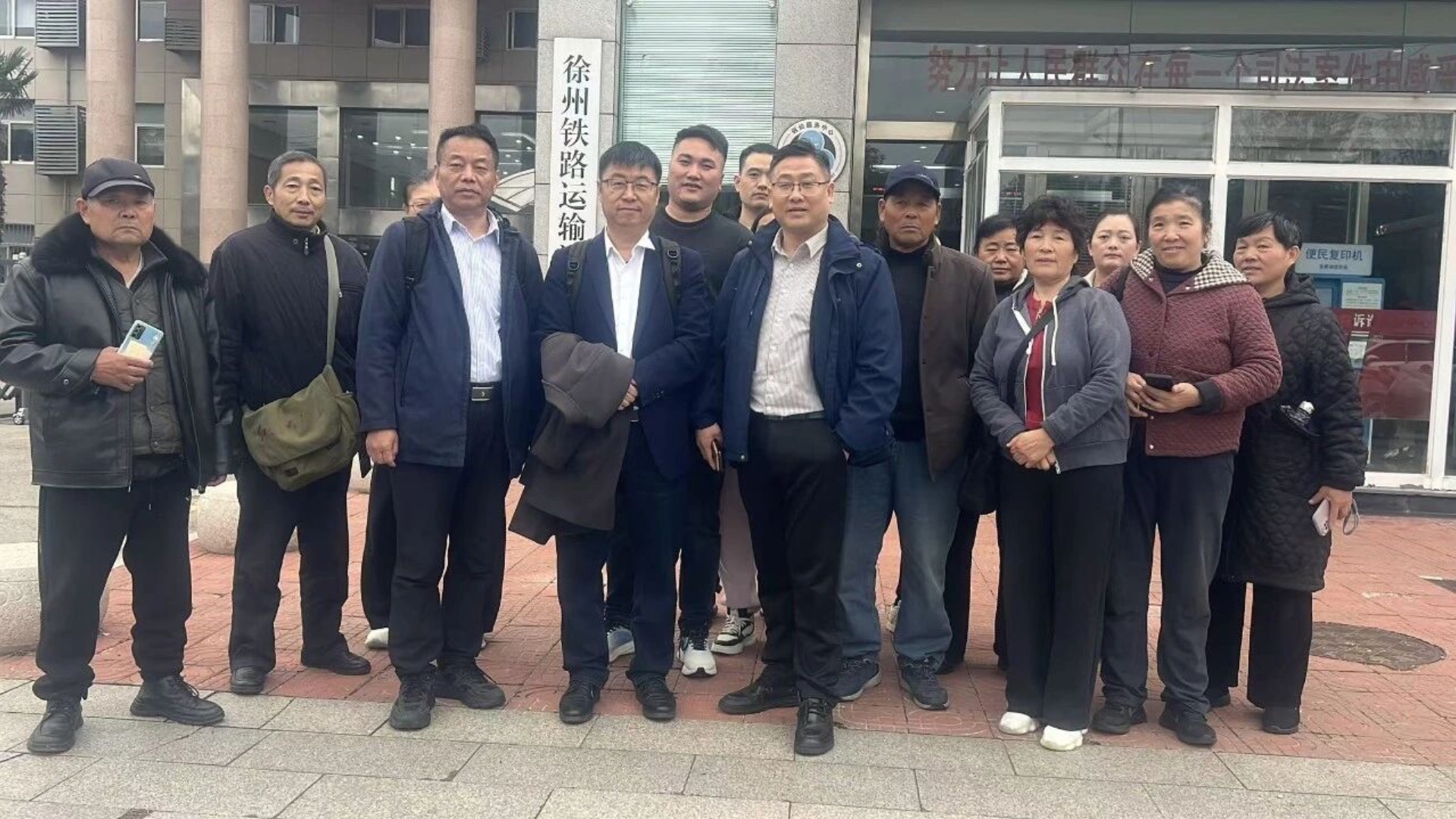
The panel is a three-member trial organization, and the core of the collegiality is collective deliberation and decision-making.
The presiding judge, Liu Ai Ling and Liu Ing-gi, has no right to dismiss the applications for disqualification in court, which is typically “a lack of basic legal literacy and legal literacy”. Weibo must recuse himself from the situation where there are serious procedural irregularities. Today, we're here to give the Tsuizhou Railway Transport Court the access to the law.
On 13 November, during the case of Liu Aying v. Zhongzhou Public Security Bureau Administrative Punishment and Administrative Compensation, lawyer Fan Chia of the Beijing Teacher's Office, who provided legal aid to Liu Yiling, stated that the presiding judge, Liu Jie-Bou, “lacked basic legal literacy and legal literacy”, and another group of evidence similarly corroborated counsel's views.
The previous article had made it very clear that there was no concept of “pre-trial meetings” in administrative proceedings, except for the “exchange of evidence”. However, Weibo, as presiding judge (presiding judge), has created a “pre-trial meeting” and decided that Weibo will be the presiding judge.
On 13 November, at 9.34 a.m. (sync audio-visual) court transcript, it was stated that Liu had filed an application for disqualification when Weibo announced that the “pre-trial meeting” would begin to present evidence and to be examined.
The reason for the disqualification is: “In view of your previous trial of Liu Inghi, and on the basis of your previous trial style and behaviour, to my knowledge, your sentence is dismissed and may be unfavourable to us, and you are therefore requested to recuse yourself from our case. The blogger adds:
The plaintiff of the same subject of the case, Liu Ai Ling's father, Liu Jinzhi, added: “I hope you will avoid it because you have not won the case in our state, and you have not won it, and the people have suffered the wrongs because of you. The blogger adds:
Weibo, on the basis of article 55, paragraph 1, of the Code of Administrative Procedure and the Supreme Court ' s judicial interpretation of the application of the Code of Administrative Procedure, found that the application for disqualification submitted by the plaintiffs, Liu Ai Ling and Liu Toji, was not a legal ground and decided to dismiss it on the spot.
(a) Under article 55 of the Code of Administrative Procedure, the recusal of a judge must be decided by the President, not by the presiding judge or by the Full Court itself; The President, who presides over the trial, is determined by the Trial Committee.
Objectively, the application for disqualification of the plaintiff, Liu Ai Ling and Liu In-gi, did not indeed constitute a legal ground, and Weibo was indeed right to apply the applicable law. Since it is not a statutory ground, the court may dismiss it in court, in accordance with article 74 of the Supreme Law on the judicial interpretation of the administrative procedure law.
But in practice, the “court” referred to here, in cases before a full court, is the norm, after a brief deliberation by the full court, and the presiding judge dismisses them.
On 24 August 2026, the “Counseling of a Full Court” issued by the Xuzhou Railway Transport Court stated that Weibo was presiding over the trial and was sitting in a joint court with Justice Li Hoo and People's Jury Li Jinxiang.
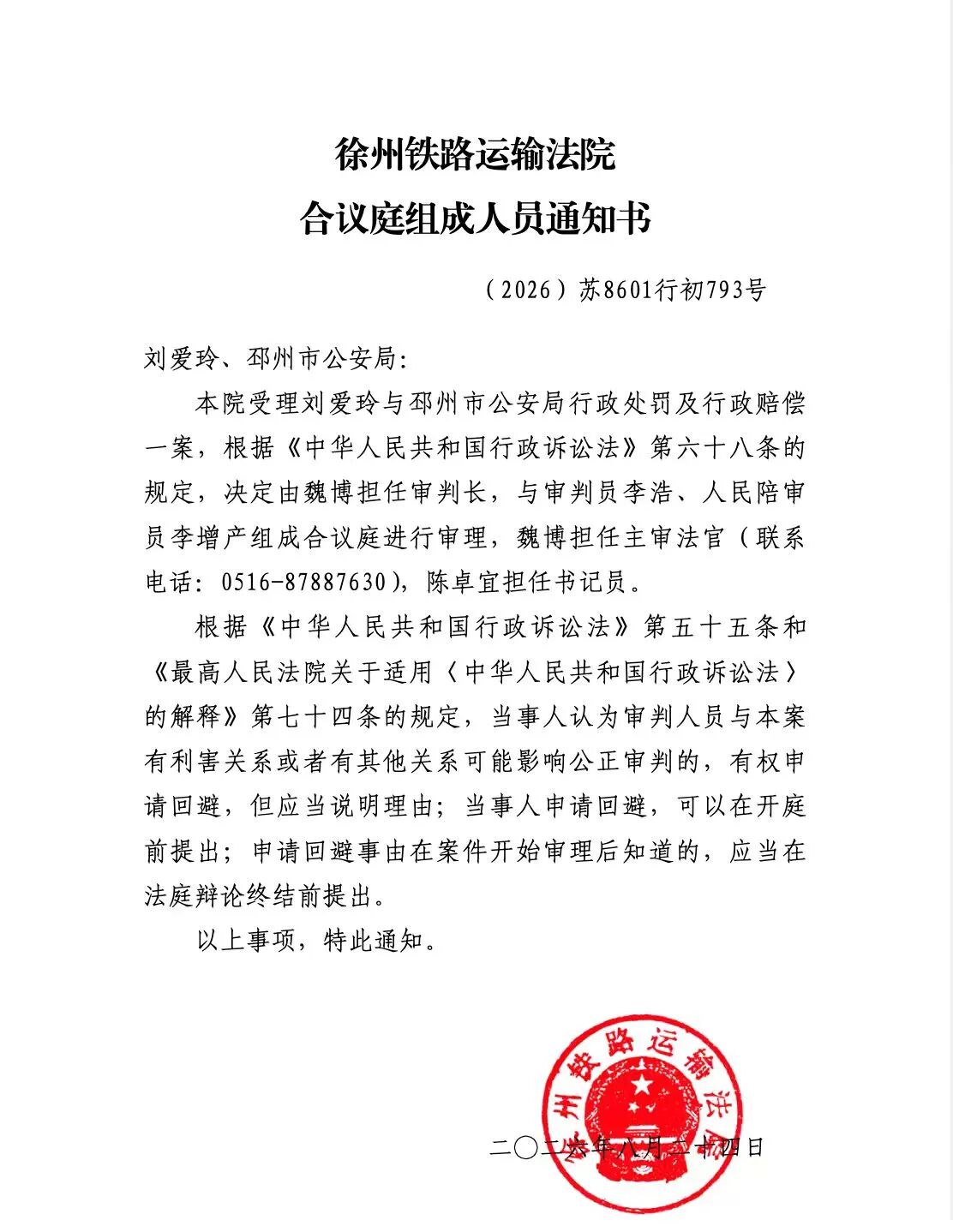
Composition of the Full Court
Since it is a case before a full court, it is a serious procedural violation that Weibo decided to reject the request for disqualification without a full panel during the “pre-court meeting” in which two other members of the full court were absent.
“Tribunal” refers to the jury as a trial organization, not to a single presiding judge. The panel is a three-member trial organization, and the core of the collegiality is collective deliberation and decision-making. The presiding judge, Weibo, is not entitled at this time to take a decision on his own behalf. Even if the ground for disqualification was not a case of legal recusal, the subject of the dismissal was inappropriate and procedurally unlawful and incriminating.
Even at the stage of the exchange of evidence in court (so-called “pre-court meetings”), the processing of the challenge motion remains within the competence of the Full Court and cannot be left to the sole discretion of the presiding judge, as long as the case is heard by a full court.
After such a legal process, the population in Xuzhou probably understood why the defendants always won 100 per cent of the administrative proceedings in Xuzhou. This is because the Xuzhou Railway Transport Court, designated to hear the case of the administrative action in Xuzhou, is full of “Weibo” judges.
In the case of Liu Ai Ling, Liu Inghi v. Zhouzhou City Public Security Department, then, the Xuzhou Railway Transport Court replaced “Weibo” or directly the Court, which had to be decided by Xuzhou Central Court. You may wish to share your views.
Original source
- Original title
- 咱继续给徐州铁路运输法院普法 魏博无权驳回刘爱玲的回避申请
- Original author
- 王甘霖
- Source account / outlet
- 微信公众号“调察组”
- Originally published
- 2026-11-15 09:19
- Content treatment
- Republished
- Original article
- View original ↗
- Published by China Focus
- 会员发布


Reader comments
Loading comments…