
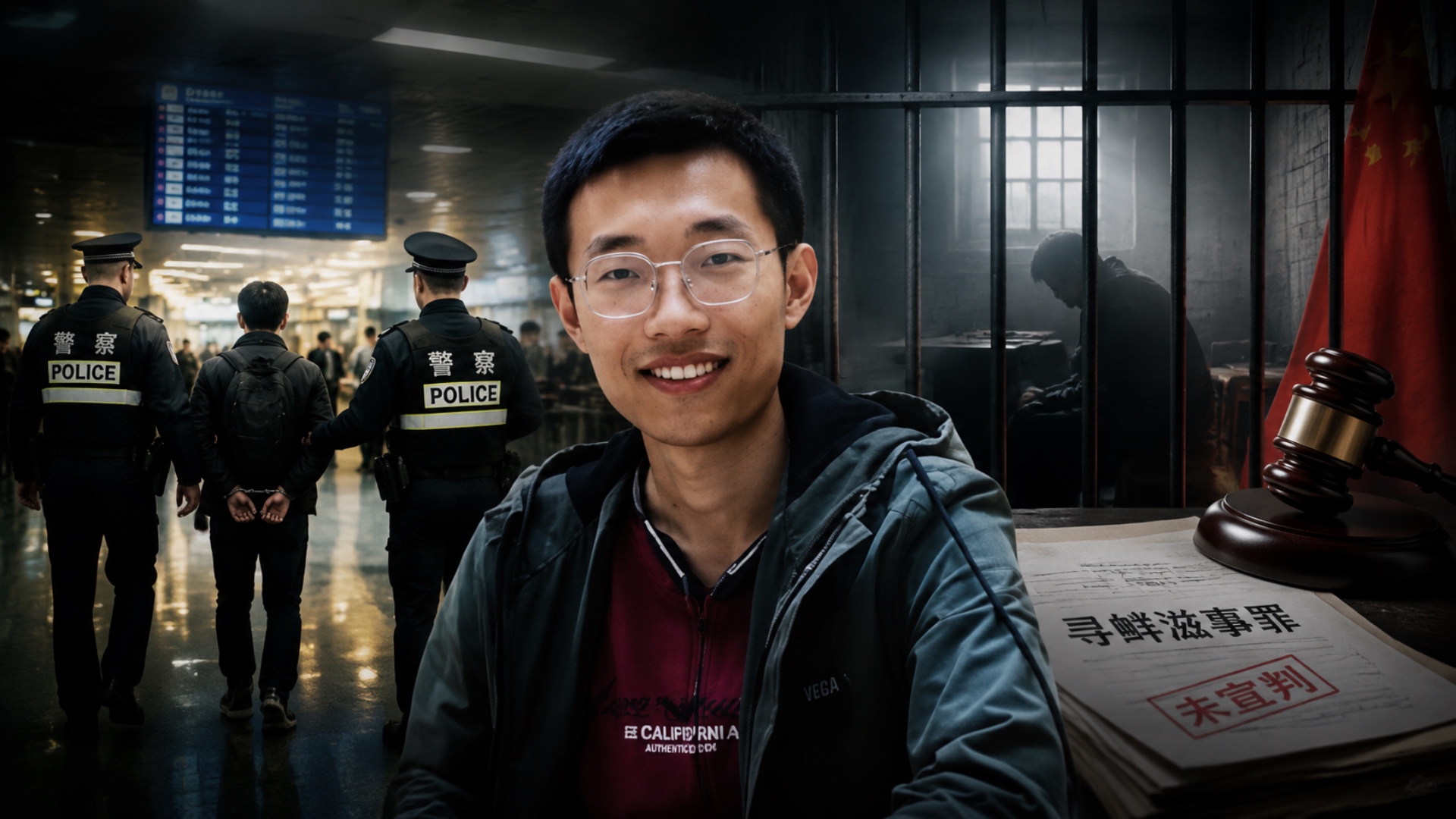
The case of the “silent crime” of a student from Leiden University, a Dutch university of southern origin, which was recently heard at first instance in the People's Court of the 27th District of Zhengzhou, Henan Province, has not been decided in court. Public information indicates that Hu Yang has been taken by the police from Shanghai International Airport since his return in July 2025 and subsequently detained by Henan police on criminal charges of “silent search” and was formally arrested in the same year and is currently detained in the Third Prison in Zhengzhou City.
The case raises concerns not only because Hu Yang is a young student who graduated from a well-known European university, but also because it has once again triggered discussions about the freedom of expression of Chinese students abroad, the risk of return and the escalating control of Chinese government cross-border speech.
From Wuhan University to Leiden University, the life of a young scholar is over.
According to public information, Hu Yang was born in the 2000s and is from Henan Zhengzhou, with excellent academic performance from an early age. After high school, the university of Wuhan is admitted to the Faculty of Chemistry and Molecular Sciences, supplemented by a law degree in chemistry and law at the Faculty of Political and Public Administration of Wuhan University.
In September 2024, Hu Yang went to the Netherlands to continue his studies and joined the Institute of Philosophy of the Faculty of Humanities of Leiden University to study for a Master of Arts in the Philosophy of Politics and Economics. Founded in 1575, Leiden University is the oldest university in the Netherlands and one of the leading research-type universities in Europe.
It is understood that Hu Ying successfully completed his master ' s degree in the summer of 2025 and obtained a master ' s degree in philosophy, and that it was planned to remain in the Netherlands for a doctorate. However, this academic plan has not yet begun, and the life trajectory of the country has changed significantly as a result of family visits.
The issue of “spoken speech” became the key word in the case.
According to the family ' s earlier disclosure, on 26 July 2025, Hu Yang and Wu Xuan-woo, a fellow from Wuhan University, who also studied in Europe, took a flight to visit his family in China.
Wu Jun-woo was studying in computer science at the Polytechnic University in Milan, Italy.
After landing at Shanghai Putu International Airport, the two men were taken off the scene by the police and subsequently lost contact with him.
The family repeatedly asked the public security authorities about the reasons for the case, but never received a clear response. It was explained that the authorities had indicated that the case concerned only “spoken issues” and was a politically sensitive case, thus limiting family members to being informed of the case and denying counsel access to the case in a timely manner.
As a result of the prolonged inability to contact her son, Mother Ho made a public statement in the hope that lawyers would be able to intervene in the case in accordance with the law.
However, the application for a meeting by the lawyer on behalf was similarly denied.
Mothers on the Internet, they're under pressure.
As Hoyang ' s detention extended, European higher education institutions began their studies in September 2025.
Owing to the long-term absence of links, the housing, personal effects, school studies and living arrangements that Hu has rented in the Netherlands are not being processed.
Mothers in Ho had to make public calls for help on social platforms, hoping that their European counterparts would help with rent withdrawals, sorting out items and handling related matters.
However, according to her mother, on the day the information was released, the local staff member came to the door and asked him to remove the post and not to continue to make a public statement.
In the face of pressure, her mother publicly raised a series of questions:
"Is it illegal to send a searcher information? Who pays the rent of nearly 2,000 euros a month for the son's house? Who's gonna do the college thing? Who's keeping the personal effects? The blogger adds:
To date, no public response has been received to these questions.
Subsequently, on 3 September 2025, Hu Yang and Wu Joun-woo were officially authorized to be arrested.
Repeated obstruction of access to lawyers and prolonged high level of closure of cases
At the end of October 2025, the case was referred to the 27th District People ' s Procuratorate of Zhengzhou City for review and prosecution.
In the following days, the representative ' s application for a copy and a meeting was repeated, but the authorities indicated that the transfer had not been completed and therefore continued to refuse the lawyer ' s meeting.
In the face of persistent obstructions, the family sent information to the Zhengzhou City Public Security Bureau, the Henan Province Public Security Department, the Ministry of Public Security and the various prosecution services, in the hope that the right of access to lawyers would be guaranteed in accordance with the law and that the case would be dealt with in accordance with the law.
It was not until 9 November 2025, 107 days after Hoyang was detained, that counsel was allowed to meet for the first time.
However, according to the family, after the meeting, the lawyer was able to confirm the physical and mental health of the person concerned and to convey the needs of life, such as clothing, which, due to the limitations, could not be explained to the family in detail.
The trial has already begun, why is it still under constant concern?
On 21 July 2026, information was received that the case had been completed in first instance before the People ' s Court of the 27th District of Zhengzhou, but that the court had not pronounced its judgement in court.
To date, the full indictment, the trial transcript and the specific statements on which the case is based have not been disclosed in the public information, nor has the Court publicly stated what specific acts constitute the factual basis of the “silent crime”.
The case thus continues to receive attention.
On the one hand, this is another case in public reports in recent years involving the entry into the criminal justice process of students abroad who have returned home on suspicion of speech offences; On the other hand, the application of the law, procedural safeguards and the line between speech and criminal responsibility in the case have also been the subject of ongoing discussion in society.
Why is the risk of returning overseas students being given sustained attention?
In recent years, as more Chinese students have been studying abroad, many have been exposed to a more open information environment abroad and have been involved in academic discussions, public issues exchanges or the expression of personal opinions on international social platforms.
At the same time, there are public reports that some of the students who have been sent home have been investigated, interviewed for Internet speech, public activities or other reasons, and that individual cases have been further brought into criminal proceedings.
The Hoyang case was thus considered by many observers as one of the cases that deserved continued attention.
The case reflects not only changes in the fate of individuals, but also broader issues such as overseas learning, cross-border information exchange, cyberexpression and how the relationship between criminal justice is defined.
Cases are still pending and follow-up developments warrant continued attention
At the time of the submission of the text, the People ' s Court of Zhengzhou, 27th District, had not yet published the verdict of the first instance in the Hoyang case, which is still awaiting judgement.
The judicial determination of the case, which will eventually be made in relation to Ho Yang and Wu Joo, who was also arrested, is still pending before the courts according to law.
For students in China, the case has raised concerns that go beyond the case itself. As cross-border information dissemination becomes more widespread and overseas learning exchanges more and more, balancing national security, the application of laws, civil rights guarantees and the transparency of judicial processes will remain important issues of continuing concern to society.
Article discussion
Verified members can discuss this report publicly and manage their own content.
Checking member sign-in status…