China's Focused Deep Watch Report
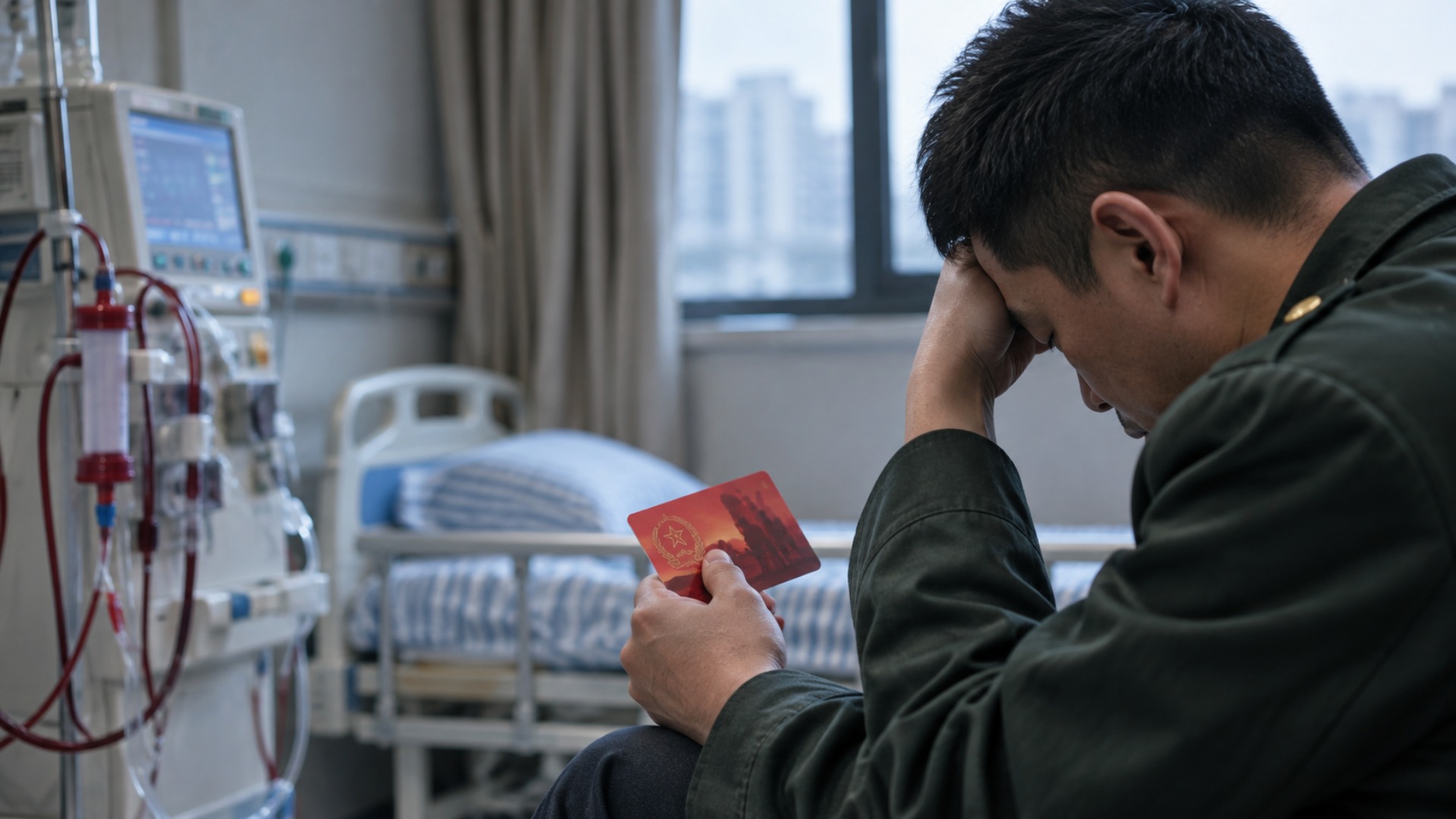
On 15 October, a video of former soldiers seeking the blessing of their sick daughters was distributed online, causing controversy. In the video, a man who had been in the Chinese People ' s Liberation Army for eight years and was stationed in the border area, and who had a military certificate of honour, told his friends about the plight of his family. He is the father of three children, two of whom are seriously ill and must rely on dialysis to support their lives. He has been in Shanghai for more than two years with his children for the treatment of his daughter.
The father did not make a clear request for a donation in the video, but only hoped that the “people” who had been guarded would be able to offer a little blessing and encouragement to the “small family” that is in trouble today.
However, there was another voice in the comment area.
“There are difficulties in finding a country. The blogger adds:
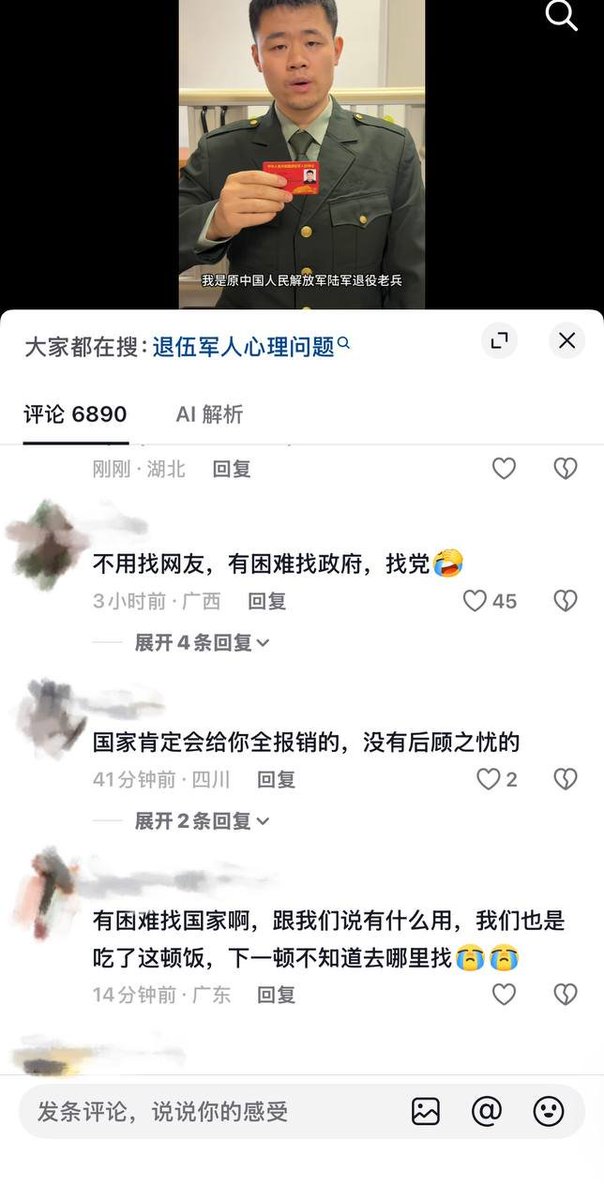
“Look for the country, look for the government, look for the party, look for the organization. The blogger adds: > > > No friends, no problems with the government, no problems with the party. The blogger adds:
These messages, which were clearly diametrically offensive, referred to the personal experiences of the father of a sick child and directly to the issue of the honour of the military and the State guarantees, which the Chinese Communist Party has long advocated.
How far can the care and security promised by the State be translated into real help when a person has given up eight years of youth to the army, when his child needs to be supported by medical equipment?
This debate also provides a realistic mirror for the soldiers and soldiers who remain in the Chinese army: the military uniform is finally taken off, political slogans cannot replace medical expenses, and the honour of soldiers cannot spare sick children from the disease.
One, eight years of experience, finally in a video of a daughter's blessing
The men in the video were wearing green uniforms and a red military merit card was displayed on their chests.
He introduced himself as a former military officer, describing the family difficulties he faced after his retirement from the service. According to his own account, he was a triple father, whose daughter required continuous dialysis treatment and had been in Shanghai for over two years.
For a family with three children, long-term access to health care implies a continuing medical expenditure, stress on support, and the possible impact on daily life and working arrangements.
The special feature of dialysis treatment is that patients often need long-term, regular treatment. For the parent who is accompanying the child, this means that life must be focused on the child ' s treatment for a long period of time.
The father did not speak of national honour in the video, nor did he make ambitious political claims. He has shown proof of his service, tried to explain his past and sought some spiritual support from society.
However, a certificate of honour that was meant to symbolize honour has rapidly shifted the web opinion towards the responsibility of the State.
The military ' s certificate of preference is the identification and preferential treatment issued by the Chinese Government to eligible veterans. It carries the State ' s recognition of service experience, but does not mean that the family of the witness automatically receives comprehensive medical care.
This is precisely the core of the problem: What should be the degree of social security that corresponds to the special honour accorded by the State to military personnel through documentation, ceremonies and propaganda?
A State should be able to organize large-scale military awareness campaigns and should be able to inform the public about the sectors responsible for providing assistance to families of ex-combatants who have long-term illness, the policies that can be applied for and the real guarantees of life-related risks that can be covered.
Two, “The difficult to find a country”: The irony of the comment area is shifting to institutional responsibility
The video comment area is marked by a marked emotional polarization, as seen in the current review screenshot.
There's a direct message:
“The nation will pay you all back, no worries. The blogger adds:
Another netizens said:
"What good is it to have trouble finding a country? We ate this meal, and we don't know where to find it next. The blogger adds:
And the netizens wrote:
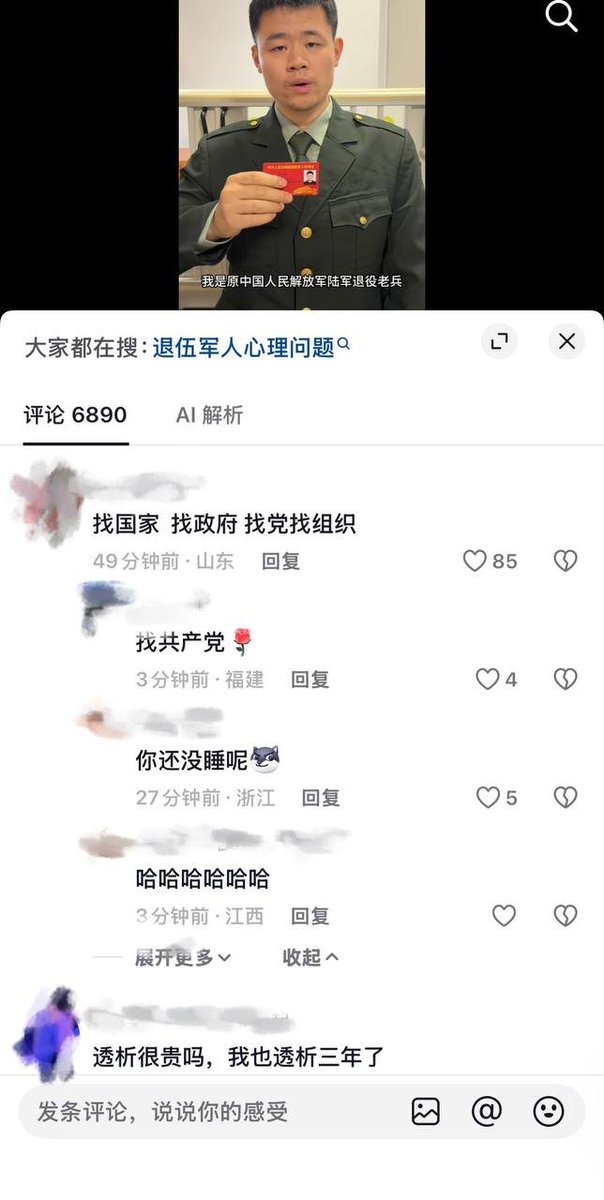
“Look for the country, look for the government, look for the party, look for the organization. The blogger adds:
These statements, which appear to be a refusal of recourse by a former soldier, reveal in fact some of the public ' s doubts about public guarantees and State responsibility.
In particular, the expression “the State will certainly pay you back in full” is clearly an apostasy. Since China ' s current health-care system does not provide for full and unconditional reimbursement of the cost of treatment for major diseases for all family members of the veterans.
It is noteworthy that some netizens linked their own survival pressures to the father ' s plight. They stressed that they were also facing economic difficulties and could not shoulder their responsibility to help others.
This means that the comment area has become more than just a different view of the status of military personnel, but also a statement of the general population ' s lack of security in terms of their own livelihood.
Of course, there were also those who defended the father.
A blogger wrote:
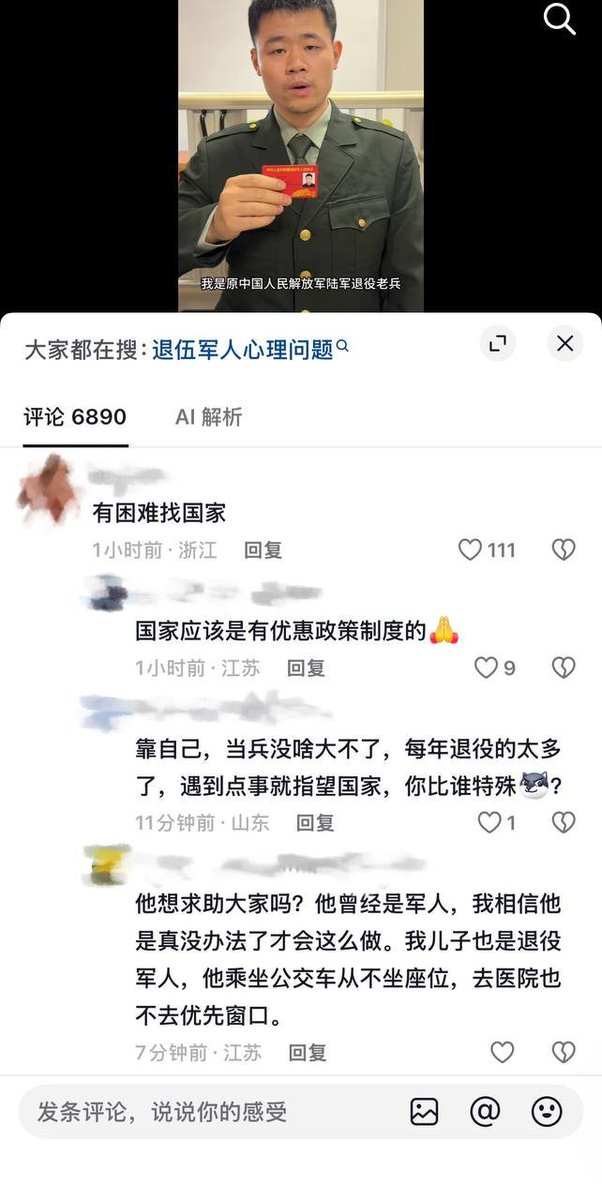
"Does he want to help you? He was a soldier, and I'm sure he did it because he had no choice. The blogger adds:
This comment reminds people that the person who is the owner of the video is first and foremost the father of a sick child. The illness of children should not be the object of ridicule, regardless of the way the Chinese army and its political affiliation are viewed by the outside world.
It is the State safeguards system and its implementers that are truly in need of public scrutiny, not the ordinary family in difficulty.
When the public began to use the official “party, government” familiar to counter the plight of a former soldier, what was worth noting was not only the attitude of commentators, but also the degree of trust that the official commitment had gained in the life of society.
Three, three, three Xi Jinping The State has already established the duty of rescue.
Xi Jinping Since taking office, the Party has been intensifying its advocacy of the honour, political loyalty and guarantees of veterans.
In 2025, the Ministry of Veterans Affairs again cited the policy of assisting the war veterans in difficult circumstances. Xi Jinping With regard to the demand for care for former soldiers, it was emphasized that they contributed to the defence of the country and that they should be placed in a position of integration, protection of services and defence of rights and interests, so that they could become a profession of high social standing.
原始来源 · mva.gov.cn退役军人事务部:七部门联合出台困难退役军人帮扶规范困难退役军人的认定、摸排走访和援助措施mva.gov.cn ↗However, military guarantees do not depend solely on the statements of political leaders.
Implemented in 2021Law of the People ' s Republic of China on the Protection of VeteransArticle 55 clearly states that:
The State establishes a support mechanism for veterans, who are in need of assistance in the areas of old-age, medical care, housing, etc., in accordance with the relevant provisions of the State.
On 20 January 2025, seven departments, namely, the Ministry of Veterans ' Affairs, the Ministry of Education, the Ministry of Civil Affairs and the Ministry of Finance, issued a joint publication.Guidelines for the Support of Veterans in NeedI'm sorry.
原始来源 · mva.gov.cn退役军人事务部解读困难退役军人帮扶政策不得以日常慰问替代重点帮扶mva.gov.cn ↗Article 2 of the document includes the support of former soldiers who have serious difficulties in their lives due to major emergencies, family changes, etc.
Article 5 requires that service centres for military veterans at the grass-roots level be able to ascertain the actual situation of families in need through visits and training.
Article 10 provides that the necessary assistance should be provided to former military personnel who continue to have difficulties in receiving social security benefits.
Article 13 further lists a range of support services, including assistance in the event of illness, assistance in the education of children, care and care, and legal assistance.
The Government's responsibility for the protection of the war veterans in need is therefore long overdue, not a political slogan, but rather a public duty, which is specifically enshrined in laws and administrative norms.
The fact that the family of the former soldier who accompanied her daughter in Shanghai for over two years, whether she was eligible for help in difficult circumstances, whether she had been visited by the service of the former soldier on an initiative, whether she had applied for assistance and what the costs of health insurance and social assistance were, could be further ascertained through specific administrative records.
In the material currently being disseminated, there is no record that clearly determines what kind of assistance their families have received or been denied.
This does not affect the reporting of oversight of the system itself. Since the relevant policies had been established, local authorities should be able to explain how the support mechanisms operated and how families with major diseases received sustained and effective support.
# IV. Health insurance can cover part of the costs, but it is difficult to bear the long-term risks of the entire family alone
The National Health Insurance Board published information in December 2024 that the government is not in a position to do so.Utility dialysis.The cost of treatment related to chronic diseases is included in the direct settlement of the cost of the outpatient care nationwide.
原始来源 · nhsa.gov.cn国家医保局:尿毒症透析等门诊慢特病跨省直接结算2024年12月国家医保局政策说明nhsa.gov.cn ↗Eligible participants may be treated in accordance with the policy of the place of participation, but the scope of reimbursement, the rate of payment, the criteria for payment and the maximum amount of payment are still subject to the corresponding health insurance regulations.
This policy reduces the burden of treatment for patients, but does not cover all family risks associated with major diseases.
For families requiring long-term medical treatment, there are problems of transport, accommodation, living expenses, and changes in labour income due to parental care.
In its presentation on the construction of a basic blood dialysis service in February 2026, the National Commission for Health and Welfare also made it clear that dialysis patients usually require two to three blood dialysis per week, and that proximity to treatment reduces the non-medical costs of travel and accommodation.
This official statement has itself shown that the real effect of medical care cannot be limited to the amount of treatment paid by the health insurance fund, but also to the other financial and care costs borne by the patient and his/her family.
The practical value of the assistance policy for a family of veterans who are permanently accompanying their daughters depends on whether the medical, civil and military services together address this continuing difficulty.
Disease does not stop because the family of the patient receives an honour card, nor does the family escape the long-term burden of care by getting a single condolence.
A truly effective system of guarantees should place the survival needs of the ordinary at the centre of administrative services, not the honour awarded by the State as proof of the actual guarantee.
V, From military to society: Political loyalty cannot eliminate the family risk of ordinary people
This incident is of greater relevance to the troops and officers who remain in the Chinese army.
Under the current political system in China, the Chinese People ' s Liberation Army (CPLA) has exercised the absolute leadership of the Chinese Communist Party (CPC) over the army. Xi Jinping He is also the Secretary-General of the Central Communist Party and Chairman of the Central Military Commission, and political education in the army has long emphasized loyalty to the party.
This political organization has been reinforcing the political mission of the military, but after leaving the army, the army is still confronted with general social problems such as employment, medical care, old age, housing and the education of children.
A military member may assume special duties while in service, but is not free from illness and economic risk after his discharge from service.
He has received many political education, has taken many oaths or has received many recognitions, and has not been able to guarantee that his family will not suffer from serious illness.
This is the reality that military honours must face.
When a person is in a uniform, the State demands that he obey orders, assume danger and perform his duties; When he returns to society and his family encounters difficulties that are difficult to shoulder on its own, he equally needs legal protection, social security and public services.
The value of military personnel cannot be reflected only when asked to give. The life, dignity and family rights of a person should not be lost to public attention as their military use ends.
It is particularly alarming that when political propaganda increases the limitless level of individual obedience, sacrifice and loyalty without providing the same level of real guarantees to individuals and families, military personnel may be used as a political resource that can be consumed on a continuous basis.
This risk does not depend on the integrity of a particular soldier, but rather on how the State arranges for the rights, obligations and post-service guarantees of the military.
The military is first and foremost a person, a child of both parents, a partner of the spouse and possibly a father of several children.
The numbers behind the uniforms are not readily available. Every political decision to put the military at risk implies that an ordinary family may suffer irreparable consequences.
For those still in service, the video of the former soldier revealed an inescapable reality: loyalty and dedication cannot be automatically converted into medical security for their families, and any commitment to national honour should be tested by specific policies and real life.
Six, what really needs to be held accountable is how public power is held accountable
The long-standing Generals ' honours are linked to the image of the country, political loyalty and the real needs of the hard-won veterans will ultimately need to be addressed by local governments and specific executive departments.
Under the current system, the services of the veterans are responsible for the coordination of support, the health care sector is responsible for the management of health care, the civil administration is responsible for social assistance for eligible families and the financial sector is responsible for the budgetary arrangements.
The absence of services at any one stage may place an additional burden on families in need.
The incident must therefore not be confined to criticism of online commentary, nor should a single condolence or social donation replace a review of the responsibility for public security.
The service of the veterans shall, in accordance with their statutory duties, have control over the situation of families in need and shall provide assistance to eligible persons; The health services should guarantee that eligible patients are treated in accordance with the law; Civil affairs and other departments are required to address the living difficulties caused by chronic diseases in accordance with the policy.
Local governments should also be able to explain to the public the coverage, application channels, approval criteria and implementation of the policy of support for the war veterans in need.
Only by identifying these administrative responsibilities can the system be judged in terms of its role in a particular case.
It is worth pursuing not why a father of a sick child seeks the blessing of society, but whether the State has established a multi-level system of guarantees that will provide reliable support to families suffering from chronic stress.
Xi Jinping The Chinese Communist regime under its leadership could continue to emphasize the honour and political loyalty of the military, but those political demands could not be a substitute for the Government's duty to guarantee under the law.
The legitimate rights and interests of military personnel are not a gift from the ruling authorities, nor should they be rewarded for the public assistance that families in need receive under the law.
Seven, a single favor, the distance between power, honor and duty
The father, who had been at the side of the border for eight years, was now accompanying her daughter for over two years in Shanghai.
He raised the military merit card in a video, hoping to be understood and encouraged by society.
The comment section turned his experience into a reticence to State responsibility.
There must be a link of responsibility that can be tested in practice, from political propaganda to the “protection of the nation” to the actual health and livelihood of the family.
The State requires that soldiers give their youth and take risks, not only when they wear uniform, but also when they are discharged from their service, and that they do not be able to take the risks of life back to their families.
The Chinese Government has established a system of legal and difficult assistance for veterans. What is really needed to measure its effectiveness is the availability of timely, sustained and equitable help for ordinary families in the face of major changes.
Respect for military personnel in a country should not be confined to military recruitment propaganda, political slogans and honours, but should be reflected in the security of life of military personnel after their retirement.
The reality of this incident is worth seeing for the soldiers and soldiers who are still in the barracks today: When the State needs military personnel to take responsibility, the personal dedication is given high meaning; When the families of soldiers suffer from illness and hardship, public power must be tested for responsibility as well.
The service experience is respected and family life is equally protected.
How a regime uses the military, reflecting the way in which its power functions; The actual colour of the public security system is tested by how a State treats those who have de-commissioned and are suffering from living conditions.
The father's merit card should ultimately be seen not only in his eight years of service but also in the State's real responsibility towards every person who has previously assumed public obligations.
Article discussion
Verified members can discuss this report publicly and manage their own content.
Checking member sign-in status…