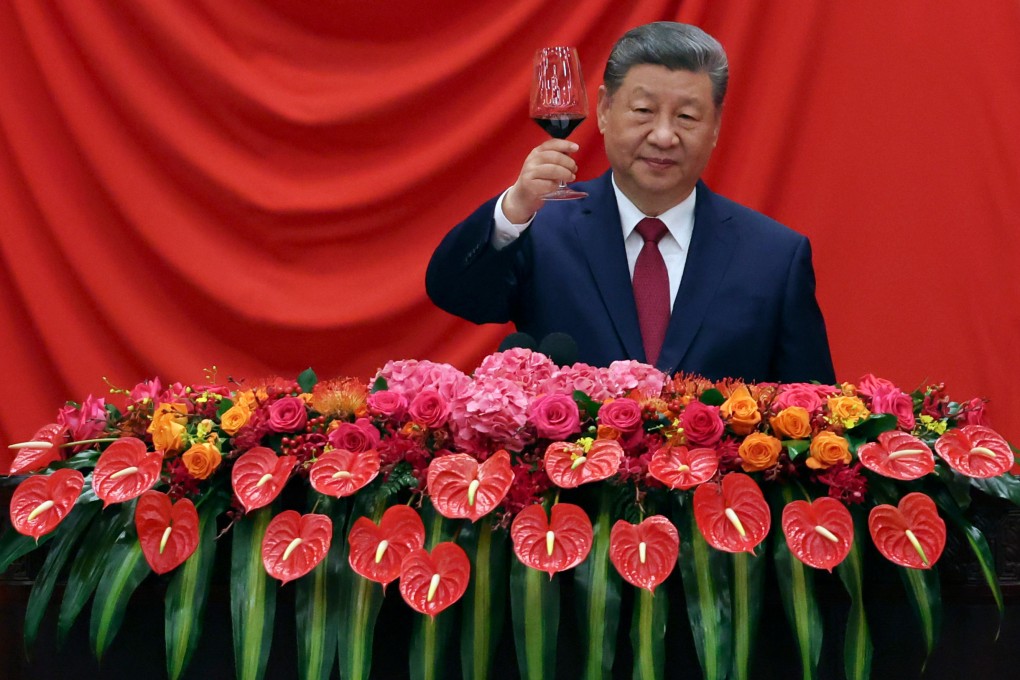
On the evening of 30 September, the reception of the People ' s Republic of China on the occasion of its 77th anniversary was held in the People ' s Hall of Beijing. In his speech, Xi described the past year as “a great deal of a difference” and reiterated his call for the advancement of high-level technology to become self-reliant and develop new quality productivity, while emphasizing the need to remain strategic in the face of risk challenges.
This is not a festive statement. Less than a month before the twenty-fifth Chinese General Assembly, the National Day reception became a political mobilization before the “155” event: economic growth, technological autonomy and national security were placed in the same narrative, while external competition continued to be interpreted as a reason for strengthening party leadership and pooling resources.

From growth target to "can you carry the risk"
The Chinese economy continues to face real estate adjustment, local debt, insufficient domestic demand and youth employment pressures. Xi did not address these specific issues in his national day speech, but instead concentrated the policy language on “quality development” “skill self-reliance” and “new quality productivity”.
This expression perpetuates the political logic of the CCP in dealing with economic pressures in recent years: rather than first interpreting growth difficulties as resource allocation, private business confidence or institutional constraints, it is placing them within the international framework of competition and national security. The result is that industrial policy, investment in research, supply chains and capital allocation are increasingly subordinate to the political objectives of “controllable” “security” and “ownership”.
The signal before the 5th plenary meeting
The five-day plenary will discuss development arrangements for the next five years. The political bureau had previously moved the issue from the party of the rule to the front. The national day speech added to the economic and technological components: the Chinese Communist Party hopes to continue to rely on the party system to pool its resources to advance strategic industries, despite the simultaneous presence of external technological constraints, trade frictions and a slowdown in internal growth.
This also means that the next five years of policy will not be just economic planning. The so-called “Fifty-five” would be a set of security and political control plans at the same time. Central demands on local, national, scientific and private enterprises are increasingly measured in terms of whether they are in line with national strategies and whether they can reduce external dependence.
Who will bear the cost of "sustained" #
Science and technology autonomy is not a problem in itself. What is really to be asked is whether the allocation of resources remains subject to market testing and public scrutiny when “self-reliance” is placed under political loyalty and national security.
Over the past few years, from the Chip Fund to the local new energy projects, there have been duplicate investments, administrative subsidies and local competitions in China. The party system can mobilize huge capital in a short time, but can also spread the costs of wrong investments to the fiscal, banking and ordinary taxpayers.
Xi’s presentation at the National Day reception was a certain narrative: China could cross the risk if it insisted on the Communist Party’s leadership. But the real uncertainty facing the economy stems from the high concentration of power, and policy correction is increasingly dependent on a change of judgement at the highest level.
The forthcoming P-5 plenary is not about to see how much of the document will be “innovation” “development” and “security”, but how these terms will ultimately be translated into budgets, industrial subsidies, corporate regulation and local government tasks. The national day speech has given direction: external pressure will not lead to a reduction in political control in Beijing, but will continue to be used to justify the need to centralize power and resources.
Article discussion
Verified members can discuss this report publicly and manage their own content.
Checking member sign-in status…