The price of oil is rising and falling, and price logic is deep in the dark.
Every time the oil price-reducing window opens, there are people happy and there are people who can't help. Millions of people in the country travel, produce and operate on a daily basis, and are held hostage to oil prices.
The result of the price adjustment is available to all, and no one understands the pricing process.
Why is it rising? On what basis? Where did the parameters come from? How do we set the formula? Who's in the research? Who signed the decision?
In response to popular inquiries, the National Commission for Development and Development (CNDD) gave the most “mixable” answer: is confidential and is not public.
A phrase of “State secrets” silences all truths and blocks the right of all to know.
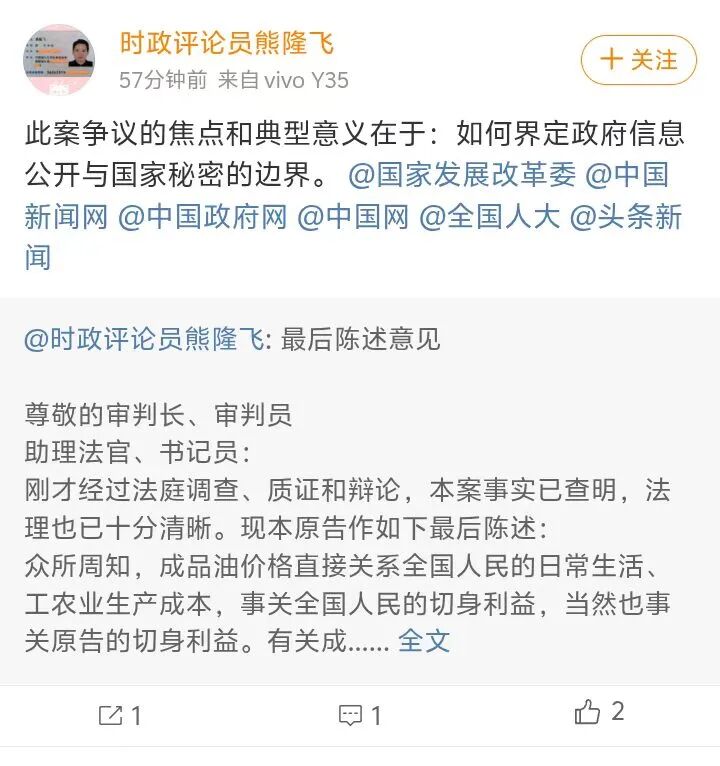
19 October 2026, Rongfik v. NDC Government Information Open Dispute , officially sitting at the First Intermediate People ' s Court in Beijing.
This is not an ordinary administrative proceeding. This is a stand-off against the rule of law by ordinary citizens against central ministries and a just claim by millions of people to seek out the truth about the price of oil.
01, most poignant response: “There is other work”, contempt of court, emptiness of law
The most salient point of the proceedings was not only the open-source substantive dispute over oil prices, but also the fact that the National Commission for Reform (CNRD) ignored the judicial and nuanced procedure.
In accordance with the Administrative Procedure Code and the Supreme Code, the head of the executive branch shall appear before the court. In particular, in cases involving significant public interest, high public interest and high social impact, the presence of the person in charge is a statutory duty, a rigid requirement and is not an option.
This case concerns the price of finished oils throughout the country, covering the entire field of livelihood, industry, logistics and agriculture, and is a well-established top-level major public interest case.
However, on the day of the hearing, CENIRE, no one was present.
Only two regular staff members appeared before the Tribunal throughout the journey.
The trial details, even more shocking
The details of the trial are even more shocking.
(b) To verify identity only before the court hearing; After the hearing, the court did not voluntarily disclose the qualifications of the accused persons before the court.
The plaintiffs, on their own initiative, requested verification and publicity of the accused ' s status before the court, which led to the confirmation that: Two persons present, without any decision-making authority, no rank, were only ordinary staff.
In response to the plaintiff ' s inquiry, the court informed that the Commission had submitted a statement of the person in charge of the failure to appear.
When the plaintiff applied for an original written statement, in accordance with the law, it was refused by the court. The presiding judge read the sentence only on behalf of the judge for a very perfunctory and unconvincing reason: The person in charge had other work.
This is the only seven words that fill the nation's attention.
What is "other work"? What kind of work could replace the statutory obligation to appear before the Court? What job is more important than the right to know in response to the oil prices of millions of people?
The Supreme Court has expressly stated that the head of the executive branch shall not appear before the court, except in the case of force majeure, accident, and unsubstituted material service, three statutory circumstances.
General, vague, and broad “other jobs” are not legally justified at all!
Central Ministries, leading Fiction of laws, air-space systems, contempt of court.
The plaintiffs were speaking in good faith and seriously critical of the fact that the defendant, who held the power of price-fixing for the core of the nation, had no sense of fear or respect for the rule of law. Ordinary citizens who respect the law, respect the courts and, as central administrative bodies, take the lead in circumventing legal obligations to respond, disregard the law, disrespect the administration of justice and infuriate the entire population!
The Court also issued a judicial recommendation to the Full Court: In the event of an offence by which the National Commission for Reform and Development (CNRD) refused to appear in court without any valid reason, it is requested that the Court issue a judicial recommendation to the supervisory and higher administrative organs, in accordance with the law, to prosecute and deal with the case. and The right to report, pursue and pursue is reserved by law.
Throughout the process, faced with the iron truth, the serious questions and public criticism of the plaintiffs, the two defendants were present in the dock, and the whole process was silent, without a single argument, without a single response.
Silence is acquiescence. Silence is self-evident.
02, most absurd logic: first, internal information, then court and state secrets
The most central and absurd controversy in this case is the contradictory and arbitrary qualification criteria of the accused.
The plaintiff's application was for public information, clear and clear: price of finished oil participating units, staff, measurement parameters, formulae, meeting records, operating processes.
This is a public information document on the performance of public functions, which regulates public decision-making and affects the interests of the whole population.
In its initial response, the Commission qualified it as: in-house, process information, not available.
When entering the proceedings, presenting evidence in court, and in order to completely block open channels, the accused changed his name and character at will: all are considered State secrets!
There is a contradiction and a lack of characterization. Make the decision as you like, keep the secret.
The question: Is the public disclosure of government information, or is it classified, that can be changed at will according to the need for litigation?
What's a national secret? The Law on the Preservation of State Secrets has a strict concrete subject, a confidential procedure, a classified standard, a declassification period. Not one word, one word, one answer, but one word, one word, one word, and one word, "a move to the top."
Life pricing information is by no means free to cover the privacy of power!
The price of oil is priced, the services are provided by the people of the country, the resources are regulated by the people and the public interest is safeguarded. It does not involve national security, nor does it concern core functions, nor does it concern national security or foreign secrets.
Why? Why do people's data on the millions of people's money bags become untouchable “State secrets” overnight?
In the end: The so-called covertness is not not not to be disclosed, but rather not to be disclosed; Secrets are not State secrets, but power privacy!
03 Sunshine is the best preservative, and the oil price box should not exist
The Government Information Disclosure Ordinance was initially enacted with only eight words: power is open and monitored.
(a) The power to be unsupervised necessarily breeds the dark box; Invisible public decision-making is bound to hide controversy.
The Commission is known as the “small government” with its core powers of price regulation, energy pricing, industrial regulation, etc. The public anti-corruption data of the past have long proved: This is a disaster zone with high levels of corruption and uncontrolled power.
The numerous officials who have fallen, countless disciplinary cases have only one source: too centralized, too closed and too oversight.
When the pricing process is closed, the decision-making records are kept secret, the formula is hidden, and public scrutiny becomes a dead letter.
The people are passively accepting the oil price hikes and falls, not knowing, not finding, not asking, not being able to arrest.
A line of secrecy that shields the public from supervision; A sentence of confidentiality covered all the processes.
This is not what the rule of law society should be, nor what central government should be!
04, the civil servant, the accuser of fairness, the contest for the rights of all.
Many asked: why does a citizen have to die in oil prices?
The blogger says that the government is not a personal claim. This is a common voice of millions of people, the legal right of citizens to know and monitor!
(b) Administrative proceedings, which are never a search for trouble, but rather a defence of rights; The referee, never confrontation, but the law.
When the executive branch can keep information about people's lives secret, when central ministries can circumvent their obligation to appear in court and exercise justice, harming not only case justice, but also the credibility of the rule of law in general.
The plaintiff stated in court that the law was not written, and that the system was not a proprietary device. Central State organs, which are supposed to be law-abiding standards, rule of law standards, must not be a negative example of circumvention of the law, of the regime, of the resistance to oversight!
At present, the trial in this case is all concluded. The plaintiff is carefully screening the entire trial, and the details of the hearing will be made public to the public at the appropriate time, while ensuring that genuine State secrets are not involved and that the confidentiality threshold is strictly observed.
Concluding remarks
Oil prices are fine, and public disclosure is the bottom line.
Without a transparent pricing process, there would be no credible price adjustment results; There can be no real human equity without the power to operate in the light.
State secrets should not be a cover for power; The provisions of the code of secrecy should not be used as a shield against surveillance.
We await a fair verdict: a transparent price for oil for all and an open line for the rule of law!
Original source
- Original title
- 熊隆飞诉国家发改委:油价定价岂能成 “国家秘密”?百姓知情权不容一纸封锁
- Original author
- 镡佐龙
- Source account / outlet
- 微信公众号“诗书茶酒股”
- Originally published
- 2026-11-02 22:03
- Content treatment
- Republished
- Original article
- View original ↗
- Published by China Focus
- 会员发布
Article discussion
Verified members can discuss this report publicly and manage their own content.
Checking member sign-in status…